

After a crash involving an Uber or Lyft vehicle, one of the first questions is: whose insurance applies? The answer depends less on who was at fault than on what the driver was doing in the moments before impact. Was the app off? Was the driver waiting for a request? Was the driver heading to pick someone up, or already carrying a passenger?
The insurance industry answers those questions with a framework of “periods,” and each period can bring a different insurance policy, a different carrier, and a different amount of coverage. Many people involved in rideshare crashes never hear this framework explained until an adjuster brings it up, and by then it may be shaping how their claim is valued.
Before I became an attorney, I spent over a decade as an insurance adjuster handling high-exposure casualty claims. Later, I defended insureds at Rymer, Echols, and Nelson-Archer. In both roles, I saw how often a claim turns on which policy applies. In a rideshare case, that question can matter as much as the question of fault. This guide explains the framework in plain English so you can understand the conversation when it happens.
This article is general educational information about Texas law. It is not legal advice, and it does not create an attorney-client relationship. Every case depends on its own facts.
Why Rideshare Insurance Works in “Periods”
A rideshare driver is not an ordinary commercial driver, and not an ordinary private driver either. The same person may use the same car for a morning commute, an afternoon of driving for Uber or Lyft, and a family errand in the evening. Insurers and transportation network companies (TNCs) handle that overlap by dividing a driver’s time into periods based on the status of the rideshare app.
Texas regulates transportation network companies under Chapter 1954 of the Texas Insurance Code. That chapter sets out insurance requirements that depend on whether the driver is logged in to the TNC’s digital network, is traveling to pick up a rider, or is transporting a rider.
You will often hear these periods described by number, and the numbering is an industry convention rather than something every policy uses in the same way. Some documents call them “Period 1, 2, and 3.” Others use “phases” or describe the app status directly. The labels matter less than the substance: the driver’s status at the moment of the crash helps determine which coverage may apply.
This is why the same collision could lead to very different insurance results depending on a few minutes of timing. It is also why evidence about the driver’s app status can become central to a claim.
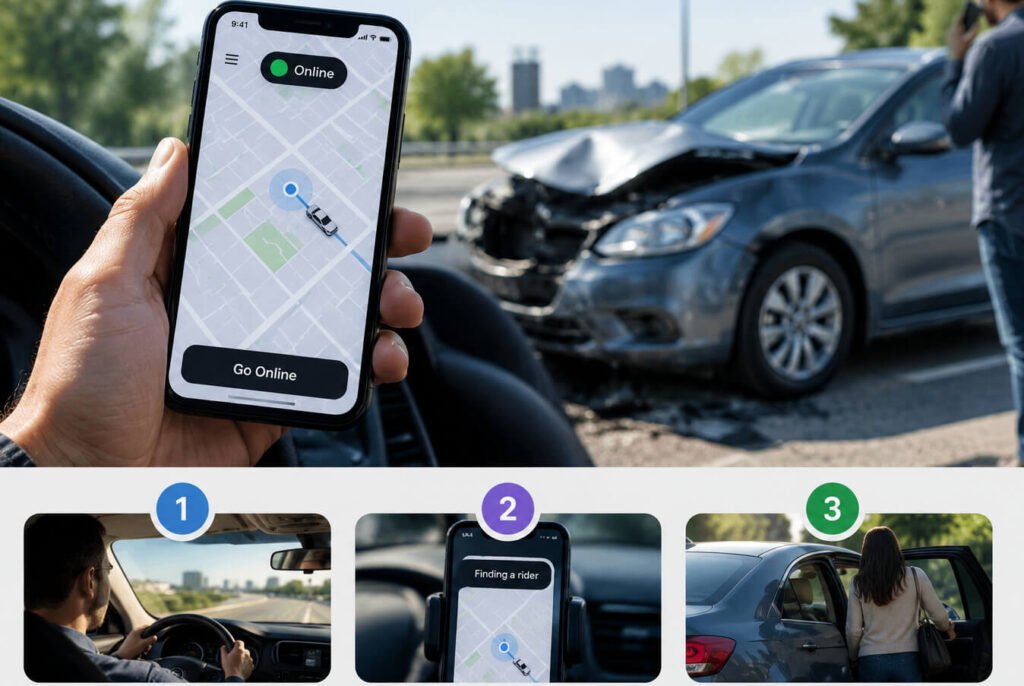
Period 0: App Off, No Rideshare Coverage Applies
Period 0 is the simplest to describe. The driver is not logged in to the rideshare app, or has otherwise gone offline. The driver may be commuting, running errands, or driving with family.
In Period 0, the rideshare company’s insurance generally does not apply, because the driver is not engaged in rideshare activity. A crash is typically handled like any other crash involving a private driver, and the driver’s personal auto insurance is generally the starting point.
Several practical points follow:
- The driver’s personal policy is the focus: The claim generally runs through the driver’s own auto policy, including its liability coverage and limits.
- Policy terms still matter: Personal auto policies can contain exclusions or conditions related to commercial use. Whether any exclusion applies depends on the policy language and the facts, which is one reason policies need to be read in full.
- Other coverage may come into play: If the at-fault driver’s coverage is limited, other sources of insurance may need to be evaluated, depending on your own policy and the circumstances.
Period 0 is also where disputes about app status tend to start. If a driver says the app was off, but the data shows the driver was logged in, the claim changes character completely. The reverse can also happen. Insurers have a strong incentive to place a crash in whichever period leaves their company with the smallest obligation.
Period 1: App On, Waiting for a Ride Request
Period 1 begins when the driver turns the app on and is available to receive requests, but has not yet accepted one. The driver is logged in and may be driving around, parked, or waiting for the next request to arrive.
This is the period that causes the most confusion. The driver is working, at least in the sense that the app is on, yet no passenger is involved and no trip has been accepted. Coverage in this period may differ from both Period 0 and the periods that follow. Some drivers and injured people are surprised to learn that being “on the clock” does not necessarily mean the highest level of rideshare coverage applies.
Under Texas Insurance Code Section 1954.052, when a TNC driver is logged on to the company’s digital network and available to receive ride requests but is not engaged in a prearranged ride, the applicable automobile insurance policy must provide at least:
- $50,000 for bodily injury to or death of one person in an incident
- $100,000 for bodily injury to or death of all persons in an incident
- $25,000 for property damage in an incident
Several issues commonly arise in Period 1:
- Coverage is often more limited than later periods. The required coverage while a driver is waiting for a request is lower than the coverage required once a ride has been accepted or a passenger is in the vehicle.
- The personal policy may interact with the rideshare policy. Depending on the arrangement, the driver’s personal insurer, the rideshare company’s insurer, or both may become involved in evaluating the claim. They may disagree about which one is responsible.
- Proof of app status is critical. The driver’s app data may show whether and when the driver was logged in and whether any request had been accepted. Getting reliable information about that status is often an early step.
If you are trying to understand how this applies to a particular company, our article on Lyft drivers between rides in Texas and who pays looks at this scenario in more detail.
Period 2: Ride Accepted, En Route to the Passenger
Period 2 begins when the driver accepts a ride request and ends when the passenger is picked up. During this time the driver is traveling to the pickup location, often navigating unfamiliar streets while looking at a phone for directions or messages.
Many people consider this the point at which the driver has clearly stopped being a private motorist and has started performing a commercial service. The insurance framework reflects that. Under Texas Insurance Code Section 1954.053, once a driver is engaged in a prearranged ride, the TNC must maintain primary automobile liability coverage of at least $1 million for death, bodily injury, and property damage. That coverage requirement applies from acceptance of the ride request through completion of the trip.
Period 2 often matters to people who were not in the rideshare vehicle at all. A driver, cyclist, or pedestrian struck by a rideshare driver who is heading to a pickup can have a claim that involves the rideshare company’s coverage, even though no passenger is in the car. Our article on third-party claims when hit by a rideshare driver in Texas addresses that situation.
Distraction is a common issue in Period 2. A driver who is looking at a navigation screen or an incoming notification may be paying less attention to the road. Whether that amounts to negligence in a given case depends on the evidence, but app activity records may be relevant to that question.
Period 3: Passenger Picked Up, Trip in Progress
Period 3 begins when the passenger enters the vehicle and runs until the passenger is dropped off and the trip ends. This is the period most people picture when they think about rideshare insurance.
In Period 3, the rideshare company’s insurance is generally at its most significant. Because the driver is engaged in a prearranged ride, the $1 million primary liability coverage requirement under Section 1954.053 continues to apply.]
Period 3 raises its own issues for the people involved:
- Passengers: A passenger injured in a rideshare crash may have claims against the rideshare driver, another at-fault driver, or both, along with questions about which insurance applies. Our article on the Texas rideshare passenger injury claim covers those questions.
- Other drivers and pedestrians: People outside the rideshare vehicle may also have claims, and the coverage that applies during a trip can be a central part of evaluating them.
- Company-level questions: In some cases, questions arise about whether the rideshare company itself bears responsibility, for example for how a driver was screened. Our article on the Texas rideshare negligent hiring claim explains that theory.
Even in Period 3, a claim is not automatic or simple. Fault still has to be shown, damages still have to be proved, and the insurers involved will still examine every detail.
Why Coverage Amounts Change Dramatically Between Periods
The practical consequence of the framework is that the amount of insurance available can change depending on the period. In general, coverage is lower when the driver is logged in but has not accepted a ride, and more substantial once a ride has been accepted or a trip is underway.
For an injured person, that difference can be the difference between a claim that can realistically be resolved within available coverage and a claim that involves limited funds, competing claimants, or a search for other sources of recovery. Serious injuries, such as those involving surgery, permanent impairment, or lost income, can carry significant costs, and the amount of available coverage can affect how a case is approached.
Several factors tend to shape how this plays out:
- Multiple insurers may be involved: The rideshare company’s insurer, the driver’s personal insurer, and the at-fault driver’s insurer may each be involved, and they may point at each other.
- Gaps and disputes can arise: When it is unclear which period applied, insurers may disagree about who is responsible. A gap between what a policy provides and what an injured person needs can exist, particularly in the period when the driver is waiting for a request.
- Your own coverage may matter: Depending on your policy, other coverage that you hold, such as underinsured motorist coverage, may need to be considered. Our article on the Texas UIM wrongful death claim explains how that type of coverage can come into play in a fatal crash, and similar questions can arise in injury cases.
- Comparative fault still applies: Texas follows a modified comparative negligence rule. An injured person can recover damages even if they share some of the fault for an accident, as long as they are not more than 50 percent responsible. Compensation is reduced by the percentage of fault assigned to the injured person, and a person who is found 51 percent or more at fault cannot recover. Insurers in rideshare cases use this rule just as they do in any other crash.
As a former adjuster, I can tell you that the question of which policy applies is often one of the first things a carrier sorts out, because it determines who is paying. Injured people are rarely told that this internal sorting is going on, which is one reason it helps to understand it.

Determining Which Period Applied at the Moment of Your Crash
If you were hurt in a crash involving a rideshare vehicle, figuring out which period applied is usually an early and important step. Because the answer depends on the driver’s app status at a specific moment, it is a question of evidence.
Information that may help establish the period includes:
- App and trip records held by the rideshare company, which may show whether the driver was logged in, whether a request had been accepted, and when a passenger was picked up
- Passenger information, such as trip receipts, notifications, or messages in the app
- The police crash report, which may note the driver’s statements or the presence of a passenger
- Witness statements from passengers, other drivers, or bystanders
- Photographs and video of the scene and vehicles, which may show signs such as a rideshare decal or a phone mounted on the dashboard
- Phone and navigation data, which may be relevant to what the driver was doing before the crash
- Insurance policy documents for the driver and any other involved parties
Some of this information is held by the rideshare company and is not available to the public. It may need to be requested through formal processes, and records can be retained for limited periods or become harder to obtain over time. That is why prompt attention matters.
Timing also matters legally. Texas generally imposes a two-year statute of limitations for most personal injury claims, measured from the date of injury, and wrongful death claims generally run two years from the date of death. Claims that involve governmental entities generally require written notice within six months. Which rules apply depends on the facts of the case.
If you are not sure which period applied to your crash, you are not alone. Insurers frequently dispute this, and the answer may not be obvious from the scene. Our articles on Uber accident insurance coverage in Texas and Lyft accident insurance coverage in Texas discuss how these questions play out with each company.
Frequently Asked Questions
What are the three rideshare insurance periods?
The commonly used framework describes the driver’s status at the time of a crash. Period 1 is when the app is on and the driver is waiting for a request. Period 2 is when the driver has accepted a ride and is on the way to the passenger. Period 3 is when the passenger has been picked up and the trip is in progress. Some descriptions also refer to “Period 0,” when the app is off. The labels can vary, but the underlying idea is that coverage may depend on what the driver was doing when the crash happened.
Is there coverage when the app is off?
When the app is off, the rideshare company’s coverage generally does not apply, and the crash is typically handled through the driver’s personal auto insurance, subject to the terms of that policy. Disputes sometimes arise over whether the app was really off, which is why app records can matter.
How much coverage applies when a driver is waiting for a ride?
Texas law generally requires at least $50,000 per person and $100,000 per incident for bodily injury, plus $25,000 for property damage, when a TNC driver is logged in and available for ride requests but has not accepted a prearranged ride. The actual coverage available in a particular crash can also depend on the driver’s personal policy and the rideshare company’s policy.
Does coverage change once a passenger is picked up?
Coverage may change as a driver moves between periods. Once a ride has been accepted or a trip is underway, Texas law generally requires the TNC to maintain at least $1 million in primary liability coverage for death, bodily injury, and property damage. The details still depend on the specific policies and facts involved.
How do I know which period applied to my crash?
It depends on the driver’s app status at the time of the crash. App and trip records, passenger information, police reports, witness statements, and photographs may all help. Some of the most important records are held by the rideshare company and may need to be requested formally. An attorney can help determine what to ask for and how to approach it.
This article is for general educational purposes and is not legal advice, and reading it does not create an attorney-client relationship. Every rideshare accident turns on its own facts, and outcomes cannot be guaranteed. Available insurance coverage may depend on the driver’s status at the time of the crash and the specific policies involved. Anyone injured in a rideshare accident can reach Herrera PLLC through the contact page or by calling 832-891-3210 to schedule a free, confidential consultation and discuss the available options.
Jonathan Herrera, J.D.
Jonathan Herrera is the founder of Herrera PLLC in Houston, Texas. He holds a J.D. from South Texas College of Law Houston and has over a decade of experience as an insurance adjuster. He previously practiced insurance defense at Rymer, Echols, and Nelson-Archer. He is a member of the Houston Trial Lawyers Association, the Texas Trial Lawyers Association, and the American Association for Justice.