
Sidewalk and Roadway Design Defects: When a Texas City Shares Fault in a Pedestrian Accident

When a pedestrian is hit by a car, the driver is usually the first person everyone looks at. Sometimes that is the whole story. In other cases, the road itself played a part. A crosswalk that was never painted, markings worn down to nothing, a signal that gave pedestrians too little time to cross, or a sidewalk that ended without warning can put people on foot in danger long before a driver ever arrives.
In those situations, a city or another governmental entity may share responsibility for the conditions that led to the crash. This is a legally distinct theory from a claim against the driver, and it comes with its own rules, its own limits, and a notice deadline that can arrive much sooner than most people expect.
Before I became an attorney, I spent over a decade as an insurance adjuster handling high-exposure casualty claims. Later, I defended insureds at Rymer, Echols, and Nelson-Archer. Across both roles, I saw how many parties can stand behind a single injury, and how often an injured person is told about only one of them. This article explains how Texas treats claims that involve unsafe sidewalk and roadway design, and why the timing and procedure of these claims deserve attention from the start.
This article is general educational information about Texas law. It is not legal advice, and it does not create an attorney-client relationship. Every case depends on its own facts.
When a Dangerous Roadway Condition Becomes the City’s Responsibility
Roads and sidewalks do not maintain themselves, and they are not all owned or managed by the same entity. Depending on the location, the party responsible for a particular street, intersection, signal, or sidewalk may be a city, a county, or a state agency. In the Houston area, a single trip can cross several of those boundaries. A pedestrian walking near EaDo, Montrose, Greater Heights, or the Texas Medical Center may be on a city street one block and a state-managed roadway the next. Who is responsible for a specific location is often the first factual question in a case of this kind.
A dangerous roadway condition can matter to a pedestrian claim in several ways:
- It may have put the pedestrian in a position of unnecessary risk, such as forcing someone to walk in the roadway because a sidewalk was missing or unusable.
- It may have reduced a driver’s ability to see the pedestrian, or the pedestrian’s ability to see traffic.
- It may have created confusion about who had the right of way.
- It may have contributed to a crash that the driver’s conduct alone does not fully explain.
A dangerous condition does not automatically mean a governmental entity can be held legally responsible. Texas law places important limits on lawsuits against government entities, which are discussed in a later section. The point here is that these claims depend on the facts: what the condition was, who was responsible for it, how it contributed to the crash, and whether Texas law allows a claim to go forward.
For readers who want to see how Texas pedestrian cases are typically framed when a driver is the focus, we have written about failure to yield to a pedestrian in a Texas crosswalk and what can happen when someone is hit by a car in a Houston crosswalk. This article looks at the other side of the picture: the roadway itself.
Missing Crosswalks, Faded Markings, and Inadequate Signal Timing
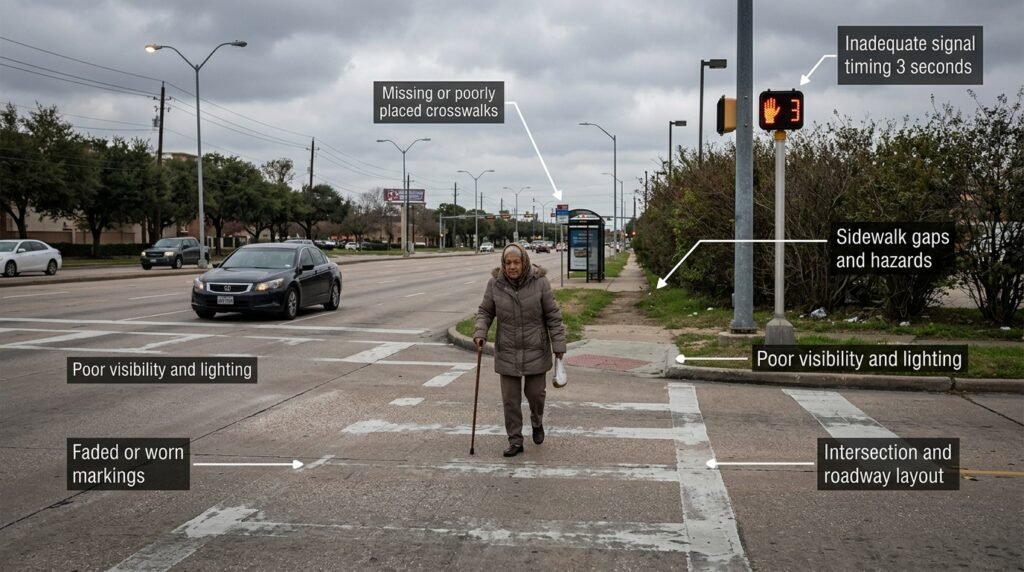
Design and condition problems that can come up in pedestrian cases take many forms. Some of the most commonly discussed include the following.
- Missing or poorly placed crosswalks: Where people on foot are likely to cross, such as near transit stops, shopping areas, schools, or medical facilities, the absence of a marked crossing can leave pedestrians to improvise. A pedestrian who crosses somewhere a driver does not expect them may be harder to see, and the lack of a marked crossing may also be raised against the pedestrian when fault is divided.
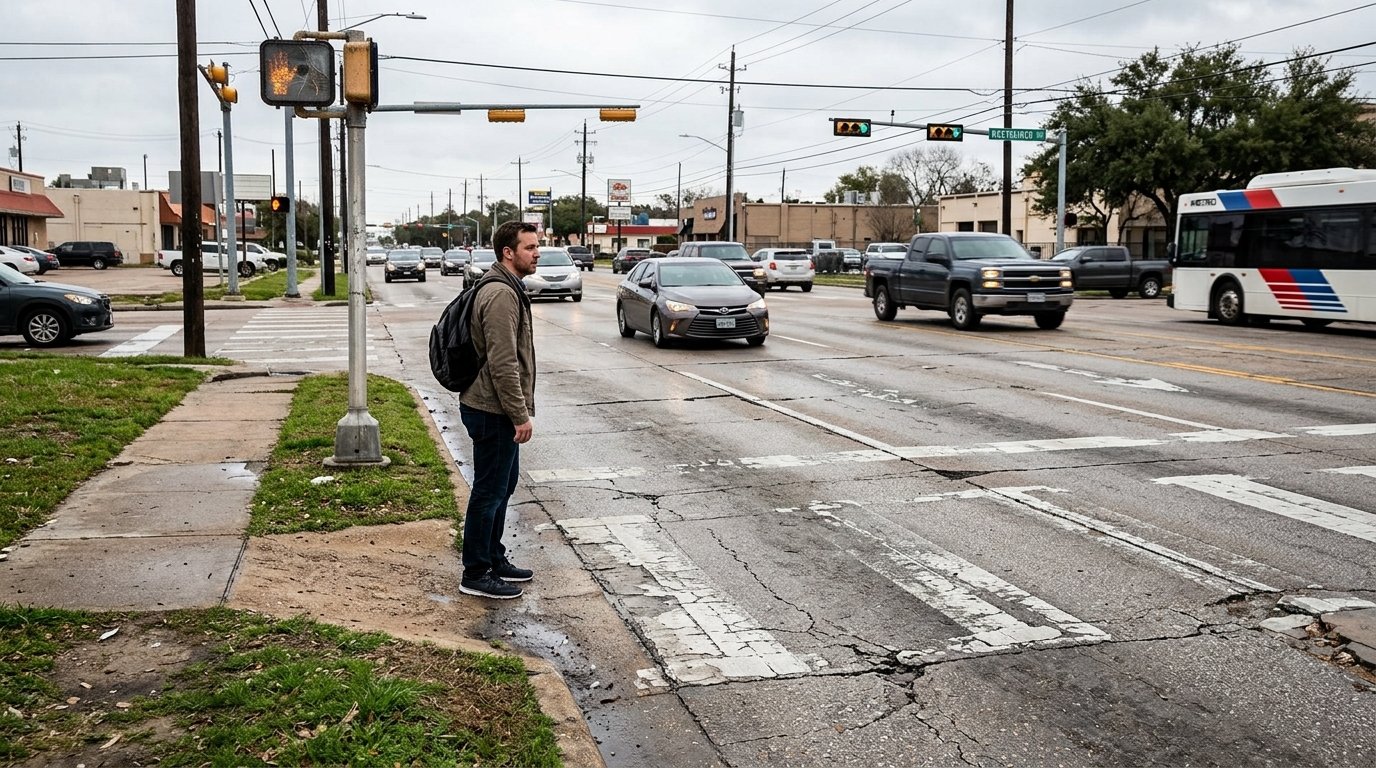
- Faded or worn markings: Crosswalk lines, stop bars, and lane markings are visual signals that tell drivers where to stop and where to expect people on foot. When those markings wear away, the signal they send to drivers weakens.
- Inadequate signal timing: A pedestrian signal that gives too little time to cross, or a signal sequence that sends turning vehicles into a crosswalk while people are still crossing, can set up dangerous conflicts. This is closely related to the turning-vehicle problem we covered in our article on Pedestrians Struck by Turning Vehicles at Houston Intersections.
- Sidewalk gaps and hazards: A sidewalk that ends abruptly, is blocked, or is so damaged that it cannot be used safely may push pedestrians into the road. That can matter when considering how and why someone was in a vehicle’s path.
- Poor visibility and lighting: Poor lighting, obstructed sight lines, and landscaping or structures that block the view between drivers and pedestrians can all affect whether a driver has a fair chance to see someone crossing.
- Intersection and roadway layout: Wide intersections, long crossing distances, high-speed approaches, and lane designs that encourage fast turns can raise the risk for people on foot. Major Houston corridors, including roads near I-10, I-45, and Highway 288, often combine heavy traffic with pedestrian activity at the edges.
Whether any of these conditions supports a legal claim depends on the specific facts and on the legal rules discussed below. A condition may be unsafe in everyday terms without being something Texas law allows a person to sue over. That distinction is one of the most important issues in these cases.
Sovereign Immunity and the Texas Tort Claims Act’s Narrow Exceptions
Governmental entities in Texas generally have immunity from lawsuits unless that immunity has been waived. This is often called sovereign immunity, or governmental immunity when it applies to cities and other local entities. The practical effect is that a person cannot simply sue a city the way they could sue a private company.
The Texas Tort Claims Act, found in Chapter 101 of the Texas Civil Practice and Remedies Code, is the statute that addresses when governmental units may be sued. It provides a limited waiver of immunity in certain circumstances. The key word is limited. The Act does not open the door to every claim against a city. A claim has to fit within the situations the statute recognizes, and claims brought under it are subject to specific requirements and limitations.
For a pedestrian case, this means several things:
- The nature of the claim matters: The way a claim is framed, including whether it concerns the physical condition of a roadway, the way something was designed, or the way something was maintained, can affect whether the claim can proceed at all. Courts treat these categories differently, and the details are technical.
- The type of entity matters: A city, a county, and a state agency are all governmental units, but the facts of who controlled the location in question can shape the analysis.
- The statute includes limits: Claims under the Act carry restrictions that are not part of an ordinary personal injury case against a private party or a driver.
I want to be straightforward about this: it is not an area where a general article can tell a reader whether their particular claim is viable. Applying Chapter 101 to a specific crash requires reviewing the exact roadway condition, who was responsible for it, how it contributed to the injury, and how the statute applies to that combination of facts. An attorney can do that review, and it is an area where an early look can matter.
This is also where my insurance background tends to come into play. Governmental entities often handle claims through risk pools, insurance programs, or other structures, and the people who evaluate these claims are looking for the same things carriers look for in any claim: how the condition is documented, what notice the entity had, and what the injured person can actually prove. Having been on the claims side, I understand how those evaluations tend to unfold.
The Six-Month Notice Deadline for Claims Against a Government Entity
If there is one point from this article that readers should take away, it is this one. Under Section 101.101 of the Texas Tort Claims Act, a governmental unit is generally entitled to written notice of a claim no later than six months after the incident that gave rise to the claim.
That is dramatically shorter than the general two-year statute of limitations that Texas applies to most personal injury cases, measured from the date of injury. A person who assumes they have two years to act on a claim against a city could miss the notice window entirely. And in a case where the driver and the roadway both played a role, the deadline for the claim against the driver and the notice deadline for the claim against the government entity may be very different.
A few practical points are worth understanding:
- The deadlines run separately: A claim against a driver and a claim against a governmental entity do not share one timetable. The six-month written notice requirement applies to the government-entity side of the case.
- Notice content matters: The statute generally calls for notice that reasonably identifies the injury or damage claimed, the time and place of the incident, and the incident itself.
- Requirements can vary: Some entities may have additional local procedures, and exceptions can apply in limited circumstances, including where the governmental unit had actual notice of the incident. Those details should be reviewed for the specific entity involved.
- Wrongful death cases follow their own timing: When a pedestrian crash is fatal, Texas generally allows two years from the date of death for a wrongful death claim. That does not eliminate the shorter notice requirement for claims against a government entity. Families dealing with a loss should know that this issue can arise quickly. Our wrongful death page describes how the firm approaches those cases.
- Waiting can cost more than time: Roadway conditions are often repaired, repainted, or redesigned after a serious crash. Photographs, records, and other evidence become harder to collect as time passes.
If you are trying to understand whether a government entity could be part of your situation, the most useful step is usually to have the facts reviewed promptly, rather than to wait and see.
Combining a Design-Defect Claim With a Claim Against the Driver
Many pedestrian cases involve more than one cause. A driver may have been inattentive, and the intersection may also have been poorly designed or poorly marked. When both are true, the injured person may have the option of pursuing different parties through different legal paths.
- The driver and the driver’s insurer. A claim against a driver generally follows the usual personal injury framework: whether the driver acted with reasonable care and whether that conduct caused the injury. The driver’s insurance coverage is often a central part of how these claims are evaluated. Our car accidents page explains how the firm approaches collisions involving drivers and insurers.
- The governmental entity. A claim against a city or another government entity follows the more restrictive rules of the Texas Tort Claims Act and carries the shorter notice requirement discussed above.
- Other private parties. Depending on the facts, private companies may also be involved. For example, a contractor working on a roadway or sidewalk may have created or contributed to a hazard. Our article on Wrongful Death Settlements vs. Trials in Texas explains how multiple parties can be involved when roadwork is part of the picture.
Texas follows a modified comparative negligence rule. An injured person can recover damages even if they share some of the fault for an accident, as long as they are not more than 50 percent responsible. Compensation is reduced by the percentage of fault assigned to the injured person, and a person who is found 51 percent or more at fault cannot recover. In a pedestrian case, insurers may point to where the pedestrian was crossing, what the signal showed, or whether the pedestrian was visible. A roadway defect can matter here too. If a missing crosswalk or a blocked sidewalk explains why a person was where they were, that context may bear on how fault is evaluated.
Pursuing more than one party is not automatically better. Each additional party adds legal rules, deadlines, and evidence to manage, and some claims may not be viable at all. Whether to bring a claim against the driver, a government entity, a private contractor, or some combination depends on the facts and on an honest assessment of what the evidence supports.
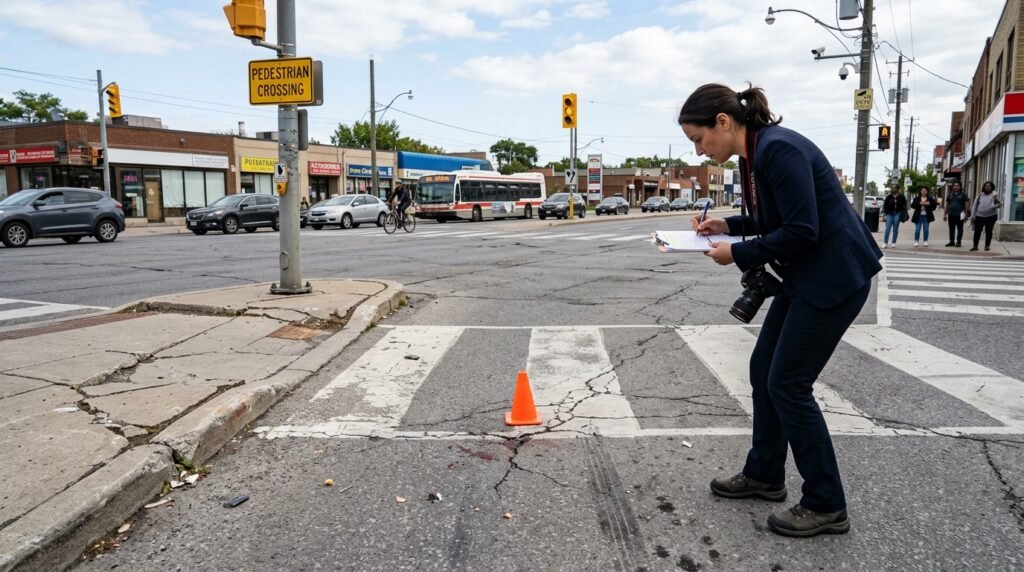
Documenting a Dangerous Roadway Condition Before It Gets Fixed
Roadway conditions change. A faded crosswalk may be repainted. A damaged sidewalk may be repaired. A signal’s timing may be adjusted. Those fixes are usually good for public safety, but they can also erase the evidence of what the location looked like when a person was injured.
The kinds of information that may become relevant in a case involving a roadway or sidewalk condition include:
- Photographs and video of the location, including the crosswalk, markings, signals, signs, and sidewalk
- Images showing sight lines from a driver’s perspective and a pedestrian’s perspective
- Surveillance footage from nearby businesses or traffic cameras, which may be overwritten quickly
- Police crash reports and witness information
- Records related to the roadway, such as maintenance history, complaints, and prior incidents, which may be obtainable through formal requests
- Signal timing records, where the intersection is signalized
- Medical records documenting the injuries and the course of treatment
- Information about who owned, controlled, or maintained the location
Records held by a governmental entity are often requested through formal processes, and a person recovering from serious injuries may not be in a position to gather them. An attorney can help determine what is worth requesting, from whom, and in what order.
I’d offer one more observation from the claims side. When I reviewed files as an adjuster, the claims that were hardest to evaluate in the claimant’s favor were frequently the ones where evidence about the scene had disappeared. That is not a statement about any one case, and no attorney can predict how a case will turn out. It is simply a reason why the early stage of a pedestrian case can matter.
Frequently Asked Questions
Can a city be liable for a dangerous roadway design?
It may be possible in some circumstances, but it is not automatic. Governmental entities in Texas generally have immunity from lawsuits unless it has been waived. The Texas Tort Claims Act, found in Chapter 101 of the Texas Civil Practice and Remedies Code, provides a limited waiver, and claims must fit within it. Whether a particular claim can proceed depends on the facts, including the nature of the roadway condition and who was responsible for it. An attorney can evaluate those details.
What counts as a design defect?
In everyday terms, people use the phrase to describe roadway or sidewalk features that make crashes more likely, such as a missing crosswalk, a confusing intersection layout, inadequate signal timing, poor sight lines, or a sidewalk that ends without a safe alternative. Whether a condition qualifies as something Texas law allows a person to sue over is a separate legal question. The way a condition is described and categorized can matter, so the specific facts and the statute both have to be reviewed.
What is the Texas Tort Claims Act notice deadline?
Claims against government entities under the Texas Tort Claims Act generally require written notice within six months of the incident. That is much shorter than the general two-year statute of limitations that applies to most personal injury cases in Texas. The notice should reasonably identify the injury or damage claimed, the time and place of the incident, and the incident itself. Because requirements and exceptions can vary by entity and by the facts, an attorney should review the specific deadline that applies to a particular situation.
Can I sue both the driver and the city?
Depending on the facts, an injured person may have claims against more than one party, including a driver, a governmental entity, and potentially private companies involved in the location. Each claim follows its own legal rules and deadlines. A claim against a government entity must satisfy the Texas Tort Claims Act, while a claim against a driver follows the usual personal injury framework. Whether claims against multiple parties make sense depends on the evidence.
How do I document a dangerous roadway condition?
Evidence that may be relevant includes photographs and video of the location, witness information, police reports, nearby surveillance footage, and records about the roadway and who maintained it. Conditions can be repaired or changed after a crash, and video can be overwritten, so this kind of evidence can become harder to find over time. An attorney can help identify what information may matter in a specific case and how it can be requested.
This article is for general educational purposes and is not legal advice, and reading it does not create an attorney-client relationship. Every pedestrian accident involving unsafe roadway conditions turns on its own facts, and outcomes cannot be guaranteed. Claims involving allegedly dangerous roads or government entities may be subject to special legal requirements and notice deadlines. Anyone injured in a pedestrian accident involving unsafe roadway conditions can learn more on our Pedestrian Accidents page or reach Herrera PLLC through the contact page or by calling 832-891-3210 to schedule a free, confidential consultation and discuss the available options.
Jonathan Herrera, J.D.
Jonathan Herrera is the founder of Herrera PLLC in Houston, Texas. He holds a J.D. from South Texas College of Law Houston and has over a decade of experience as an insurance adjuster. He previously practiced insurance defense at Rymer, Echols, and Nelson-Archer. He is a member of the Houston Trial Lawyers Association, the Texas Trial Lawyers Association, and the American Association for Justice.