
Comparative Negligence in Texas: How Being Partially at Fault Affects Your Recovery

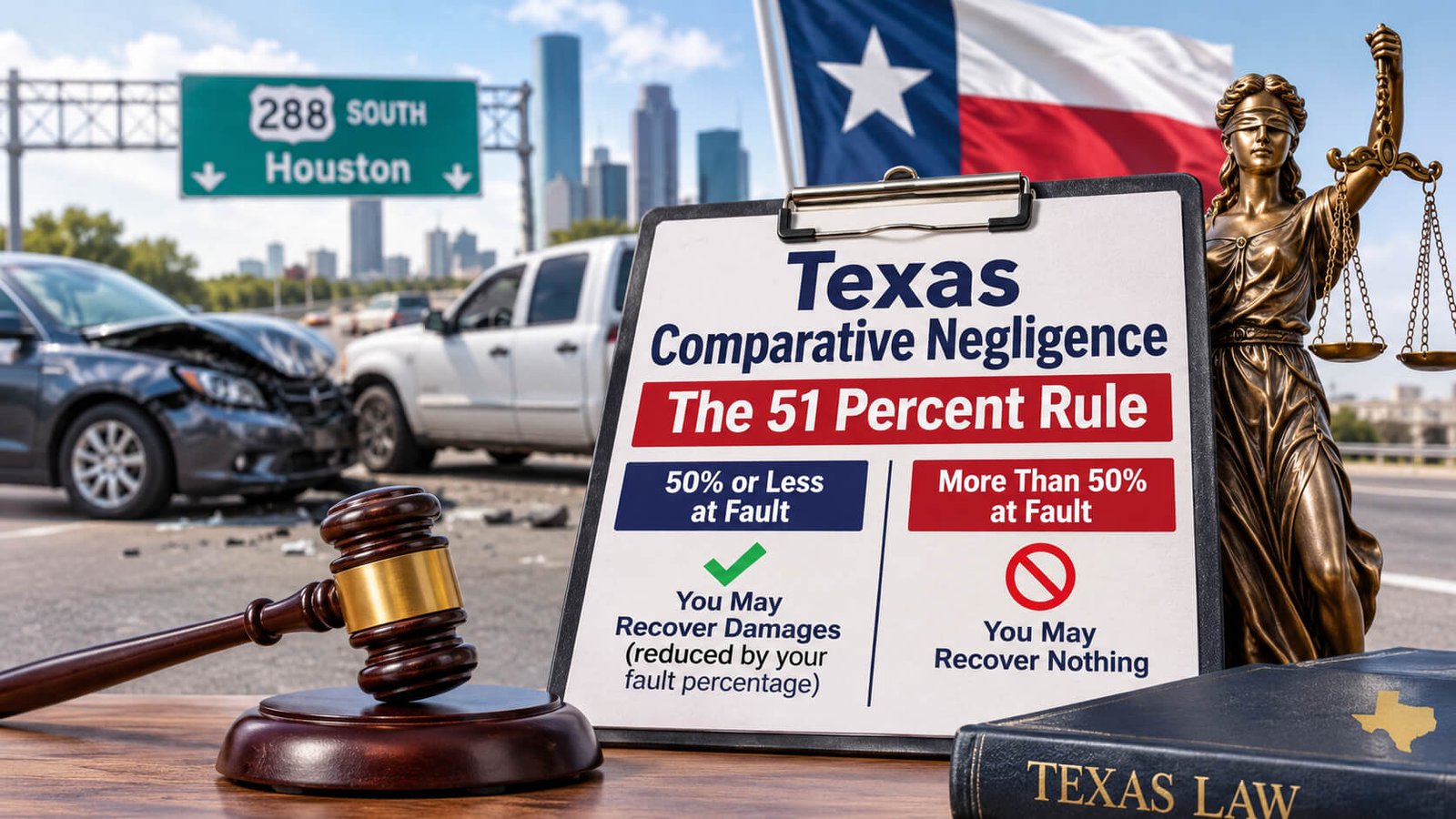
Picture a driver heading south on Highway 288 who is struck by a vehicle that drifted across lanes. At the hospital, the first call comes from the other driver’s insurance company, and one of the questions is whether the injured driver might have been going over the speed limit. The question is rarely casual. In Texas, the answer can affect how much an injured person may recover, and in some cases whether they may recover at all. In short, a claimant found more than 50 percent responsible may recover nothing, while a claimant found 50 percent or less responsible may recover damages reduced by that percentage. Having spent over a decade managing claims from the insurance carrier’s side, Jonathan Herrera has seen how quickly a conversation about fault can become the center of a claim.
Texas’s Modified Comparative Negligence Rule Explained
In Texas, fault is measured in percentages rather than assigned to one side alone. The governing law is Chapter 33 of the Texas Civil Practice and Remedies Code, titled proportionate responsibility, and it is commonly described as a modified comparative negligence rule. Under it, the trier of fact, meaning a jury or a judge in a bench trial, determines a percentage of responsibility for each claimant, each defendant, each settling person, and each responsible third party who has been designated under the statute. Those percentages are stated in whole numbers and reflect each person’s role in causing or contributing to the harm.
Chapter 33 applies to any cause of action based on tort in which a defendant, settling person, or responsible third party is found responsible for a percentage of the harm. That reach includes the claims Herrera PLLC handles in its serious injury practice, from car accidents and truck accidents to motorcycle collisions, pedestrian accidents, premises liability and slip and fall claims, rideshare crashes, and drunk driving accidents. The statute does carve out some matters. It does not apply to an action to collect workers’ compensation benefits, and it does not apply to a claim for exemplary damages included in an action to which the chapter otherwise applies. Whether it governs a particular situation depends on the facts.
The 51 Percent Bar: What Happens If You Are Found More Than Half at Fault
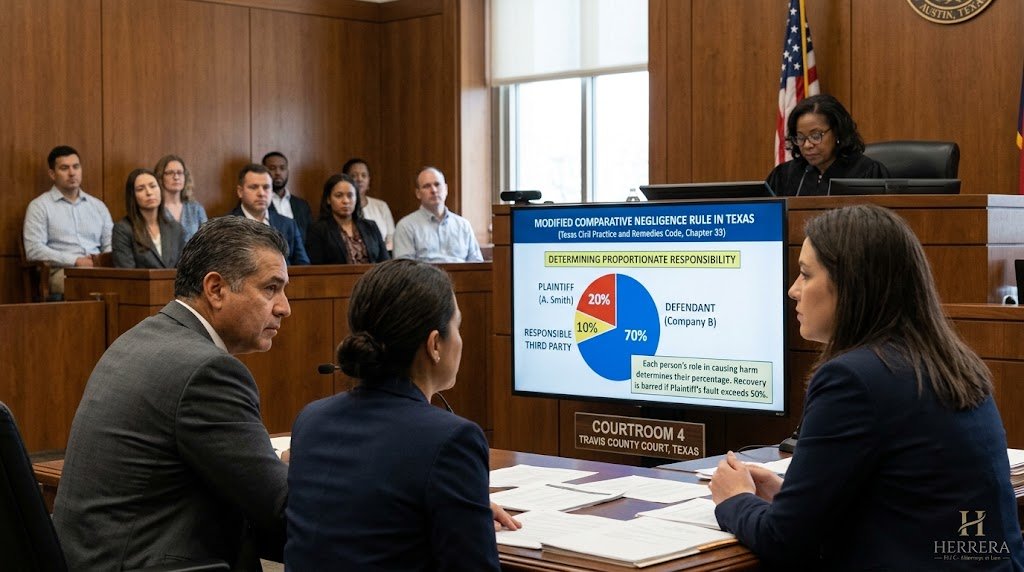
The bar rule is found in Section 33.001. It provides that in an action to which the chapter applies, a claimant may not recover damages if the claimant’s percentage of responsibility is greater than 50 percent. That is where the shorthand “51 percent rule” comes from. A person assigned 50 percent or less of the responsibility is not barred, while a person assigned 51 percent or more may recover nothing from the other parties.
Because findings are stated in whole numbers, a single percentage point can separate a reduced recovery from no recovery. That is one reason fault allocation is so heavily contested. A claim that looks strong on the injuries can become much weaker if the other side persuades a jury that the injured person carried just over half of the blame.
The rule also matters to families. In a wrongful death case, the statute defines a “claimant” to include both the person who died and anyone seeking recovery for that person’s death. A fault percentage attributed to the person who died may therefore affect what a family can recover, which is one reason the firm’s wrongful death work involves close attention to how fault is framed from the start.
How a Fault Percentage Reduces, Rather Than Eliminates, Your Recovery
When a claimant is not barred, Section 33.012 directs the court to reduce the damages by a percentage equal to the claimant’s percentage of responsibility. The following is an illustration only, not a prediction. If a jury found that a person’s damages totaled $200,000 and assigned that person 20 percent of the responsibility, the recoverable amount would be reduced by 20 percent, to $160,000. If the jury assigned 51 percent, the bar in Section 33.001 would apply and the reduction math would never be reached.
Other parts of Chapter 33 can affect the final figure. If the claimant has settled with one or more persons, the statute provides for a further reduction by the dollar amount of those settlements. Under Section 33.013, a liable defendant is generally responsible only for the percentage of the damages equal to that defendant’s own percentage of responsibility, although a defendant found more than 50 percent responsible is also jointly and severally liable for the damages recoverable under Section 33.012. The types of damages Texas law may allow in an injury case, such as medical expenses, lost income, and pain and suffering, are the starting point for these calculations, and the fault percentage is applied afterward.
Who Decides the Fault Percentage, and When
At trial, the formal answer is the trier of fact. The statute requires a percentage to be determined for each claimant, defendant, settling person, and designated responsible third party, but it also states that no question about a person’s conduct may be submitted without sufficient evidence to support it. In practice, though, fault percentages are argued long before a verdict. Most serious injury cases settle without a trial, and insurance adjusters and defense counsel evaluate and negotiate fault percentages as part of settlement discussions.
The statute also sets timing rules for naming others who may share the blame. A defendant may ask the court for leave to designate a person as a responsible third party, and the motion must generally be filed on or before the 60th day before trial unless the court finds good cause for a later filing. Another party can object within 15 days of being served with the motion, and the court must grant leave unless the objecting party establishes the grounds listed in the statute. Separately, a defendant that alleges in its answer that an unknown person committed a criminal act may, in certain circumstances, seek to designate that unknown person. After adequate time for discovery, a party may also move to strike a designation when there is no evidence that the designated person is responsible. Each designation can shift percentages, which is why the identity of everyone named in a case can matter.
Insurance Company Tactics to Inflate Your Share of Fault
The comparative negligence rule gives insurers a built-in incentive to shift blame onto the person who was hurt. Every percentage point assigned to an injured person can reduce what the carrier may owe, and 51 percent can eliminate it. Jonathan Herrera’s years as an adjuster, followed by insurance defense work at Rymer, Echols, and Nelson-Archer, gave him a view of how that incentive plays out from the inside.
Tactics that can arise include requests for early recorded statements, when the injured person may still be in pain or on medication and unable to describe events precisely. Adjusters may seize on a casual remark such as “I’m okay” or “I didn’t see him” and later characterize it as an admission. They may point to a minor traffic infraction or an arguable lapse in attention, such as a lane position, a speed estimate, or a brief glance away, and argue that it contributed to the crash. In premises cases, they may argue that a hazard was open and obvious. Gaps in medical treatment, social media posts, and inconsistencies between early and later accounts may also be used to question credibility. None of these approaches is necessarily improper, but each is aimed at moving the percentage, and each can be tested against the evidence.
Evidence That Protects You From an Unfair Fault Allocation

Because Section 33.003 requires sufficient evidence before a person’s conduct goes to the trier of fact, the evidence in a case can shape the outcome. Evidence that may bear on fault includes police reports, photographs and measurements from the scene, statements from independent witnesses, surveillance or dashcam video, vehicle damage patterns, and medical records that tie the injuries to the event. In commercial vehicle and industrial cases, records kept by the company involved can also be relevant. Where the facts are technical, expert analysis such as accident reconstruction may help explain what happened.
Herrera PLLC’s approach to serious injury matters includes visiting the scene, interviewing witnesses while memories are fresh, obtaining police reports and medical records, and consulting experts where necessary, with every case prepared for trial from the outset.
Timing also matters. Texas generally imposes a two-year statute of limitations from the date of injury in most personal injury cases, and two years from the date of death in wrongful death cases, with a generally applicable six-month written notice requirement for claims against government entities. The firm handles serious injury cases on a contingency fee basis, meaning clients pay no attorney’s fees unless compensation is recovered, and the firm advances case costs. A free, confidential conversation with Jonathan Herrera is available for injured Houston-area residents who want to understand how fault may affect their situation.
Frequently Asked Questions
What is Texas’s 51 percent bar rule?
Under Section 33.001 of the Civil Practice and Remedies Code, a claimant may not recover damages if the claimant’s percentage of responsibility is greater than 50 percent. A person found 50 percent or less responsible is not barred.
Can I still recover damages if I was partly at fault?
Texas law may allow a recovery if the percentage of fault assigned to the injured person is 50 percent or less. The outcome depends on the facts, the evidence, and how responsibility is allocated among everyone involved.
How does a fault percentage reduce my compensation?
Section 33.012 directs the court to reduce the damages by a percentage equal to the claimant’s percentage of responsibility. A claimant found 20 percent responsible, for example, would see recoverable damages reduced by 20 percent, and settlement credits can further affect the final figure.
Who decides how much fault I share?
At trial, the jury or judge determines each person’s percentage. Before trial, insurers and attorneys negotiate fault as part of settlement discussions, and many cases resolve on those terms.
How do insurers try to inflate my share of fault?
Insurers may seek early recorded statements, highlight minor traffic infractions, question gaps in treatment, or rely on offhand remarks. Evidence gathered early can help test each of these arguments.
This article is for general educational purposes and is not legal advice or a substitute for advice about a specific situation. How Texas comparative negligence applies depends on the facts of each claim, and an attorney can evaluate how fault may affect a particular injury case. Anyone with questions about a serious injury, a wrongful death, or an insurer’s fault allegations is welcome to call Herrera PLLC at 832-891-3210, email jherrera@jh-lawpllc.com, or schedule a free, confidential consultation through the contact page.
Jonathan Herrera, J.D.
Jonathan Herrera is the founder of Herrera PLLC in Houston, Texas. He spent more than a decade as a licensed insurance adjuster managing high-exposure casualty and property claims, founded the multi-state adjusting firm JH Claims LLC, and practiced insurance defense at Rymer, Echols, and Nelson-Archer before opening his own firm. He is a member of the Houston Trial Lawyers Association, the Texas Trial Lawyers Association, and the American Association for Justice.