

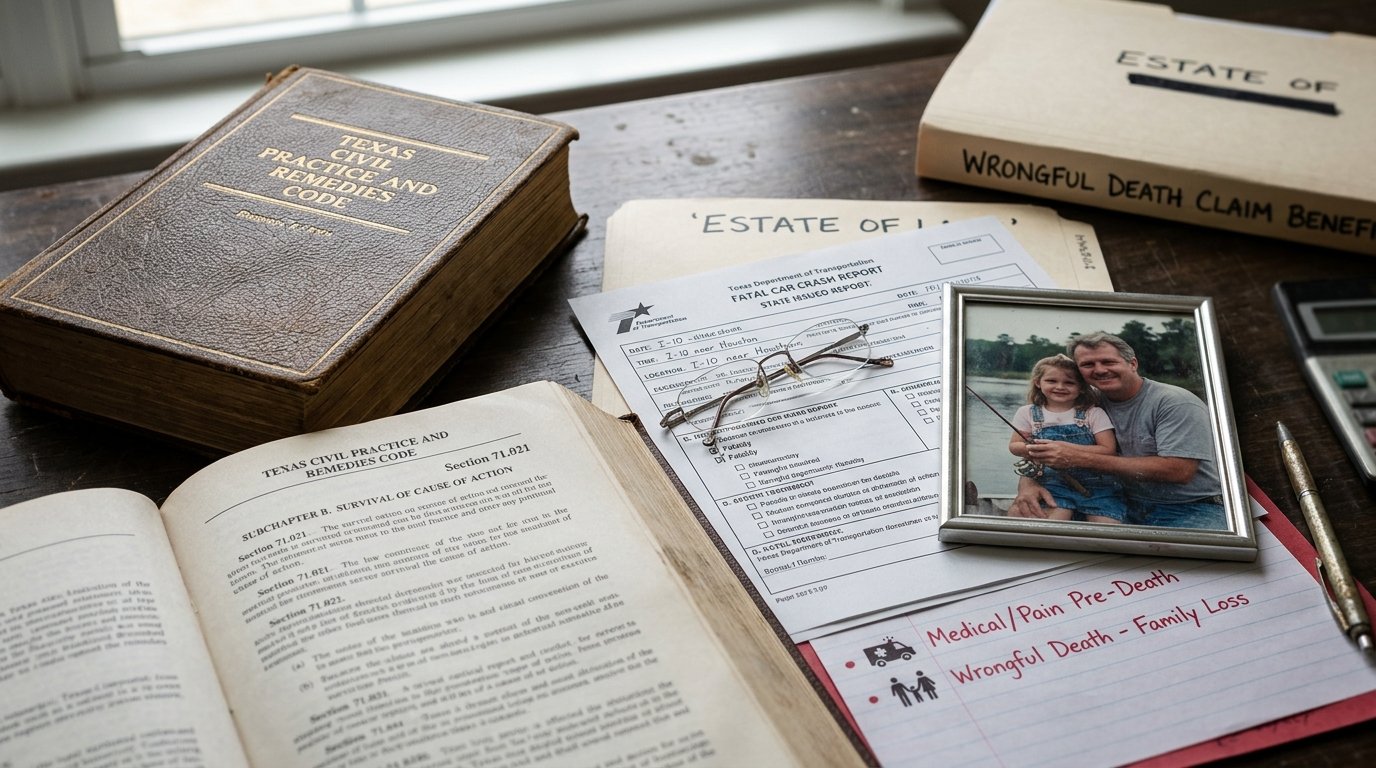
Survival Actions in Texas: The Difference Between a Survival Claim and a Wrongful Death Claim

When a person dies in a crash or other accident caused by someone else, most families hear one legal term: “wrongful death.” Far fewer hear that Texas law also recognizes a second, separate claim, called a survival action. The two claims arise from the same tragedy, but they compensate different people for different losses. They also follow different rules about who files, who receives the money, and how the recovery is treated.
Before becoming an attorney, I spent over a decade as an insurance adjuster handling high-exposure casualty claims. Later, I defended insureds at Rymer, Echols, and Nelson-Archer. In both roles, I saw how a fatal-injury claim is evaluated, and the way an insurer breaks a death case into its separate parts is something families rarely see. This article explains how Texas treats those parts, and why a survival action matters even though it is less familiar than wrongful death.
This article is general educational information about Texas law. It is not legal advice, and it does not create an attorney-client relationship. Every case depends on its own facts.
What a Survival Action Actually Compensates For
A survival action continues a claim that the person who died already had. Imagine someone is hurt in a collision on I-10 and lives for hours, days, or weeks before dying. During that time, that person had a personal injury claim against whoever caused the crash. Under Texas law, that claim does not simply vanish at death.
The legal basis is the Texas survival statute, found in Subchapter B of Chapter 71 of the Texas Civil Practice and Remedies Code. Section 71.021 provides that a personal injury cause of action does not abate, meaning it does not end, because of the death of the injured person or the death of the person liable for the injury. The action survives to and in favor of the heirs, legal representatives, and estate of the injured person, and the suit may be instituted and prosecuted as if the liable person were alive.
In plain terms, a survival action is about the harm the person suffered before death. It compensates for what the decedent personally went through, not for what the family lost afterward. That distinction is the foundation for everything else in this article.
Without the survival statute, a defendant’s liability for the decedent’s own injuries could end at the moment of death. The statute prevents that result by letting the claim continue.
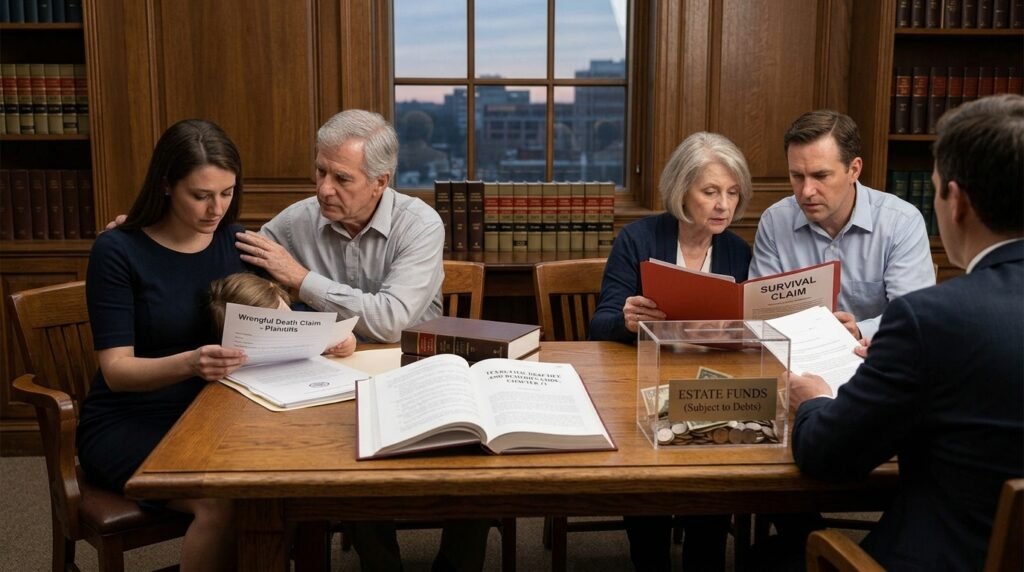
How a Survival Claim Differs From a Wrongful Death Claim
Both claims come from Chapter 71 of the Texas Civil Practice and Remedies Code, and both can arise from the same fatal accident. They are still legally distinct, and the differences are significant.
Whose loss is being compensated. A survival claim addresses the decedent’s own injuries and losses before death. A wrongful death claim addresses the losses suffered by certain surviving family members because of the death. Under Section 71.004, a wrongful death action is for the exclusive benefit of the surviving spouse, children, and parents of the deceased. Our Wrongful Death page explains how the firm approaches those claims.
Who the claim belongs to. A wrongful death claim belongs to the statutory beneficiaries. A survival claim belongs to the decedent’s estate, a point covered in more detail below.
Where the money goes. Wrongful death recoveries are intended for the family members of the statute names. Survival recoveries go to the estate and are then handled according to the decedent’s will or, if there is no will, Texas law on who inherits. The two are also treated differently when it comes to the debts of the person who died. Section 71.011 provides that damages recovered in a wrongful death action are not subject to the debts of the deceased. Survival recoveries, because they belong to the estate, pass through the estate’s administration, where the debts of the estate are generally addressed before distribution.
What has to be proven. A wrongful death claim requires showing that the death was caused by the wrongful act or neglect of another, in a situation where the decedent could have brought a claim had they lived. A survival claim requires showing that the decedent had a viable personal injury claim before death and what that person experienced and lost during that time.
Timing. The deadlines can differ, as explained in the final section below.
The simplest way to remember it: wrongful death asks, “What did this death take from the family?” Survival asks, “What did this injury do to the person before they died?” Texas law lets both questions be asked in the same case.
Pre-Death Pain, Suffering, and Medical Expenses as Recoverable Damages
Because a survival action steps into the decedent’s shoes, the damages are those the decedent could have pursued in a personal injury case. Depending on the facts, categories may include:
Medical expenses incurred between the injury and death, such as emergency transport, trauma care, surgery, and intensive care.
Physical pain and suffering the person experienced before death.
Mental anguish the person experienced before death, including fear and distress while conscious and aware.
Lost earnings during the period the person survived after the injury.
Funeral and burial expenses, which Texas courts allow in a survival action when they are not recovered as part of the wrongful death claim.
Whether a person was conscious, how long they survived, and what they experienced are central questions for the pain and mental anguish elements of the claim. In some fatal accidents, death is instantaneous or the person was never aware of their injuries. In others, a person lives through a prolonged and painful period before dying. Those facts are often disputed. Other categories, such as medical expenses and funeral expenses, are evaluated on their own terms and do not depend on proof of consciousness.
This is where my years on the insurance side come into play. When an adjuster reviews a fatal-injury file, the pre-death period receives close attention. Insurers examine EMS reports, hospital records, and nursing notes, looking for evidence of consciousness, responsiveness, and pain. Records showing sedation, loss of consciousness, or a short survival time can be used to argue that the survival claim is small. Records documenting awareness and suffering can support a different view. These details are rarely obvious to families at the time, and the evidence often sits in medical and emergency records.
Texas law allows an injured person to seek compensation for the harm they suffered. A fatal case is no different in principle, though what is realistically available depends on the evidence, the coverage involved, and the facts of the case. No attorney can promise a particular outcome.
Also keep in mind that Texas follows a modified comparative negligence rule. A claimant can recover as long as they are not more than 50 percent responsible, and any recovery is reduced by their percentage of fault. In a survival action, insurers may raise arguments about the decedent’s own conduct, such as speed, lane position, or seat belt use. The proportionate responsibility rules appear in Chapter 33 of the Texas Civil Practice and Remedies Code.
Who Brings a Survival Claim: The Estate, Not the Family Directly
This is the point that surprises many families. A wrongful death claim is brought for the benefit of the spouse, children, and parents. A survival claim is different, because it is the decedent’s claim and it passes through the estate.
Section 71.021 says the personal injury action survives to and in favor of the heirs, legal representatives, and estate of the injured person. In practice, Texas courts generally require the claim to be brought by a qualified personal representative of the estate, such as an executor or administrator. An executor named in a will still generally needs to be appointed by the probate court before acting for the estate. Once appointed, that representative has the legal authority to act for the estate, including filing a lawsuit or negotiating a resolution.
This has several practical consequences:
An estate representative may be needed. If no one has been appointed, the family may need to ask a probate court to appoint someone before a survival claim can move forward in the ordinary way.
The family member serving as representative is acting for the estate. The person appointed has duties to the estate and to those entitled to receive from it. A representative is not simply collecting for themselves.
Distribution follows the estate, not the wrongful death statute. If the decedent left a will, the recovery is generally distributed according to it, after the estate’s obligations are addressed. If not, Texas law on intestate succession determines who receives it. That may or may not match the group of people entitled to share in a wrongful death recovery.
The estate’s claim is distinct from the beneficiaries’ individual claims. A person may be a wrongful death beneficiary, an heir, both, or neither, and these roles do not always overlap.
These distinctions can be confusing in the days after a loss, when families are managing grief, funeral arrangements, and paperwork. The practical point is that survival claims involve estate questions that wrongful death claims do not.
Filing Both Claims Together After a Fatal Accident
Because the two claims often arise from the same collision, same defendants, and same body of evidence, they are commonly evaluated together. The same investigation can inform both: the police report, scene evidence, witness statements, vehicle data, and the medical records documenting what happened between injury and death. Texas peace officers’ crash reports are maintained by the Texas Department of Transportation, and the TxDOT crash reports and records page explains how to request them.
Although the claims are legally separate, bringing them together can offer practical advantages:
One investigation. The liability evidence is largely the same for both claims.
A fuller picture of the loss. A wrongful death claim focuses on the family’s losses. A survival claim addresses the decedent’s own experience. Together, they describe the whole harm from the death.
Coordinated handling of insurance coverage. In a fatal case, available coverage may be limited, and how it is allocated between claims can matter. Insurers want to know who the claimants are and what each claim covers. Coverage questions can become complicated, including when the at-fault driver is underinsured. Our article on the Texas UIM wrongful death claim discusses that issue.
Families also ask how these claims apply across different accident types. A fatal car accident is one familiar setting, and the same framework applies to many others, including motorcycle accidents and certain workplace incidents. Our post on trench collapse and excavation accidents in Texas looks at one construction setting where deaths can occur. Emerging technology raises its own questions, which we address in our article on autonomous vehicle wrongful death claims in Texas. Our post on damages when an adult child dies addresses a common question for parents.
Whether to bring a survival claim, a wrongful death claim, or both depends on the facts. Some cases, such as an instantaneous death, may have little or no evidence of pre-death pain or mental anguish, though other damage categories may still be evaluated. In others, the survival claim is a meaningful part of the overall case. An attorney can evaluate how the two claims apply to a particular situation.
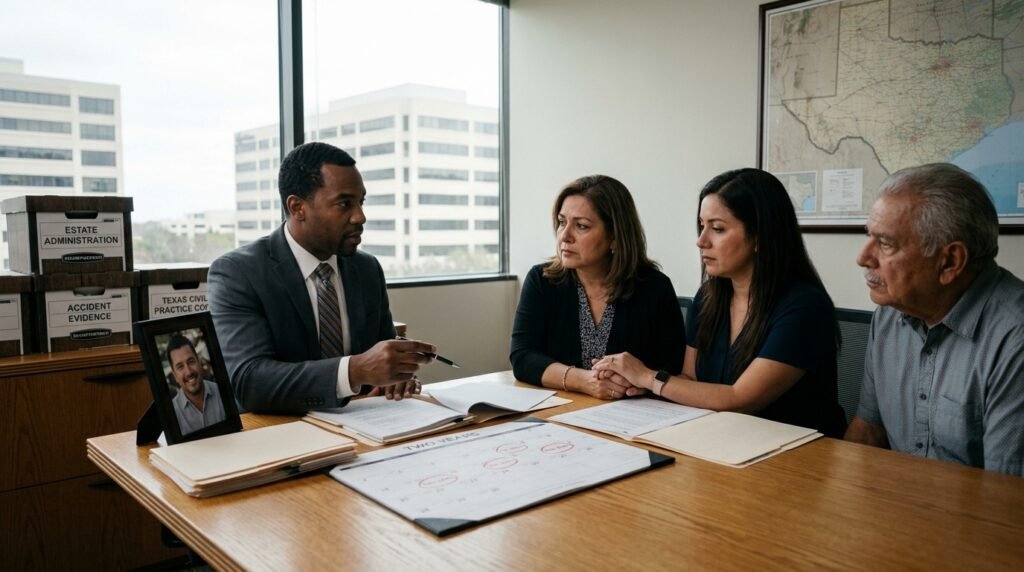
Deadlines That Apply to a Survival Action in Texas
Time limits are among the most important considerations after a fatal accident, and they can differ by claim.
For most personal injury claims, Texas imposes a two-year statute of limitations, measured from the date the claim accrues, which for an injury case is generally the date of injury. The two-year rules appear in Chapter 16 of the Texas Civil Practice and Remedies Code. The same chapter addresses claims for an injury resulting in death: under Section 16.003(b), such a suit must generally be brought not later than two years after the cause of action accrues, and the cause of action accrues on the date of death. That is the rule most often applied to wrongful death claims.
Because a survival action continues the decedent’s personal injury claim, the two-year period that applied to that claim is generally the starting point, running from the date of injury. When a person survives for a period of time after the injury, the two dates can differ. Texas law also provides a rule that matters in these cases: under Section 16.062, the death of a person in whose favor a cause of action exists suspends the running of the applicable limitations period for up to 12 months, and if a qualified executor or administrator of the estate is appointed during that period, the period resumes at that point.
Claims involving government entities carry additional requirements. When the claim is against a city, county, or state agency, the Texas Tort Claims Act generally requires written notice of the claim within six months, though some cities impose different deadlines under their charters and exceptions can apply. A fatal crash involving a government vehicle or a dangerous public roadway condition can raise this issue quickly.
Several practical points follow:
Do not assume the two claims share one deadline. Wrongful death and survival can run from different starting dates.
Evidence can disappear. Vehicle data, surveillance video, and company records may be overwritten or lost over time.
Estate administration takes time. If an estate representative is needed, the process of opening an estate can consume part of the limitations period.
Deadlines may vary with the facts. Exceptions and special rules can apply, which is why the dates should be reviewed by an attorney for any specific case.
A family does not have to resolve every legal question before reaching out. A free consultation is a way to understand which deadlines may apply and which claims may be available.
Frequently Asked Questions
What is a survival action in Texas?
A survival action is a legal claim that continues the personal injury claim a person had before they died. Under Section 71.021 of the Texas Civil Practice and Remedies Code, a personal injury cause of action does not end because the injured person dies. It survives to and in favor of the heirs, legal representatives, and estate. The claim addresses the harm the decedent suffered before death, such as medical expenses and pain and mental anguish experienced during that period, depending on the evidence.
How is it different from a wrongful death claim?
A wrongful death claim compensates certain surviving family members, the spouse, children, and parents, for their own losses caused by the death. A survival action compensates for the decedent’s own injuries and losses before death, and it belongs to the estate. The two claims can arise from the same accident but have different beneficiaries, different proof, and potentially different deadlines.
What damages does a survival claim cover?
Depending on the facts, a survival claim may cover medical expenses incurred between the injury and the death, physical pain and suffering, and mental anguish the decedent experienced before dying, along with lost earnings during the period of survival and funeral and burial expenses when those are not recovered in the wrongful death claim. How long the person survived and what the medical records show about their awareness and condition often shape the pain and mental anguish elements. Other categories are evaluated on their own terms.
Who has the right to bring a survival action?
Section 71.021 provides that the action survives to and in favor of the heirs, legal representatives, and estate of the injured person. In practice, Texas courts generally hold that a survival claim is brought by a qualified personal representative of the estate, such as an executor or administrator. Recovery goes to the estate rather than directly to individual family members. An attorney can review how this applies to a particular family and estate.
Can a family file both claims at the same time?
Yes, the two claims arise from the same fatal accident and are often evaluated and pursued together, though they remain legally separate. Handling them together allows one investigation to support both. Whether both claims are appropriate in a given case depends on the facts, including whether the decedent survived for a period after the injury.
If you have lost a loved one in an accident caused by someone else, you may have legal options under Texas law. At Herrera PLLC, Jonathan Herrera personally handles every matter, so the attorney you speak with is the attorney working on your case. The first conversation is free, confidential, and carries no obligation to hire the firm. Serious injury and wrongful death cases are handled on a contingency fee basis, meaning you pay no attorney’s fees unless compensation is recovered, and the firm advances all case costs. Herrera PLLC serves families throughout Houston, Harris County, the surrounding counties, and across Texas in both English and Spanish. Visit the Herrera PLLC homepage to learn more about the firm, or contact us or call 832-891-3210 to schedule a free, confidential consultation.
This article is for general educational purposes and is not legal advice, and reading it does not create an attorney-client relationship. Every wrongful death case depends on its specific facts, and outcomes cannot be guaranteed. Contact an attorney to discuss your circumstances and the legal options that may be available.
Jonathan Herrera, J.D.
Jonathan Herrera is the founder of Herrera PLLC in Houston, Texas. He holds a J.D. from South Texas College of Law Houston and has over a decade of experience as an insurance adjuster. He previously practiced insurance defense at Rymer, Echols, and Nelson-Archer. He is a member of the Houston Trial Lawyers Association, the Texas Trial Lawyers Association, and the American Association for Justice.