

Multi-Employer Construction Sites in Texas: Who’s Liable When Several Contractors Share the Blame

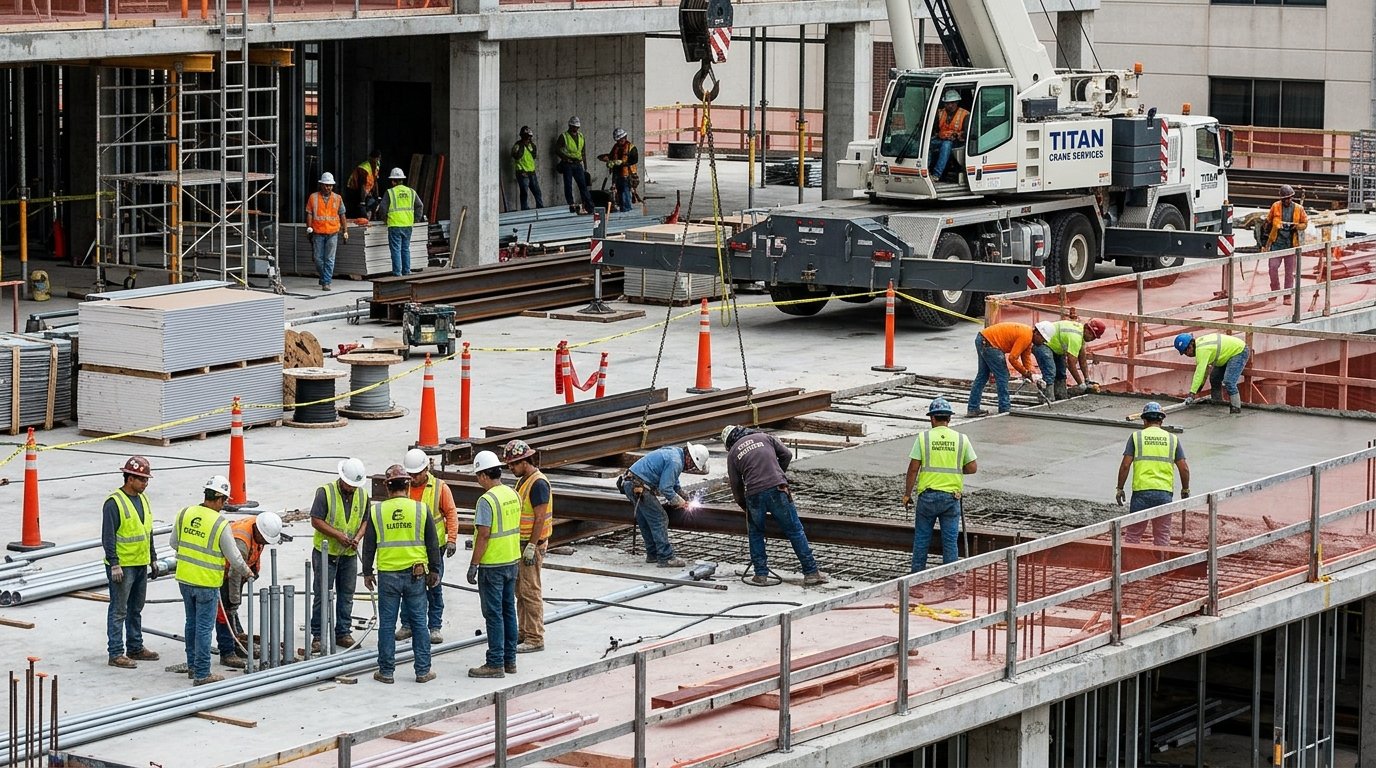
Picture a mid-rise project going up near downtown Houston. A framing subcontractor is stacking materials on the fourth floor while an electrical crew pulls wire nearby. Earlier that week, a different crew hoisting equipment knocked out a section of perimeter guardrail, and nobody replaced it. On Friday afternoon, an electrician steps back to make room for a pallet and goes over the edge. Within hours, the general contractor, three subcontractors, and their insurance carriers are all offering different accounts of who was responsible.
That scenario is a hypothetical, but its shape is familiar. Serious construction accidents in Texas often involve more than one company on the same site. Owners, general contractors, subcontractors, equipment suppliers, and lower-tier crews overlap on the same ground, and responsibility for one hazard can be spread across several of them. Put simply, OSHA decides which companies may be cited for a hazard, while Texas civil law decides who may owe an injured worker compensation, and the two analyses are not the same. Jonathan Herrera spent over a decade as an insurance adjuster managing high-exposure casualty and property claims and worked directly with coverage attorneys and defense counsel, so he has seen how multi-party construction claims are evaluated from the carrier’s side. This article explains how federal safety policy sorts out roles on shared sites, how Texas law divides fault, and what that can mean for injured workers. It supports Herrera PLLC’s broader coverage of construction and industrial accidents.
OSHA’s Multi-Employer Worksite Citation Policy Explained
The Occupational Safety and Health Administration addresses shared job sites in its Multi-Employer Citation Policy, CPL 02-00-124, which took effect on December 10, 1999. Texas does not operate its own OSHA state plan for private employers, so this federal policy applies to private construction sites in the state. The directive states that on a multi-employer worksite, more than one employer may be citable for a single hazardous condition that violates an OSHA standard. It does not create new duties for employers. It clarifies how existing duties apply when several companies share a workplace.
OSHA describes a two-step process. The first step is to decide whether an employer was a creating, exposing, correcting, or controlling employer. The second step is to decide whether that employer’s actions were enough to meet the obligations that come with the role. The directive also emphasizes that citation decisions should rest on all of the relevant facts revealed by an inspection or investigation, and that its examples are not meant to be exclusive.
This policy governs how OSHA issues citations. It is not a rule for deciding who pays an injured worker in a civil case. Texas courts decide civil duty under their own common-law principles, discussed below, rather than by OSHA’s labels. Even so, the framework gives a useful vocabulary for understanding who had a hand in creating, controlling, or failing to fix a dangerous condition.
Creating, Exposing, Correcting, and Controlling Employers
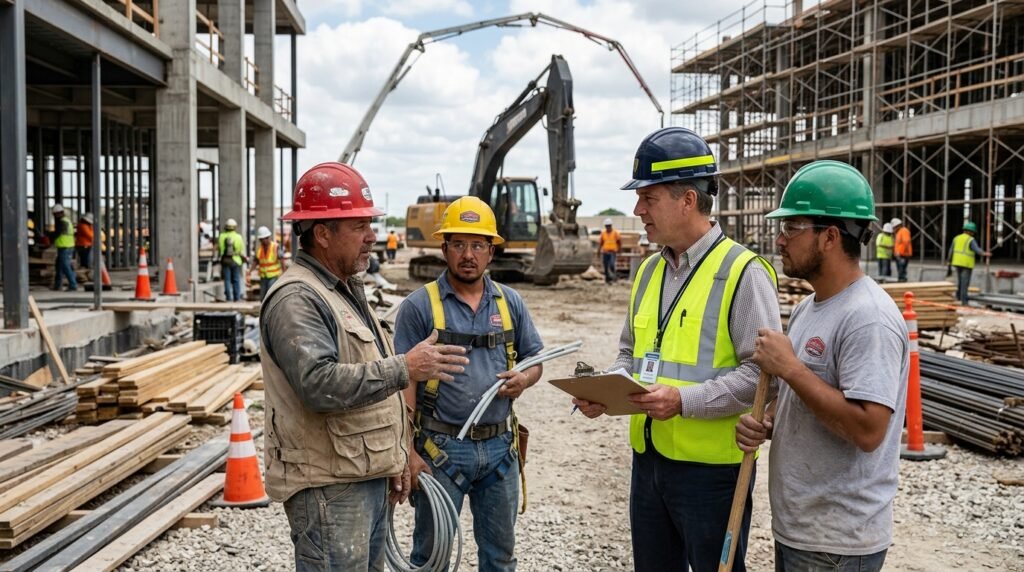
OSHA defines the four roles this way, and a single company can hold more than one:
- Creating an employer: The employer that caused the hazardous condition, such as a contractor that damages a perimeter guardrail while hoisting materials. A creating employer may be citable even when the only workers exposed belong to other companies.
- Exposing employers: The employer whose own employees are exposed to the hazard. If another company created the condition, an exposing employer may still be citable when it knew or should have discovered the problem and failed to take steps consistent with its authority, such as asking for correction, informing its workers, and using reasonable alternative protections.
- Correcting my employer: An employer engaged in a common undertaking on the same site is responsible for fixing a hazard, often because it was assigned to install or maintain safety equipment such as guardrails. It is expected to use reasonable care to prevent and discover violations.
- Controlling employer: An employer with general supervisory authority over the site, including the power to correct violations or to require others to do so. Control may come from the contract or from how the employer behaves in practice.
OSHA notes that a controlling employer must exercise reasonable care to prevent and detect violations, though that duty is less demanding than what an employer owes to its own workers. Factors include the scale of the project, the pace and changing nature of the work, and what the employer knows about a subcontractor’s safety history. These roles show up in many types of accidents, from falls from heights on Texas construction sites and ladder and roofing falls to trench collapse and excavation accidents, where one crew’s work and another crew’s exposure often intersect.
Why a General Contractor Can Be Liable Even for a Subcontractor’s Mistake
A common assumption is that a general contractor is insulated once it hires subcontractors to do the work. In practice, the general contractor often sits at the center of the site. It typically sets schedules, sequences the trades, coordinates access, and holds contractual authority over the companies working under it. OSHA’s policy recognizes this by treating an employer with broad supervisory authority as a controlling employer, even when its own employees were not the ones injured.
OSHA’s directive explains that control can be established in more than one way. A contract may give an employer a specific right to require compliance with safety rules and to demand correction of violations. Even without an explicit safety clause, a combination of contractual rights, such as resolving disputes between subcontractors, setting schedules, and determining construction sequencing, can show the kind of broad responsibility that affects safety. In some situations OSHA looks at what an employer actually does on the site rather than what the paperwork says.
Civil liability follows a different test. Under Texas Supreme Court decisions such as Elliott-Williams Co. v. Diaz, 9 S.W.3d 801 (Tex. 1999), a general contractor ordinarily has no duty to ensure that a subcontractor performs its work safely. A duty can arise, however, when the general contractor retains control over how the work is done, either through its contract or by actually exercising control. In Lee Lewis Construction, Inc. v. Harrison, 70 S.W.3d 778 (Tex. 2001), the court held that a general contractor that retained control over fall protection owed a duty to a subcontractor’s employee. The duty is tied to the control retained, and a general right to recommend safe practices is typically not enough on its own. A property owner faces its own, narrower test under Chapter 95 of the Civil Practice and Remedies Code when a contractor’s worker is hurt while repairing or building an improvement on the owner’s property. On industrial sites, a host company may play a similar role, which is relevant to oilfield and refinery accident claims, and a property owner may face separate exposure under premises liability principles.
Identifying Every Potentially Responsible Party After an Accident
After a serious accident, the question of who may be responsible usually reaches well beyond the company that employed the injured worker. Potentially responsible parties can include the property owner, the general contractor, the subcontractor whose work created the hazard, other trades whose work exposed the worker to it, and equipment suppliers or manufacturers if a machine or tool failed. A struck-by incident involving equipment is a good example, since the operator, the company that employed the operator, and the contractor that directed the work area may all be different entities.
The documents behind a project often reveal the chain of responsibility. Prime contracts and subcontracts, safety plans, daily reports, site sign-in sheets, inspection logs, incident reports, and any OSHA inspection records can show who agreed to do what and who actually did it. Insurance paperwork matters too. Construction contracts frequently require one company to be named as an additional insured on another’s policy, and the answer to whether a given carrier owes a defense or coverage can shape how a case unfolds. Jonathan’s insurance law practice includes additional insured disputes, which gives him a working familiarity with how those arrangements interact with injury claims.
Because evidence on active job sites changes quickly, early investigation matters. Equipment is moved, work areas are altered, and crews disperse to other projects. Where a worker has died, families may also have options through a wrongful death claim, and identifying the responsible parties follows the same logic.
How Proportionate Responsibility Applies Among Several Contractors
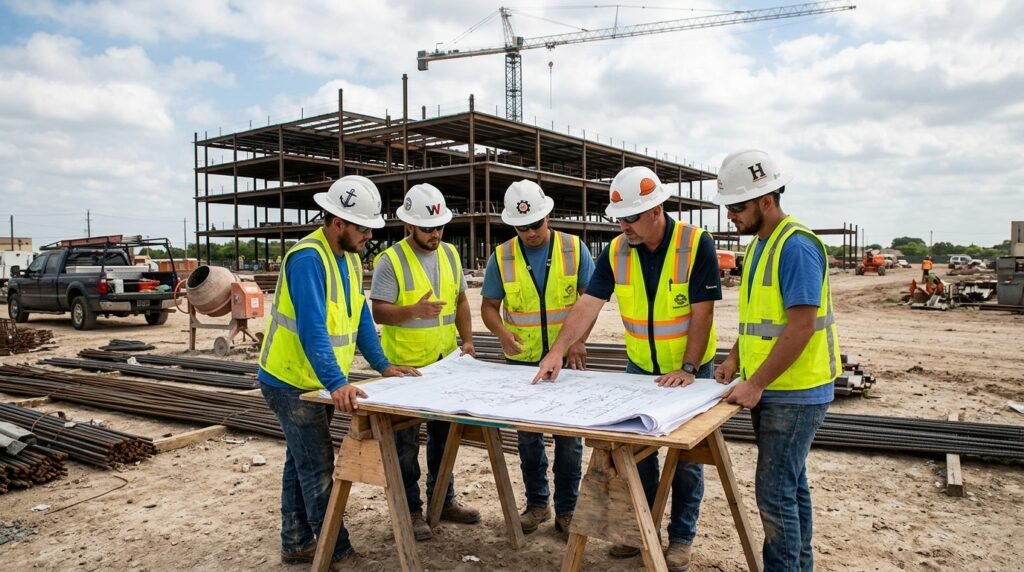
When more than one company shares the blame, Texas applies the proportionate responsibility rules in Chapter 33 of the Texas Civil Practice and Remedies Code. Under Section 33.003, the trier of fact determines a percentage of responsibility for each claimant, each defendant, each settling person, and each responsible third party who has been designated under Section 33.004. Those percentages add up to 100%.
Several consequences follow. A claimant may not recover damages if his or her own percentage of responsibility is greater than 50 percent, a rule that matches the modified comparative negligence standard Texas applies in injury cases. When a claimant is found partly responsible but not above that threshold, the recovery is reduced by that percentage. As a general rule, a liable defendant answers only for the percentage of responsibility assigned to it, although Section 33.013 provides that a defendant whose percentage is greater than 50 percent can be jointly and severally liable for the damages recoverable by the claimant.
The designation process under Section 33.004 explains why multi-contractor cases can become contentious. Defendants may seek to designate other parties as responsible third parties, which can move a share of the blame onto companies that were not sued. Insurers may use these tools to shift responsibility toward the injured worker or toward absent parties.
Workers’ compensation adds another layer. Texas does not require most private employers to carry coverage. When a worker’s employer does carry it, the employer is generally protected from a negligence suit by that worker, but claims against other companies on the site may remain available, and defendants may still try to designate the protected employer as a responsible third party. A general contractor that provides coverage to its subcontractors’ workers under Texas Labor Code Section 406.123 may also be treated as their employer for this purpose. Herrera PLLC discusses this overlap in its article on Houston construction site injuries beyond workers’ comp.
Coordinating a Third-Party Claim Across Multiple Companies
A third-party claim is a claim against someone other than the injured worker’s own employer. When several contractors are involved, it is not simply a larger version of a one-defendant case. Each company may have its own insurance carrier, its own defense counsel, and its own account of what happened. Each carrier evaluates exposure through its own policy, its own contractual risk transfer, and its own view of who should absorb the loss. Sorting through overlapping coverage, indemnity arrangements, and competing explanations takes coordination, consistent evidence, and a clear theory of how each party’s conduct contributed.
That coordination is where Jonathan’s background is directly relevant. After his years managing claims from the carrier’s side, he practiced insurance defense at Rymer, Echols, and Nelson-Archer, where he saw how carriers document these losses and how defense counsel approach discovery and depositions. Herrera PLLC prepares every case for trial from day one.
Herrera PLLC offers a free, confidential initial consultation with no obligation. Serious injury cases are handled on a contingency fee basis, so no attorney’s fees are owed unless compensation is recovered, and the firm advances case costs, including expert fees, investigation expenses, and court costs. Texas generally allows two years from the date of injury to file a personal injury claim. Claims against government entities often require written notice within six months, and some city charters set shorter deadlines, which can matter on public construction projects. With several companies involved, an attorney can review the specific dates, contracts, and circumstances to evaluate what options may be available.
Frequently Asked Questions
What is OSHA’s multi-employer worksite policy?
It is a federal enforcement policy, CPL 02-00-124, explaining when more than one employer may be cited for the same hazard on a shared site. It sorts employers into creating, exposing, correcting, and controlling roles and asks whether each took reasonable steps for its role.
Can a general contractor be liable for a subcontractor’s mistake?
It may be, depending on the facts. Under Texas law, a general contractor ordinarily has no duty to make sure a subcontractor works safely, but a duty can arise when it retains control over the work, by contract or by actually exercising control. The duty generally extends only to the aspects of the work it controls, and an attorney can evaluate the contract and the site facts.
How do I identify every responsible party after an accident?
Contracts, subcontracts, daily reports, safety plans, inspection logs, incident reports, and insurance documents can show who controlled the work area and who created or failed to correct a hazard. Early investigation matters because job sites change quickly. An attorney can help trace these relationships.
How is fault divided among several contractors?
Under Chapter 33 of the Texas Civil Practice and Remedies Code, the trier of fact assigns percentages of responsibility to the claimant, defendants, settling persons, and designated responsible third parties. A claimant found more than 50 percent responsible may not recover damages, and recoveries are otherwise reduced by the claimant’s share.
Can I bring a claim against more than one company?
Texas law may allow claims against more than one responsible party when the facts support it. Which companies can be named, and how workers’ compensation coverage affects that choice, depends on the circumstances. An attorney can review the situation and discuss available options.
This article is for general educational purposes and is not legal advice, and reading it does not create an attorney-client relationship. Every construction accident turns on its own facts, and outcomes cannot be guaranteed. Anyone injured on a job site that involved several contractors can reach Herrera PLLC through the contact page or by calling 832-891-3210 to schedule a free, confidential consultation and talk through the available options.
Jonathan Herrera, J.D.
Jonathan Herrera is the founder of Herrera PLLC in Houston, Texas. A former licensed insurance adjuster with over a decade of experience managing high-exposure casualty and property claims, he founded JH Claims LLC, a multi-state independent adjusting firm, and later practiced insurance defense at Rymer, Echols, and Nelson-Archer. He now represents injured individuals and policyholders, and he is a member of the Texas Trial Lawyers Association and the American Association for Justice.