
Construction Site Wrongful Death Claims in Texas: When a Job Site Accident Turns Fatal

A worker leaves for a job site in the morning and does not come home. The family then faces grief, funeral costs, lost income, and a string of calls from employers, insurers, and investigators. Many families also learn that a fatal construction accident does not lead to one claim. It can lead to several, and each follows its own rules.
Before becoming an attorney, I spent over a decade as an insurance adjuster, handling high-exposure casualty and property claims. Those files included construction defects and industrial accidents. Later, I defended insureds at Rymer, Echols, and Nelson-Archer. I have seen how a fatal job site claim is evaluated from the carrier’s side, including how responsibility gets divided among employers, contractors, owners, and equipment makers. This article explains how Texas law may apply when a construction accident turns fatal, so families can understand the landscape.
This article is general educational information. It is not legal advice and does not create an attorney-client relationship. Every case depends on its own facts.
Why Construction Sites See a Disproportionate Share of Workplace Fatalities
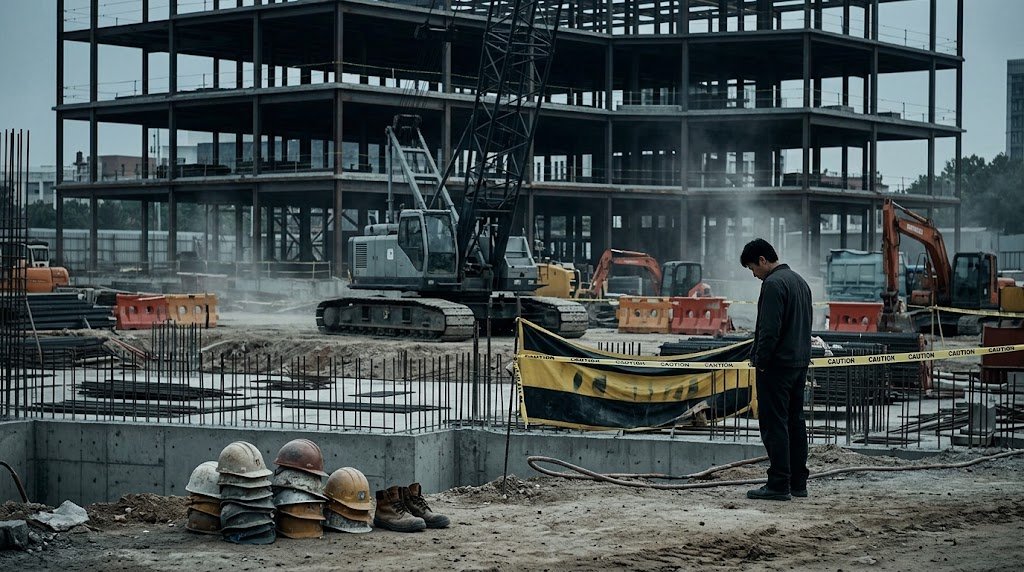
Construction remains one of the most dangerous industries in Texas. According to the Texas Department of Insurance, Division of Workers’ Compensation (TDI-DWC), Texas recorded 557 fatal work injuries in 2024. Construction accounted for 128 of those deaths, or 23 percent of all workplace fatalities in the state.
Several features of job sites help explain that pattern:
- Work at height: Roofs, scaffolds, ladders, and open floors create fall hazards, and falls are consistently among the leading causes of construction deaths.
- Heavy equipment in tight spaces: Cranes, excavators, loaders, and trucks operate near workers on foot.
- Constantly changing conditions: A site looks different from week to week as trades arrive and leave, and hazards can appear overnight.
- Many employers on one site: General contractors, subcontractors, and suppliers share a workspace, which can blur who is responsible for safety.
- Time and cost pressure: Schedules and budgets can push crews to skip safeguards.
OSHA identifies four hazards that cause a large share of construction deaths: falls, struck-by incidents, electrocutions, and caught-in or caught-between incidents. TDI explains these hazards on its page about OSHA’s “Fatal Four” and notes that OSHA standards generally call for fall protection when a worker is six feet or more above the ground.
Houston adds its own context. It is one of the largest construction markets in the country, with commercial towers, industrial expansion, and residential development in neighborhoods from EaDo to the Heights. The Gulf Coast climate and the region’s expansive clay soils create further challenges, and they can play a role in excavation and foundation work. Our posts on falls from heights on Texas construction sites, struck-by equipment accidents, and trench collapse and excavation accidents look at these hazards in more detail.
Workers’ Compensation Death Benefits vs. a Full Wrongful Death Claim
One of the most common questions after a fatal job site accident is whether workers’ compensation is the only option. The answer depends on the facts, and the two systems work quite differently.
Workers’ compensation death benefits
Texas workers’ compensation is a benefits system. Under Chapter 408 of the Texas Labor Code, certain family members of an employee who dies from a compensable work-related injury may qualify for death benefits. According to TDI, death benefits are generally 75 percent of the deceased employee’s average weekly wage, subject to statutory limits.
Those who may qualify include a surviving spouse, minor children, certain older children who are in school, and other dependents. A beneficiary generally must file a DWC Form-042 with the Division of Workers’ Compensation or the insurance carrier within one year of the employee’s death. Burial benefits may also be available to the person who paid burial expenses; for injuries occurring on or after September 1, 2015, the maximum burial benefit is $10,000.
Workers’ compensation benefits are generally paid without a need to prove fault. The trade-off is that the benefits are set by statute and do not include the full range of damages available in a lawsuit.
A wrongful death claim
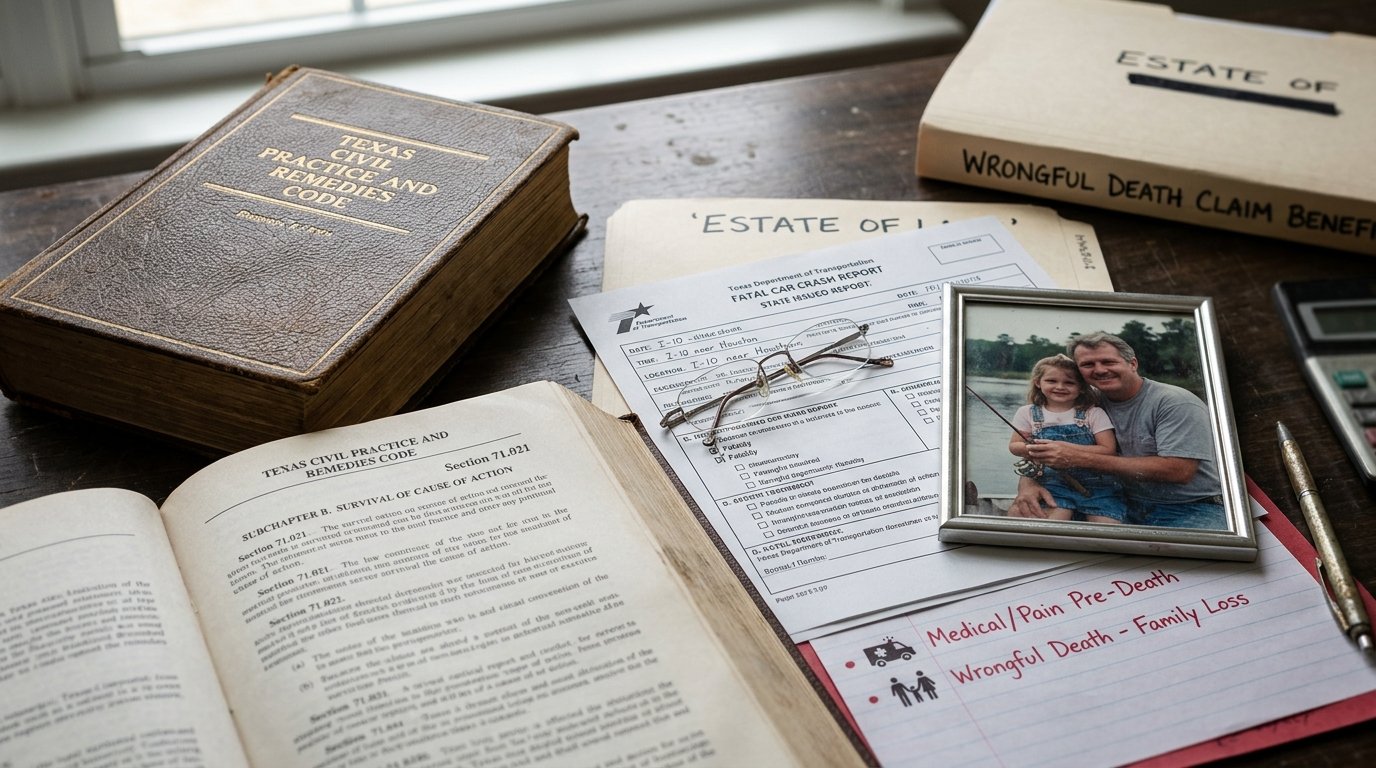
A wrongful death claim is a civil lawsuit under Chapter 71 of the Texas Civil Practice and Remedies Code. It is brought for the benefit of the surviving spouse, children, and parents of the person who died, and it requires showing that someone’s wrongful conduct caused the death. Our Wrongful Death page explains how the firm approaches these cases.
How the two interact
In many cases, workers’ compensation and a wrongful death claim are not an either-or choice. Generally speaking:
- If the employer has workers’ compensation coverage, the family’s claims against that employer are typically limited to the workers’ compensation system, with narrow exceptions.
- Texas is unusual because many private employers can choose whether to carry workers’ compensation. If an employer is a nonsubscriber, the family may be able to bring a negligence-based death claim against the employer, and Texas law limits some defenses available to nonsubscribers.
- Whether or not the employer is covered, workers’ compensation does not necessarily bar claims against other, unrelated parties, as discussed below.
Our post on construction site injuries beyond workers’ comp in Houston explores this overlap further. As a former adjuster, I know how benefit claims and liability claims are handled by different departments and often by different carriers. Families rarely see that division of labor, but it affects how and when each claim moves.
Third-Party Wrongful Death Claims Against Contractors, Owners, and Equipment Makers
A third-party claim is one against a party other than the employer. On a construction site, there are often several potential third parties. Depending on the facts, they may include:
- General contractors and subcontractors other than the decedent’s own employer. A worker may be killed by a mistake made by a different trade on the same site.
- Property owners and developers who controlled the site, its conditions, or its safety rules. Our premises liability page discusses how responsibility for dangerous property conditions can arise.
- Equipment and product manufacturers. If a crane, scaffold, harness, guard, or other piece of equipment was defective or failed, a product defect claim may be part of the picture.
- Equipment owners, lessors, and maintenance companies responsible for keeping machinery safe.
- Engineers, designers, and suppliers whose work contributed to an unsafe condition.
Texas law contains special rules that can affect claims against property owners and against general contractors who provide workers’ compensation coverage to their subcontractors’ workers. These rules turn on specific facts, such as who controlled the work and what insurance arrangements existed.
Contracts matter, too. Construction projects typically rely on layers of agreements, indemnity provisions, and insurance requirements, including additional insured coverage. Because of my background as an adjuster and in insurance defense, I look closely at how those policies and contracts fit together, since they often determine which insurer is involved and what coverage is realistically available.
The same principles can apply to industrial settings beyond traditional construction. Fatal incidents at refineries and petrochemical plants raise similar questions, and the firm’s oilfield accident page covers those cases.
Investigating a Fatal Job Site Accident Before Evidence Is Cleared or Altered
After a fatal accident, a construction site does not stay frozen. Work resumes, debris is cleared, equipment is repaired or moved, and records can be revised or lost. That is why early investigation is so important in these cases.
When a worker dies, employers are generally required to report the fatality to OSHA, and OSHA may open its own investigation. OSHA explains reporting requirements on its report a fatality page. An OSHA inquiry can generate valuable records, but it is not the same as an investigation on behalf of the family. OSHA’s work focuses on regulatory compliance, not on compensating a family, and the standards and timelines differ.
An investigation on behalf of a family may include:
- Visiting and documenting the scene, including photographs and measurements before conditions change.
- Preserving physical evidence, such as failed equipment, harnesses, scaffolding components, or tools.
- Obtaining records, including OSHA records, incident reports, site safety plans, daily logs, inspection reports, training records, and maintenance histories.
- Identifying every company on the site and the contracts and insurance policies that connect them.
- Interviewing witnesses while memories are fresh. Co-workers may be reluctant to speak, particularly if they still work for a defendant.
- Consulting experts, such as safety engineers, accident reconstructionists, and medical professionals, where the case calls for it.
- Requesting that companies preserve evidence, because electronic data, video, and communications can be overwritten.
As an adjuster, I saw how a claim file is built in the hours and days after a serious loss. Carriers and employers often begin gathering their own evidence right away. A family’s investigation starts from behind unless it begins early.
My firm prepares every case as though it will be tried before a jury. In my experience, insurers evaluate a claim differently when they know the attorney on the other side is ready to go to court.
Multiple Contractors and Shared Fault in a Fatal Construction Case
Construction sites are crowded with companies, and fatal accidents often involve more than one contributing cause. A scaffold may have been erected by one company, inspected by another, and used by a third. A trench may have been dug by a subcontractor, under a plan from a general contractor, on land controlled by an owner. In cases like these, the question is not only who was at fault but how fault is divided.
Texas follows a modified comparative negligence rule. A person can generally recover damages as long as they are not more than 50 percent responsible, and any compensation is reduced by the percentage of fault assigned to that person. The proportionate responsibility rules appear in Chapter 33 of the Texas Civil Practice and Remedies Code.
In a fatal construction case, expect defendants to point in several directions:
- At the decedent: Insurers may argue the worker ignored a rule, skipped a safety step, or took an unnecessary risk. Comparative responsibility is a common defense, and it can reduce recovery.
- At each other: Contractors, owners, and manufacturers often blame one another, and each may be insured by a different carrier with different interests.
- At the employer: Defendants may attempt to place fault on the decedent’s employer, even though the employer may be protected from a direct claim.
In my years evaluating claims, shared fault was one of the main levers carriers used to reduce what they paid. I also saw how defense counsel assembled these arguments. Understanding that approach helps in anticipating the defenses and building a record that addresses them. That does not guarantee any result, and no attorney can promise one. It simply means these arguments are better met with evidence gathered early.
Damages Available to a Construction Worker’s Family Under Texas Law
When someone is killed through another party’s wrongful conduct, Texas law may allow certain family members to seek compensation for their own losses. Under Chapter 71, the wrongful death beneficiaries are the surviving spouse, children, and parents. Depending on the facts and the evidence, categories of damages in a wrongful death case may include:
- Loss of the financial support the worker would have provided, including income and benefits.
- Loss of care, guidance, and household services.
- Loss of companionship and society.
- Mental anguish experienced by family members.
A separate claim may also be available through the estate. Texas law allows the estate to pursue a survival action for the worker’s own losses between the injury and death, such as medical expenses and pre-death pain and mental anguish. Our article on survival actions vs. wrongful death claims in Texas explains how the two claims differ.
A few points are worth keeping in mind:
- Coverage shapes what is realistic: Insurance limits, layered policies, and indemnity agreements affect what can actually be recovered.
- Workers’ compensation benefits may interact with a third-party recovery: A carrier that paid benefits may assert reimbursement rights, which can affect the net result for a family.
- No result is guaranteed: The value of any case depends on its facts, the evidence, and the available coverage.
- Time limits matter: Texas generally imposes a two-year deadline for wrongful death claims, measured from the date of death. If a claim involves a government entity, such as a city, county, or state agency on a public project, Texas generally requires written notice within six months. Workers’ compensation has its own, separate filing deadlines, including the one-year period for death benefits noted above. These deadlines run on different clocks, so each should be reviewed on its own.
No upfront fees: Herrera PLLC handles serious injury and wrongful death cases on a contingency fee basis. Clients pay no attorney’s fees unless compensation is recovered. The firm advances all case costs, including expert fees, investigation expenses, and court costs, and is reimbursed only if the case is won.
Frequently Asked Questions
Why do construction sites have so many workplace fatalities?
Construction involves work at height, heavy equipment, changing site conditions, and many companies working in the same space. OSHA identifies falls, struck-by incidents, electrocutions, and caught-in or caught-between incidents as leading causes of construction deaths. Time pressure, inadequate training, and missing safeguards can also contribute. Whether any of these played a role in a particular death is a question for investigation.
Is workers compensation the only option after a fatal job site accident?
Not necessarily. If the employer carries workers’ compensation, the family may qualify for death and burial benefits, and claims against that employer are generally limited, with narrow exceptions. Workers’ compensation does not automatically prevent claims against other parties, such as a different contractor, a property owner, or an equipment manufacturer. If the employer does not carry coverage, different rules may apply. An attorney can review the specific facts.
Can a family sue a contractor for wrongful death?
Depending on the facts, a family may be able to bring a wrongful death claim against a contractor that is not the decedent’s employer, if that contractor’s wrongful conduct contributed to the death. Texas law includes special rules that can affect claims involving general contractors and property owners, so the contractor’s role on the project and the contracts and insurance in place matter. The beneficiaries under Chapter 71 are the surviving spouse, children, and parents.
How is a fatal construction accident investigated?
OSHA may investigate after an employer reports a fatality, and law enforcement may be involved depending on the circumstances. A separate investigation on behalf of the family may include documenting the scene, preserving equipment, gathering safety records and contracts, identifying all companies on the site, interviewing witnesses, and consulting experts. Because evidence can be altered, repaired, or lost, early investigation is a priority.
What damages can a construction worker’s family recover?
Texas law may allow eligible family members to seek compensation for losses such as lost financial support, loss of companionship, and mental anguish, depending on the facts and evidence. The estate may also pursue a survival claim for the worker’s own losses before death. Workers’ compensation death and burial benefits may be available as well. What is realistically recoverable depends on liability, insurance coverage, and the evidence in the case.
This article is for general educational purposes and is not legal advice, and reading it does not create an attorney-client relationship. Every construction accident depends on its specific facts, and outcomes cannot be guaranteed. Herrera PLLC serves injured individuals and families throughout Houston, Harris County, the surrounding counties, and across Texas in both English and Spanish. Anyone injured in a construction accident can visit the Construction & Industrial Accidents page, access the Herrera PLLC homepage, or use the contact page to schedule a free, confidential consultation and discuss the available options.
Jonathan Herrera, J.D.
Jonathan Herrera is the founder of Herrera PLLC in Houston, Texas. A former licensed insurance adjuster with over a decade of experience, he managed high-exposure claims and previously practiced insurance defense at Rymer, Echols, and Nelson-Archer. He also founded JH Claims LLC, a multi-state independent adjusting firm. He now represents injured individuals and policyholders and is a member of the Houston Trial Lawyers Association, the Texas Trial Lawyers Association, and the American Association for Justice.