
Struck by Equipment on a Texas Construction Site: Who Is Liable When a Machine or Falling Object Causes Your Injury

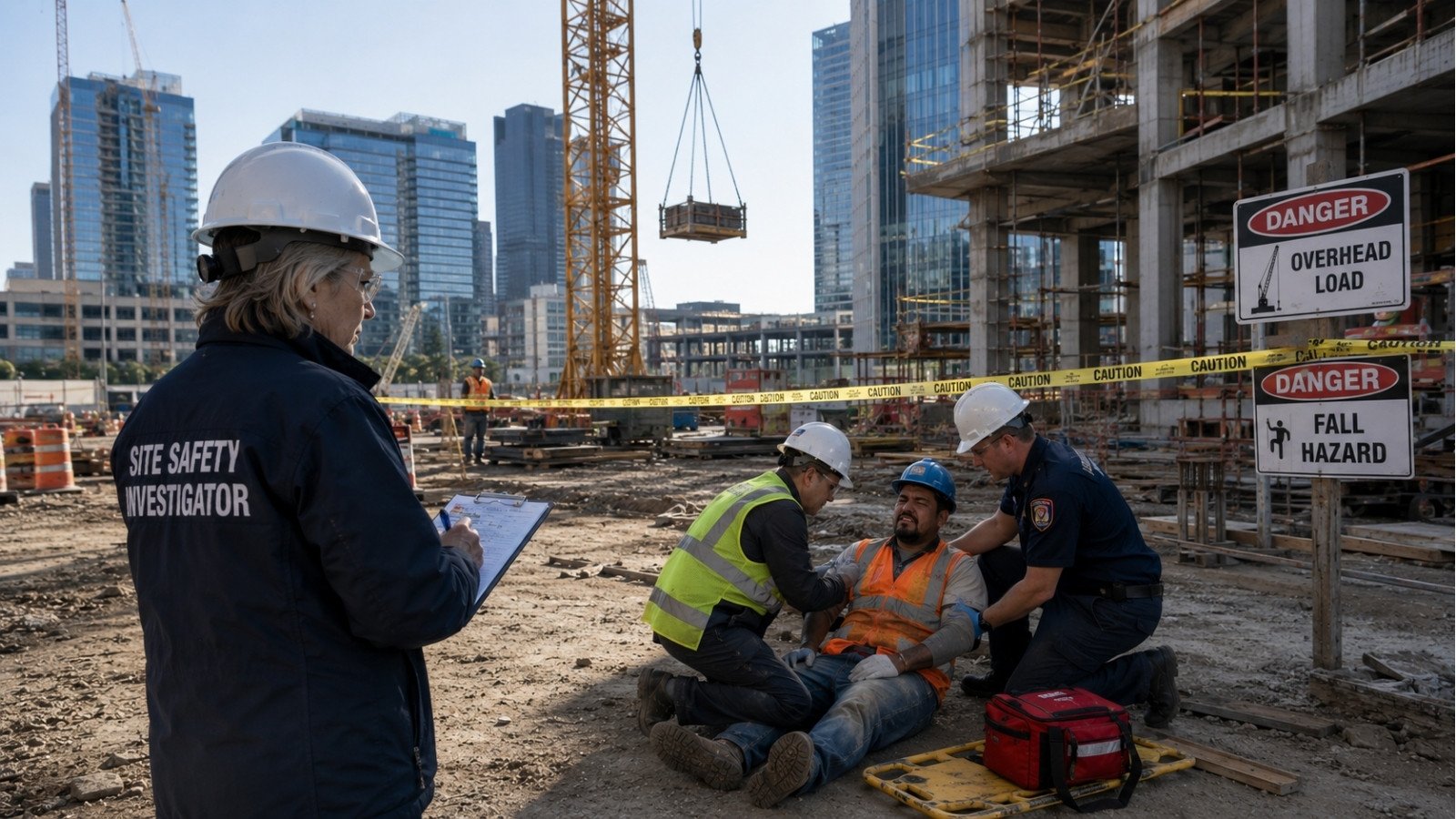
The OSHA “Fatal Four” categories that kill construction workers are well known in the industry. Falls get the most attention. But struck-by incidents, the category covering workers hit by moving equipment, falling loads, swinging crane booms, and overhead debris, represent the second-largest cause of construction fatalities, accounting for roughly eight percent of construction deaths annually. In Houston’s construction market, where cranes operate over active work zones, forklifts move through congested laydown areas, and overhead work proceeds alongside ground-level crews, the struck-by hazard is a daily reality.
What makes struck-by cases legally distinct from most construction injury claims is the number of parties who can bear responsibility for the same incident. A load that falls from a crane and strikes a worker below may involve the crane rental company, the rigging subcontractor, the general contractor whose superintendent approved the lift plan, and the load manufacturer whose packaging or securing method failed. Understanding who bears liability for a struck-by injury requires tracing the chain of responsibility from the equipment back to every party who touched it, owned it, operated it, or was responsible for keeping workers away from its path.
Jonathan Herrera spent over a decade evaluating high-exposure casualty claims as a licensed insurance adjuster, including construction and industrial cases with multi-party liability structures, before becoming an attorney. The struck-by category is one of the most fact-specific and defendant-dense areas of construction injury litigation, and that complexity is precisely where his adjusting background applies.
What “Struck-By” Actually Means Under OSHA’s Framework
OSHA defines the struck-by hazard category broadly enough to encompass four distinct mechanisms, each governed by separate regulatory requirements.
Flying objects. Workers struck by material ejected from tools, equipment, or cutting operations fall under this subcategory. Pneumatic tools that discharge fasteners or fragments, grinding operations that project sparks or pieces, and saws that kick back material all produce flying-object struck-by incidents.
Falling objects. Workers struck by material falling from overhead, whether tools dropped from elevated surfaces, unsecured loads on scaffolding, or materials dislodged from storage, are the most common struck-by mechanism on vertical construction projects. OSHA’s overhead protection requirements under 29 CFR 1926.502(j) require toeboards, screens, guardrails, or canopy structures wherever workers pass beneath overhead work. Workers in areas below elevated work must be protected, and tool lanyards must be used on elevated platforms to prevent drops.
Swing hazards from cranes and equipment. Workers struck by the swing arc of a crane boom, load line, or counterweight, or by the movement of heavy equipment through work areas, represent a separate and uniquely dangerous struck-by mechanism. OSHA’s crane work area control standard at 29 CFR 1926.1424 requires employers to erect barricades or caution lines to prevent employees from entering hazard areas created by the crane’s swing radius, and a separate standard at 29 CFR 1926.1425 addresses personnel clearance from the fall zone during active hoisting operations.
Vehicle and equipment movement within the site. Workers struck by forklifts, dump trucks, concrete mixers, and other vehicles moving within the construction site perimeter fall under OSHA’s general traffic control and equipment operation requirements. This category accounts for a significant share of struck-by fatalities, particularly on large sites where equipment travel routes overlap with pedestrian work areas.
What Happened at Port Arthur LNG: A 2025 Case That Illustrates the Stakes
Shortly before 2 a.m. on April 29, 2025, three workers were killed and two others were injured at the Port Arthur LNG construction project in Sabine Pass, Jefferson County, Texas. In the days immediately following the incident, attorneys representing the victims’ families stated publicly that the evidence including a loose rigging strap observed at the scene suggested a load had failed or fallen from the crane and struck the scaffolding below. Bechtel’s own internal investigation, published in October 2025, identified a different cause: an improperly secured bracket connection in the climbing “tank jump” formwork system, which slipped when the crane operator released the rigging, causing the platform to rotate and sending workers plummeting sixty-five to eighty-five feet.
The project involved Sempra Infrastructure and ConocoPhillips as project owners, Bechtel Global Corporation as the construction contractor, and a crane company called Fagioli Inc. Lawsuits were filed in both Harris County and Jefferson County against multiple entities, and the case entered multidistrict litigation proceedings in Jefferson County.
This incident illustrates precisely why struck-by cases involving crane operations are among the most legally complex in construction litigation. The rigging failure analysis implicates the crane rental company, the rigging sub, the GC’s safety program, and the load’s securing method simultaneously. Each party had a role in either the crane operation, the hazard area control, or the load handling, and each may bear independent responsibility for what occurred.
The Key Legal Question: Who Employed the Equipment Operator?
One of the most consequential threshold questions in a struck-by case is the employment status of the person operating the equipment that caused the injury. The answer determines where the primary liability runs and what insurance policies respond.
When a crane operator is a direct employee of the general contractor, the crane’s operation falls within the GC’s own workforce, and the GC bears vicarious liability for the operator’s negligence in addition to any independent liability for its safety program. When the crane operator is a direct employee of a crane rental company or a specialty subcontractor, the liability analysis shifts to that entity, though the GC may still bear independent liability under the Redinger v. Living, Inc. retained control framework for the conditions on the site.
Establishing employment status requires reviewing several layers of documentation: the contract between the GC and the crane company, the crane rental agreement and its terms on who supplies the operator, the operator’s own employment records and certifications, and site records showing who directed the operator’s activities and gave lift approvals. In large industrial projects like Port Arthur LNG, these layers can involve multiple entities with overlapping contractual relationships, and the party nominally labeled the “crane company” may not actually be the employer of the individual who operated the equipment.
Exclusion Zones and Work Area Control: What They Are and Why Their Failure Creates Liability
OSHA’s crane standard addresses hazard area management through two distinct but related provisions. Under 29 CFR 1926.1424, the work area control standard, employers are required to erect barricades or caution lines to prevent employees from entering the hazard areas created by the crane’s swing radius and the load’s movement path. Where physical barriers are not feasible, warning signs and high-visibility markings must be used, and employees must be trained to understand what those markings mean. Under 29 CFR 1926.1425, the load clearance standard, no employee may be within the fall zone during active hoisting except those performing specific, authorized functions such as guiding the load, unhooking, or receiving a landing load, and only under defined safety conditions.
Work area control and fall zone clearance failures are among the most common contributing factors in fatal struck-by incidents. These failures take several forms: a swing-radius barrier that was never established, a hazard area that was inadequately marked, a zone that was initially established but then compromised as work continued around the lift, or an operator who proceeded with a lift despite knowing workers were within the hazard area.
When a work area control failure is the contributing factor in a struck-by injury, the liability analysis typically runs to the party responsible for establishing and enforcing the barrier. On most commercial projects, that is the general contractor or the prime contractor for the crane operation, not the individual operator alone. A GC’s safety manual that addresses hazard area control, a superintendent who had the authority to stop the lift, or a daily safety inspection that identified the missing barrier and did nothing are all evidence of the level of organizational responsibility for the failure.
Product Liability: When the Equipment Itself Was the Problem
Not every struck-by injury involves human error in operating or managing equipment. Some involve equipment that failed due to a defect in design or manufacture, and in those cases, the path to recovery runs through product liability rather than, or in addition to, standard negligence.
Struck-by product liability claims arise in several specific scenarios.
Rigging and lifting equipment failures. A wire rope that parts under a load below its rated capacity, a rigging hook with a defective latch that fails to retain the load, or a spreader bar with a hidden manufacturing flaw that collapses under stress can all produce load-drop incidents. If the rigging component was defective as manufactured or distributed, the manufacturer and any distributor in the supply chain may bear strict product liability.
Equipment guarding failures. Cranes, forklifts, and heavy equipment have specific guarding and warning system requirements. Equipment that lacks required guards, has defective proximity warning systems, or whose operator visibility was reduced by a design defect may create a product liability claim alongside the operational negligence claim.
Material and product packaging failures. When stacked materials, palletized goods, or secured loads fall because the packaging, banding, or securing method was inadequate for the load, the product manufacturer’s packaging design may be a contributing factor to the falling-object claim.
Under Texas strict product liability doctrine, the injured worker does not need to prove the manufacturer was careless. The defect itself, if shown to have caused the injury, is sufficient to establish liability against the entity that placed the defective product into the stream of commerce.
How OSHA Citation Records Are Obtained and Used in Struck-By Cases
Every serious struck-by injury on a Texas construction site that results in a hospitalization, amputation, or death triggers a mandatory OSHA reporting requirement and typically initiates an inspection. The OSHA inspection record is one of the most valuable sources of evidence in a struck-by case, but accessing and using it requires understanding both its content and its limitations.
The OSHA inspection file for a struck-by incident typically contains the inspector’s photographs and measurements of the scene, witness interviews conducted while events were fresh, a review of the employer’s safety program and training records, documentation of any hazard area barriers or their absence, the inspection of the equipment involved, and, if violations are found, formal citations identifying the specific standard that was not met. OSHA inspection records for a specific employer are publicly searchable through the OSHA online establishment search tool, and full inspection files are obtainable through the legal discovery process.
As with fall protection violations, OSHA citations in struck-by cases are not automatically admissible as proof of negligence in a Texas civil proceeding. However, the factual documentation they contain can be used to support expert testimony on what a compliant site would have looked like and how the responsible party’s conduct fell short. A history of prior struck-by citations for the same employer or GC, documented in OSHA’s public database, is among the most powerful evidence of systemic negligence available in these cases.
The Multi-Party Defendant Structure in Struck-By Claims
The struck-by category produces the most complex multi-defendant structures of any construction injury type, because the equipment involved typically passes through multiple layers of ownership, operation, and control before it reaches the construction site.
A comprehensive struck-by case evaluation examines each of the following parties.
The direct employer of the injured worker. The exclusive remedy limit applies against a subscribing employer; in non-subscriber cases, the employer can be sued directly for ordinary negligence.
The GC or prime contractor. The Redinger retained control analysis applies, combined with the GC’s independent OSHA obligations as the controlling employer on the site, including work area control under 29 CFR 1926.1424.
The crane rental company or equipment lessor. When the party that supplied the equipment is separate from the party that operated it, the rental company’s maintenance obligations, equipment certification records, and supply of a qualified operator all become potential sources of liability.
The rigging subcontractor. Where a specialty sub performed the rigging, that party’s competency, training records, and compliance with OSHA crane rigging standards are all in issue.
The equipment manufacturer. Product liability for defective equipment or components is separate from and independent of any of the above negligence claims.
The material supplier. When the object that struck the worker was supplied by a material company whose packaging or securing method was inadequate for the load, the supplier may bear independent liability.
Each of these parties carries its own insurance coverage. Identifying all of them and preserving the evidence that connects each to the incident is one of the most time-sensitive tasks in a struck-by case, because equipment is returned to service, crane logs are overwritten, and rigging crews move on to other projects within days of a serious incident.
The construction and industrial accident practice at Herrera PLLC approaches struck-by cases with this multi-party framework from day one, understanding that the first preservation demand and the first liability map need to cover every potentially responsible party, not just the most obvious one.
Frequently Asked Questions About Struck-By Construction Injuries in Texas
Who is responsible if I was struck by a crane, forklift, or falling object on a Texas construction site?
Responsibility in struck-by cases can extend to multiple parties simultaneously. The direct employer of the equipment operator may bear vicarious liability for the operator’s negligence. The general contractor may bear independent liability under the Redinger retained control test for site safety conditions and work area control. The crane rental company or equipment lessor may be liable for maintenance failures or supply of an unqualified operator. The equipment manufacturer may bear product liability if a component defect contributed to the incident. Identifying each potentially responsible party requires reviewing the employment structure, the equipment history, and the contractual relationships among every entity on the site.
Can I sue the equipment manufacturer if a defective machine injured me on a Houston construction site?
Yes. Texas product liability doctrine allows a claim against the manufacturer, distributor, or seller of a defective product that caused injury, and this claim can be pursued under a strict liability theory that does not require proving carelessness, only that the product had a defect and that the defect caused the injury. In struck-by cases, defective rigging hardware, equipment with failed guarding systems, and improperly rated lifting components are the most common sources of product liability claims. This claim exists independently of any negligence claims against the operator, the GC, or the employer.
What OSHA regulations apply to struck-by hazards on Texas construction sites and how do violations help my case?
The primary OSHA regulations governing struck-by hazards are found in 29 CFR Part 1926. The crane work area control standard at 29 CFR 1926.1424 requires employers to erect barriers or markings preventing employees from entering hazard areas created by the crane’s swing radius and load path. Section 1926.1425 separately governs personnel clearance from the fall zone during active hoisting operations. The overhead protection requirements at 29 CFR 1926.502(j) govern protection from falling objects. OSHA violations in these categories document that a specific regulatory standard was not met, and while citations are not automatically admitted as proof of negligence in Texas civil proceedings, the documented facts they contain can support expert testimony and establish a pattern of prior notice of the hazard.
What is an “exclusion zone” and what happens legally if a general contractor fails to maintain one on a Texas site?
A crane hazard area or exclusion zone is the area around a crane’s swing radius and load path where personnel are prohibited from entering during operations. Under 29 CFR 1926.1424, employers must erect physical barriers or use warning signs and high-visibility markings to prevent employees from entering these areas. Section 1926.1425 further requires that no employee be within the fall zone during active hoisting except those performing specific authorized functions. When a GC fails to establish, mark, or enforce these hazard areas and a worker in an unprotected area is struck, the GC’s failure to exercise its site safety control directly implicates its liability under the retained control test established in Redinger v. Living, Inc. OSHA’s multi-employer citation policy also allows the GC to be cited as the controlling employer for this failure even when the exposed worker was employed by a subcontractor.
How long do I have to file a lawsuit after being struck by equipment on a Texas construction site?
Texas imposes a two-year statute of limitations on personal injury claims from the date of injury under Texas Civil Practice and Remedies Code Section 16.003. For wrongful death claims arising from a fatal struck-by incident, the two-year period runs from the date of death. Claims against government entities on public construction projects may require shorter written notice periods, sometimes six months, as a prerequisite to suit. As a practical matter, the evidence preservation window in struck-by cases is significantly shorter than the legal filing deadline, because equipment returns to service, crane logs cycle, and site configurations change within days of a serious incident.
The Evidence Disappears Faster Than the Filing Deadline
Texas’s two-year statute of limitations exists on paper. The actual window for preserving the evidence needed to support a strong struck-by case is measured in days and weeks. Crane logs, load tickets, rigging inspection records, equipment maintenance files, lift plan approvals, and the physical condition of the equipment and rigging components are all at risk from the moment a serious incident occurs. An early formal preservation demand sent to every potentially responsible party creates a documented legal obligation to retain all of this evidence.
For anyone seriously injured in a struck-by incident on a Texas construction site, or for families who lost someone in a fatal struck-by accident, speaking with an attorney who understands the multi-party liability structure and the evidence timeline specific to this type of case is the most time-sensitive step available.
Jonathan Herrera, J.D. is a Houston-based attorney who represents seriously injured Texans, including construction workers and their families, in personal injury and civil litigation matters across the state. Before practicing law, he spent over a decade as a licensed insurance adjuster managing high-exposure casualty claims, including construction and industrial cases, for carriers and third-party administrators across multiple states. He is the founder of Herrera PLLC and a member of the Texas Trial Lawyers Association and the American Association for Justice.