
Falls From Heights on Texas Construction Sites: The Law, the Liability, and Your Rights

A fall from a scaffold, roof, or elevated platform on a Houston construction site changes everything in an instant. What happens after, medically, financially, and legally, depends on a set of overlapping rules that most injured workers are never told about until it’s too late to make use of them.
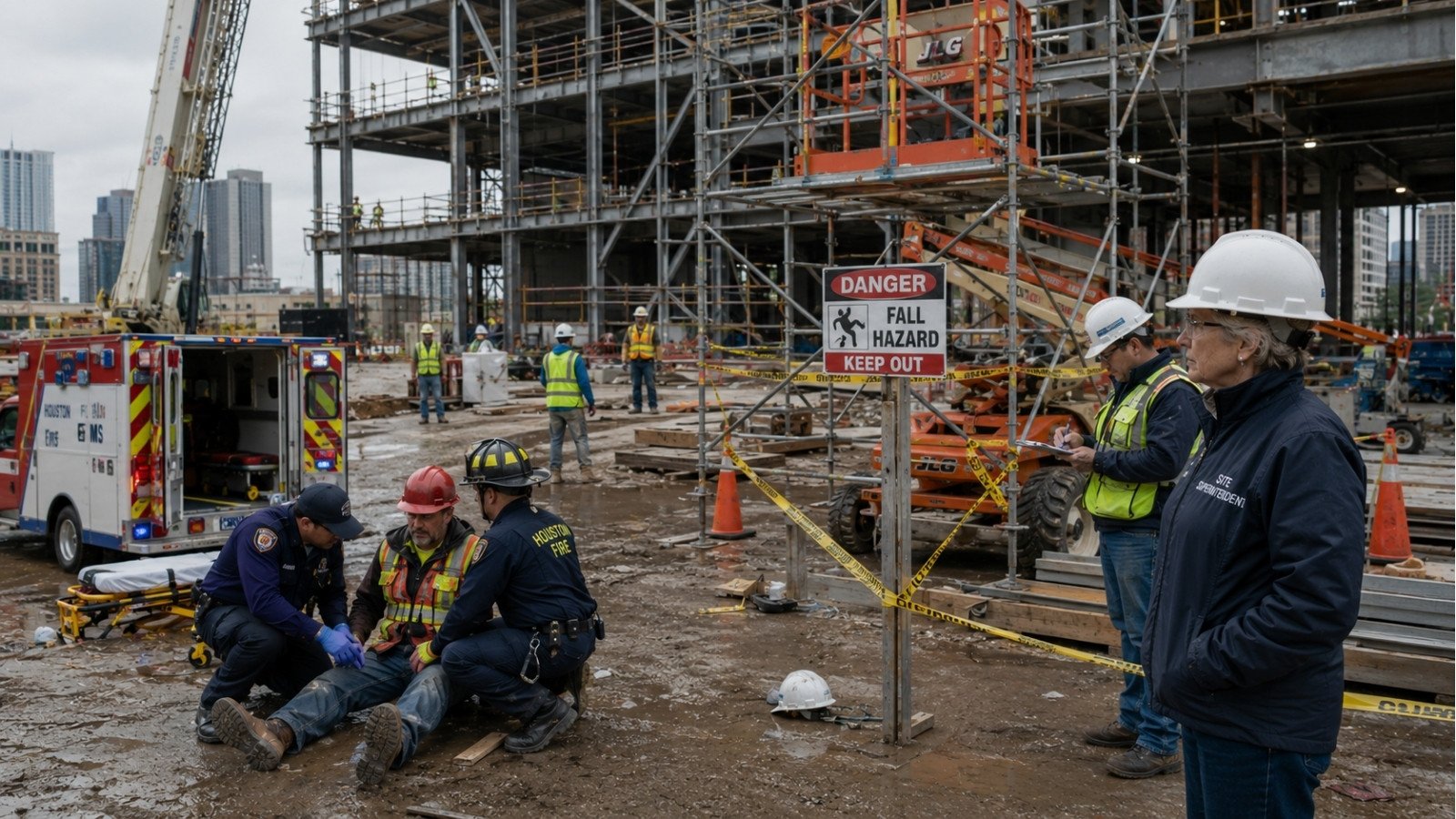
Falls are the leading cause of serious injury and death in construction, accounting for more than one in three fatal construction accidents nationally. On Houston job sites specifically, the combination of the city’s intense construction pace, multi-story commercial and industrial projects, and the constant pressure to meet deadlines creates exactly the conditions where fall protection gets treated as secondary to schedule. When that results in a serious injury, the question is not just who is responsible; it is which of multiple parties on the site bear that responsibility, and how the legal system allows an injured worker to pursue each of them.
What OSHA’s Fall Protection Standard Actually Requires
The federal standard governing fall protection on construction sites is 29 CFR Part 1926, Subpart M, administered by the Occupational Safety and Health Administration. Understanding what this standard actually requires, not a general summary, but the specific obligations, is the foundation for understanding when a fall was preventable and who failed to prevent it.
The general six-foot threshold. Under 29 CFR 1926.501, employers must provide fall protection for any construction worker exposed to a fall of six feet or more above a lower level. This applies to unprotected sides and edges, leading edges, hoist areas, excavations, dangerous equipment, and roofing work. Three compliant systems are recognised: guardrail systems, safety net systems, and personal fall arrest systems. These are not interchangeable preferences; they are specific, regulated systems with their own performance standards set out in 29 CFR 1926.502.
The scaffolding exception. Falls from scaffolding are governed by a separate and distinct standard: 29 CFR 1926.451, Subpart L. The trigger height for scaffolding fall protection is ten feet, not six. This means a worker on a scaffold platform less than ten feet above the lower level is not automatically entitled to fall protection under Subpart L, though the general site conditions and the specific task being performed may trigger additional protections under Subpart M. Scaffolding under 29 CFR 1926.451 is among the most frequently cited OSHA standards; weight capacity overloading, improper plank installation, inadequate base support, and missing guardrails are the most common violation patterns on Houston job sites.
Steel erection. For steel erection work, the threshold is fifteen feet under 29 CFR 1926.760, Subpart R. Connectors must be protected at thirty feet or two stories, whichever is less. This is a distinct standard that applies to structural steel assembly and reflects the specific conditions of that work environment.
Roofing work distinctions. For low-slope roofs (four in twelve pitch or less), OSHA permits a combination of warning line systems with personal fall arrest systems, guardrails, or safety nets. On smaller low-slope roofs fifty feet or less in width, a safety monitoring system alone may satisfy the standard. For steep-slope roofs (greater than four in twelve), only guardrails with toeboards, safety nets, or personal fall arrest systems are permitted. Warning line or safety monitor approaches alone are not sufficient.
Training requirements. 29 CFR 1926.503 requires employers to provide fall protection training to every employee who may be exposed to fall hazards, before that exposure occurs. The training must enable the employee to recognise fall hazards and understand the procedures and systems used to address them. A worker who was sent to elevated work without adequate training is a worker whose employer may have violated the training standard before the physical fall protection violation even occurred.
The Most Common Causes of Elevated Falls on Houston Construction Sites
Understanding how falls happen is directly connected to identifying who is legally responsible for them. The physical mechanism of the fall determines which regulatory standard applies and which party on the site had the obligation to prevent it.
Scaffolding failures. Scaffolding-related falls occur in several distinct ways: the scaffold itself collapses due to structural failure or overloading; a plank is missing, improperly installed, or fails under load; guardrails are absent, inadequate, or removed and not replaced; or the scaffold base is improperly positioned on Houston’s unstable clay soil, causing the entire structure to shift or tip. Each failure type potentially implicates a different responsible party: the entity that erected the scaffold, the entity that modified it, or the GC that was monitoring the site, or the equipment manufacturer if a component was defective.
Roof and leading edge falls. Workers on rooflines and leading edges without guardrails, personal fall arrest systems, or compliant warning line systems represent violations of Subpart M’s most basic requirements. These falls are often the result of a deliberate decision by someone with site authority, such as a foreman, a superintendent, or a GC’s safety officer, to proceed with work at height without compliant protection in place.
Floor and opening falls. Floor openings, wall openings, and skylight openings on construction sites must be covered, and the covers must be capable of supporting twice the maximum intended load and secured against displacement. A worker who falls through an unguarded floor opening, an uncovered elevator shaft, or an unmarked skylight fell through a violation of 29 CFR 1926.502(i). The question is always who was responsible for maintaining that cover.
Ladder incidents. Falls from ladders are governed under Subpart X. Ladders must be inspected before use, must be used at a proper angle, and must extend at least three feet above the landing surface when used to access a higher level. A ladder that shifts because it was improperly footed, collapses because it was defective, or slides because it was not secured represents a failure that may involve the employer, a co-worker who set the ladder, or the manufacturer.
Aerial lift and man-basket incidents. Workers in scissor lifts, boom lifts, and man-baskets are required to wear personal fall arrest systems tied off to the designated anchor point within the lift. A worker ejected from an aerial lift because the ground surface was uneven, the lift was operated improperly, or the equipment was defective has a claim that may extend to the lift rental company, the GC responsible for the work area conditions, or the operator’s employer.
Who Bears Legal Responsibility After a Fall?
A fall on a Houston construction site rarely has a single responsible party. The legal analysis tracks the physical facts: who had the obligation to provide fall protection for this specific worker on this specific task, and what did each party on the site do or fail to do?
The direct employer. The most immediate obligation to provide fall protection under OSHA’s standards runs to the direct employer. A subcontractor whose crew was working at height without compliant fall protection has violated its own regulatory obligations, and that violation may support a civil negligence claim. In subscriber cases, the workers’ comp exclusive remedy limits the direct claim against the employer; in non-subscriber cases, the worker can sue the employer directly for ordinary negligence.
The general contractor. Under the Redinger v. Living, Inc. retained control test, a GC that exercises supervisory control over a sub’s work may be directly liable for the sub’s employees’ injuries. In fall cases specifically, a GC that implemented and enforced a site-wide fall protection program, that directed the sequence or timing of elevated work, or whose superintendent observed unsafe elevated work without intervention may meet the control test. The GC’s own OSHA obligations are also relevant: OSHA’s multi-employer citation policy recognises that a controlling employer, meaning the entity responsible for overall site safety, can be cited for fall protection violations even when the exposed workers are employed by a sub.
Equipment manufacturers and rental companies. When the fall occurred because the equipment itself failed, such as a scaffold component with a hidden defect, a harness that separated under load, or a lift that malfunctioned, the manufacturer and any equipment rental company may bear product liability. Product liability in Texas does not require proof of negligence; under the doctrine of strict liability for product defects, a product that fails due to a manufacturing or design defect makes the manufacturer liable regardless of whether they were careless.
Property owners and the Chapter 95 standard. A property owner’s liability to contractor and subcontractor employees is governed by Texas Civil Practice and Remedies Code Chapter 95, not merely by the general Redinger retained control test. Under Section 95.003, a property owner is not liable for personal injury or death to a contractor’s or subcontractor’s employee unless two conditions are both met: first, the property owner exercises or retains some control over the manner in which the work is performed, beyond merely the right to order work to start or stop or to inspect progress or receive reports; and second, the property owner had actual knowledge of the specific danger or condition that caused the injury, and failed to adequately warn. This is a more demanding standard than the general retained control test. An injured worker cannot succeed against a property owner under Chapter 95 by showing the owner should have known about the hazard. Actual, subjective knowledge of the specific condition must be established. Understanding whether and how Chapter 95 applies to a specific fall requires careful analysis of the owner’s role on the project, the contractual structure, and what the owner actually knew.
How OSHA Records Strengthen a Civil Claim
An OSHA inspection following a serious fall generates a documentary record that, while not automatically admissible as proof of negligence in a Texas civil lawsuit, provides a factual foundation that a skilled attorney can use throughout the litigation.
The OSHA investigation file typically contains photographs of the scene taken shortly after the incident, witness statements obtained while memories are fresh, measurements and documentation of the physical conditions, the investigating officer’s factual findings about what standard was not met, and, if a citation is issued, a formal regulatory determination that a specific violation existed. Each of these elements is potentially obtainable through the discovery process, and each can support expert testimony about what a compliant, reasonably safe site would have looked like and how the defendant’s conduct fell short of that standard.
A pattern of OSHA violations by the same employer or GC, documented in OSHA’s online inspection and citation database, is particularly valuable. A company with repeat fall protection citations in the years before a serious injury is a company with documented notice of the hazard. That documented notice goes directly to the question of whether the dangerous condition was a known risk that the responsible party chose not to address.
What an Injured Worker Can Recover
A fall from height that causes a serious injury, such as spinal cord damage, traumatic brain injury, or fractures requiring surgery, or any injury that affects a worker’s ability to return to their trade, carries damages that workers’ compensation alone cannot address.
Workers’ comp provides medical treatment and a portion of lost wages during recovery. It does not pay for pain and suffering, mental anguish, loss of earning capacity over a full working lifetime, or the full economic impact of a permanent disability. A third-party personal injury lawsuit against the GC, another sub, or an equipment manufacturer opens access to all of those categories, stacked on top of whatever workers’ comp provides.
For families who have lost someone in a fatal fall, the wrongful death framework applies: the surviving spouse, children, and parents may bring claims for lost earning capacity, loss of companionship, mental anguish, and funeral expenses, with exemplary damages available where gross negligence is established, subject to the constitutional limitation on parents recovering exemplary damages under Article XVI, Section 26 of the Texas Constitution.
The construction and industrial accident practice at Herrera PLLC approaches fall cases with the understanding that the OSHA record, the GC’s site control, the scaffolding and equipment history, and the worker’s employment classification all need to be evaluated simultaneously rather than in sequence. These cases are built from the ground up, with evidence gathered first.
Frequently Asked Questions About Construction Falls in Texas
What fall protection is legally required on Texas construction sites?
Federal OSHA standards under 29 CFR Part 1926 govern fall protection on all Texas construction sites. The general threshold is six feet: for most construction activities, any worker exposed to a fall of six feet or more above a lower level must be protected by a guardrail system, safety net system, or personal fall arrest system. Scaffolding falls under a separate standard that requires protection at ten feet under 29 CFR 1926.451. Steel erection requires protection at fifteen feet under 29 CFR 1926.760. Employers must also provide fall protection training to every employee who may be exposed to fall hazards before that exposure occurs.
Who can be held responsible after a scaffolding or roof fall in Texas?
Multiple parties can bear legal responsibility simultaneously. The direct employer has the primary OSHA obligation to provide fall protection. The general contractor may be liable under the Redinger retained control test if it exercised supervisory control over the conditions that caused the fall. Equipment manufacturers and rental companies may bear product liability if the scaffolding, harness, or lift equipment failed due to a defect. Property owners may bear liability under Texas Civil Practice and Remedies Code Chapter 95, which requires proof of both retained control and the owner’s actual knowledge of the specific dangerous condition. Texas’s proportionate responsibility framework allows fault to be allocated among all responsible parties.
Can I file a lawsuit if I was injured in a fall from height on a Houston construction site?
Yes, in most cases. Workers’ compensation, when available, is the exclusive remedy against the direct employer. It does not bar claims against any other party on the site. Third-party claims against the general contractor, other subcontractors, equipment manufacturers, and property owners are fully available regardless of workers’ comp coverage. If the direct employer is a non-subscriber, the worker can also sue the employer directly for ordinary negligence. For workers killed in a fall, surviving family members can pursue wrongful death claims independently of workers’ compensation.
How do OSHA fall protection violations affect a Texas injury claim?
OSHA violations create a documentary record of the specific regulatory standard that was not met and document the site conditions. While OSHA citations are not automatically admitted as proof of negligence in Texas civil proceedings, the underlying facts they document can be obtained through discovery and can support expert testimony on what a compliant, reasonably safe site would have required. A pattern of prior fall protection citations by the same company is particularly valuable evidence that the responsible party had documented notice of the hazard and failed to correct it.
What evidence should I collect after a construction fall accident in Texas?
The most important categories of evidence in a construction fall case include photographs of the exact location of the fall, the condition of any fall protection equipment that was or was not in place, the scaffold or elevated surface from which the fall occurred, and any equipment involved. Witness contact information from co-workers and bystanders present at the time of the incident is also critical, since memories fade quickly and witnesses become difficult to locate once a project moves on. The OSHA investigation file, which typically includes the agency’s own photographs, witness statements, and factual findings, is obtainable through the legal process and often provides evidence that would be difficult to reconstruct independently. An early legal preservation demand to the employer, the GC, and any equipment company ensures that relevant records, maintenance logs, and electronic data are not lost to routine document management before they can be obtained through discovery.
The Scale of the Problem in Houston
According to CCR-Mag’s analysis of fatal construction accidents on Houston job sites, Houston is one of the busiest construction markets in the United States, with active projects across the Energy Corridor, the Medical Center, and the Port of Houston keeping thousands of workers on sites every day. Texas consistently ranks among the states with the most construction deaths, and many of these fatalities involve falls that OSHA investigations later find could have been prevented by fall protection that was required but not provided.
The legal framework that governs these cases is complex, but the underlying principle is straightforward: every worker on an elevated surface on a Houston construction site is entitled to the specific fall protection the law requires for that surface, that height, and that task. When that protection is not in place and a worker falls, the question is who failed to provide it, and Texas law provides a mechanism to hold every responsible party accountable.
For anyone who has sustained a serious fall injury on a Texas construction site, or for families who have lost someone in a fatal construction fall, speaking with an attorney who understands both the regulatory framework and the multi-party liability structure of Houston construction cases is the first step toward understanding the full scope of what recovery is available.
Jonathan Herrera, J.D. is a Houston-based attorney who represents seriously injured Texans, including construction workers and their families, in personal injury and civil litigation matters across the state. Before practicing law, he spent over a decade as a licensed insurance adjuster managing high-exposure casualty claims, including construction and industrial cases, for carriers and third-party administrators across multiple states. He is the founder of Herrera PLLC and a member of the Texas Trial Lawyers Association and the American Association for Justice.