

Third-Party Claims for Injured Texas Workers: When Workers’ Comp Isn’t Your Only Option

When a worker is seriously hurt on the job in Texas, the conversation usually starts and ends with workers’ compensation. A supervisor mentions it, a human resources representative hands over paperwork, and the injured person assumes that is the whole picture. Sometimes it is. But workplaces are crowded with people other than the employer: general contractors, subcontractors, equipment manufacturers, property owners, and trucking companies. When one of them contributes to an injury, the legal picture can be larger than a single claim.
In short: when an employer carries workers’ compensation, comp benefits are generally the worker’s exclusive remedy against that employer, but Texas law allows the worker to also seek damages from a third party whose negligence or defective product contributed to the injury. When an employer is a non-subscriber and carries no comp coverage, different rules apply.
I spent over a decade as an insurance adjuster before becoming an attorney, handling complex casualty and property claims, including catastrophic injuries, industrial accidents, and construction matters. I later practiced insurance defense, and I now represent injured people through Herrera PLLC. This article explains, in general terms, why workers’ compensation is not always the only path to recovery and what injured Texas workers may want to understand about their options.
Why Workers’ Compensation Is Not Always the Only Path to Recovery
Workers’ compensation is a system designed to address workplace injuries between an employee and an employer. The Texas Department of Insurance publishes information for injured employees and a consumer guide to workers’ compensation, and workers can review those resources directly to understand how the system works. Benefits under that system are addressed in Chapter 408 of the Texas Labor Code. Under Section 408.001, when an employer has coverage, comp benefits are the exclusive remedy of the covered employee against the employer and its employees, with a narrow exception allowing a surviving spouse or heirs to seek exemplary damages when a death results from the employer’s intentional act or gross negligence.
TDI’s materials also describe deadlines that apply inside the system itself. In general, an injured worker must report the injury to the employer within 30 days of the injury or of learning it may be work-related, and must file a claim with the Division of Workers’ Compensation within one year, subject to limited exceptions. Because missing those deadlines can affect benefits, they are worth confirming for any particular situation.
The question many injured workers never hear is whether anyone besides the employer may have contributed to the injury. That is where a third-party claim comes in. A third-party claim is a claim against a person or company other than your employer, based on that party’s own negligence or defective product.
Serious workplace injuries often involve more than one responsible party. A construction fall might involve a scaffolding company, a general contractor, and a property owner. A refinery incident might involve an equipment supplier or a contractor working beside the injured person’s own crew. Cases like these frequently involve complex liability questions, multiple potentially responsible parties, and significant workers’ compensation intersections that require understanding both the insurance and legal dimensions at the same time.
That last point is where my background is most relevant. When a worker is hurt, several insurance policies may be in play: the employer’s coverage, the policies of other contractors, and the policies of property owners. Having spent years on the carrier side, I know how those layers can interact and why a claim that looks simple from the outside may be anything but.
If you want a broader overview of how Herrera PLLC approaches these matters, see our work injury lawyer page.
Non-Subscriber Employers: A Uniquely Texas Situation
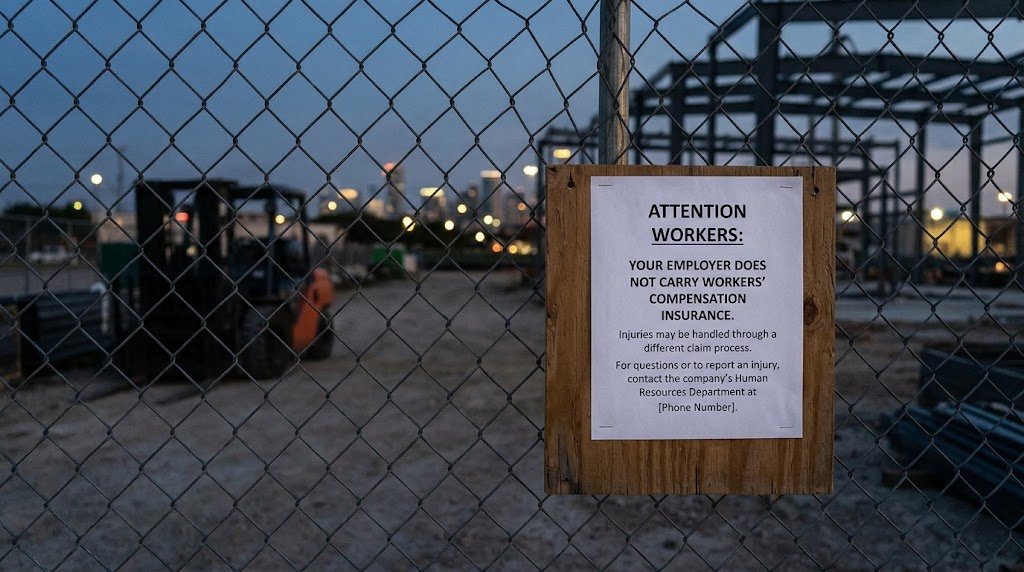
Many people are surprised to learn that workers’ compensation is not the same for every Texas employer. Texas is unusual in allowing most private employers to choose whether to participate in the system. A non-subscriber employer is one that does not subscribe to workers’ compensation, which means it does not carry coverage through that system. Texas Labor Code Chapter 406 addresses non-subscriber employers, and Section 406.002 is available on the Texas Legislature’s website for readers who want to review the statutory language themselves. The Texas Department of Insurance also maintains a page on non-subscribers.
Why does this matter to an injured worker? Because the legal route after an injury looks different depending on whether the employer carries workers’ compensation coverage. A worker who assumes there is a comp claim waiting may find that the employer does not participate in the system at all. In that situation, the worker may be able to bring a negligence claim against the employer. Under Labor Code Section 406.033, a non-subscriber generally cannot defend such a claim by arguing that the employee was contributorily negligent, that the employee assumed the risk, or that a fellow employee’s negligence caused the injury, although the worker still has to prove the employer’s negligence, and the employer may raise certain other defenses, such as an intentional self-inflicted injury or intoxication. Texas law also restricts agreements that waive this right before an injury occurs, and some non-subscribers use injury benefit plans or arbitration agreements, which can affect how a claim proceeds. How the law applies to a particular non-subscriber situation depends on the employer, the facts, and the governing statutes, and that is a question an attorney can evaluate once the details are known.
It is also worth knowing that a worker does not always know their employer’s status, and finding out early, ideally in writing, can matter. Our article on Houston construction site injuries beyond workers’ comp looks at how this plays out for construction workers specifically.
Third-Party Claims Against Contractors, Equipment Makers, and Property Owners
If a party other than the employer helped cause the injury, a third-party claim may be worth examining. These are the categories that come up most often in Houston-area workplace cases.
Contractors and subcontractors. Large job sites rarely belong to a single company. A general contractor, several subcontractors, and specialty crews may all be working at once, and one company’s negligence can injure another company’s employee. Our page on construction and industrial accident cases describes injuries such as falls from heights, scaffolding collapses, equipment failures, and electrocutions, which frequently involve more than one potentially responsible party.
Equipment and product manufacturers. When a machine, tool, or safety device fails because of a defect, the manufacturer or another company in the chain of distribution may be a potential defendant. Product defect cases are part of the firm’s serious injury practice, and our page on product defect injury claims explains how those cases work.
Property owners and premises. Workers are often injured on property controlled by someone other than their employer. Depending on the facts, unsafe conditions on that property may support a claim. Texas law, however, limits a property owner’s liability to a contractor’s employee in some situations. Under Chapter 95 of the Civil Practice and Remedies Code, when the employee was injured while constructing, repairing, renovating, or modifying an improvement to real property, the owner is generally liable only if it exercised or retained some control over the manner in which the work was performed and had actual knowledge of the danger. That standard can be a significant hurdle in construction and refinery cases, which is one reason the facts about who controlled the work matter. See our page on premises liability and slip and fall cases.
Industrial and oilfield settings. Houston is the center of the American energy industry, and oilfield and refinery incidents can involve burns, explosions, toxic exposures, and crush injuries at facilities from Houston through Texas City and along the Gulf Coast. Many companies work at those sites, and they often have different insurers. My adjusting background included industrial claims, so I understand how those companies and their carriers assess liability and manage high-exposure incidents. Our page on oilfield accident cases and our article on what to do if you are injured in a Texas oilfield accident provide more detail.
Everyday workplace hazards. Falls from ladders and roofs are another frequent source of serious injury, and those cases can involve parties beyond the employer as well. Our article on Texas ladder fall and roofing accident claims discusses this area.
Whether a third-party claim exists in a given situation depends on who controlled the site, who owned or supplied the equipment, what caused the injury, and what the evidence shows. Not every workplace injury has a viable third party, and an honest evaluation includes saying so when that is the case.
What Workers’ Comp Covers and What It Leaves Out
Workers’ compensation addresses workplace injuries within its own framework, and the details of its benefits and procedures are set out in Texas Labor Code Chapter 408 and in the Texas Department of Insurance materials linked above. Because those details are specific, injured workers are best served by reading the official sources or speaking with a qualified professional about their own situation rather than relying on general summaries.
What can be said in general terms is that a comp claim and a claim against a third party are different legal actions. They proceed against different parties, under different rules. Comp is designed to provide benefits without regard to fault, while a civil claim against a third party generally requires proof that the third party was negligent or sold a defective product. The kinds of damages that a civil claim may involve under Texas law include medical bills, lost wages, and pain and suffering, and in appropriate cases punitive damages. Whether those categories are available, and in what amounts, depends on the facts of the case and the nature of the claim. Nothing here should be read as a promise of any particular recovery.
Workers who have suffered the most serious injuries often discover that the full effect of the injury reaches well beyond the first few weeks. Brain injuries, spinal cord injuries, burns, and amputations can bring permanent disability, lifetime medical needs, and lost earning capacity. When the stakes are that high, understanding every possible source of recovery matters.
Can You Pursue Both a Comp Claim and a Third-Party Claim?
This is probably the question I hear most often, and the short answer is that Texas law generally allows both. Section 417.001 of the Labor Code provides that an employee, or the legal beneficiary of a deceased employee, may seek damages from a third party who is liable for a compensable injury or death, and may also pursue a workers’ compensation claim.
The complication is how the two interact. A workers’ compensation carrier that has paid benefits generally has a right to be reimbursed out of a worker’s recovery from a third party, which is often called a subrogation interest or lien, and the rules in Chapter 417 govern how that reimbursement works. Defendants in a third-party case may also try to assign some of the fault to the employer, which can affect both the worker’s recovery and the carrier’s reimbursement interest. The details are technical and depend on the facts, the parties, and the governing law, so I do not think it is responsible to offer more than a general outline in an article.
What I can say is that an injured worker generally does not have to choose blindly. Evaluating the options together, before decisions are made or documents are signed, allows each path to be weighed against the other. That is a significant part of why the first consultation matters.
Time limits are another reason not to wait. Texas generally imposes a two-year statute of limitations from the date of injury for most personal injury cases. For wrongful death cases, the period is two years from the date of death. Claims against government entities, including cities, counties, and state agencies, require written notice within six months. The workers’ compensation system has its own, shorter deadlines, including the 30-day report to the employer and the one-year claim filing period described above. Different types of claims can carry different timelines, so an attorney should review the specific deadlines that apply to your situation.
Fault matters too. In an ordinary third-party negligence case, Texas’s modified comparative negligence rule allows an injured person to recover damages even if they share some of the fault, provided they are not more than 50% responsible. The recovery is reduced by the percentage of fault assigned to them. In my experience, insurance companies actively use this rule to shift blame onto injured people, which is one reason the early documentation of what happened is so important. Claims against a non-subscriber employer follow the different rules described above.
Sadly, some workplace incidents are fatal. Families who have lost a loved one may have legal options of their own, including, depending on the facts, a claim against third parties and, in certain cases, a claim for exemplary damages against the employer. Our page on wrongful death cases and our article on Texas construction site wrongful death claims discuss that situation.
Choosing the Right Legal Strategy After a Serious Workplace Injury

There is no single correct strategy for every injured worker, and any article that claims otherwise should be treated with caution. What tends to matter is a clear understanding of the facts:
- Who employed the worker, and whether that employer participates in the workers’ compensation system.
- Who else was involved at the site, including contractors, subcontractors, property owners, and equipment suppliers.
- What caused the injury, including any equipment failure, unsafe condition, or breach of safety practices.
- What evidence exists, such as incident reports, photographs, witness accounts, and medical records.
- How serious and lasting the injury is, since that shapes what is at stake.
At Herrera PLLC, the process begins with a free, confidential consultation that carries no obligation to sign. I give an honest assessment of the case, including whether hiring an attorney is necessary at all. If a case moves forward, investigation begins right away: visiting the scene, interviewing witnesses while memories are fresh, obtaining records, and consulting experts where necessary. Every case is prepared for trial from day one, because insurers evaluate claims differently when they know the attorney is ready to go before a jury.
Frequently Asked Questions
What is a non-subscriber employer in Texas?
A non-subscriber employer is an employer that does not subscribe to the Texas workers’ compensation system. Chapter 406 of the Texas Labor Code addresses these employers, and the Texas Department of Insurance has a page on the topic. A worker injured on the job may be able to bring a negligence claim against a non-subscriber employer, and Section 406.033 limits certain defenses the employer can raise, but the worker must still prove the employer’s negligence. How the law applies to a particular claim depends on the facts.
Can I sue someone other than my employer after a work injury?
Depending on the facts, you may have a claim against a party other than your employer if that party’s negligence or defective product contributed to your injury. Examples include contractors, equipment manufacturers, and property owners, although Texas law, including Chapter 95 of the Civil Practice and Remedies Code, limits owner liability in some construction-related situations. An attorney can evaluate whether such a claim exists in your situation.
What does workers’ compensation not cover?
Workers’ compensation has its own framework of benefits and rules, described in Texas Labor Code Chapter 408 and in the Texas Department of Insurance’s consumer materials. For a covered worker, comp is generally the exclusive remedy against the employer, which means the benefits do not include the broader categories of damages available in a civil claim, such as pain and suffering. A separate civil claim against a third party is a different legal action with its own rules and potential damages. Reviewing both together can help an injured worker understand the full picture.
Can I pursue a comp claim and a third-party claim at the same time?
Texas law generally allows both under Labor Code Section 417.001, although the comp carrier may have a right to reimbursement from a third-party recovery, and how the two claims interact depends on the facts. Rather than assuming one path excludes the other, speak with an attorney before making decisions or signing documents, so the options can be evaluated together. The workers’ compensation system also has its own deadlines, including reporting the injury to the employer within 30 days and filing a claim within one year.
How do I know which legal options apply to my injury?
The answer turns on who employed you, whether that employer participates in the workers’ compensation system, who else was involved at the site, and what caused the injury. If a worker has died, a surviving spouse or heirs may have additional options. A free consultation with an attorney can help sort through those questions.
This article is for general educational purposes and is not legal advice or a substitute for advice about a specific situation. Workplace injury claims depend on the circumstances of the accident, the nature of the injuries, the available documentation, and the applicable laws and insurance coverage. Injured workers and their families are welcome to call Herrera PLLC at 832-891-3210, email jherrera@jh-lawpllc.com, or reach out through the contact page to schedule a free, confidential consultation.
Jonathan Herrera, J.D.
Jonathan Herrera is the founder of Herrera PLLC in Houston, Texas. He spent more than a decade working as an insurance adjuster, founded JH Claims LLC, and practiced insurance defense at Rymer, Echols, and Nelson-Archer before opening his own firm representing injury victims, policyholders, and businesses.