
Construction Zone Accidents on Texas Highways: Who’s Liable When Work Zones Turn Dangerous

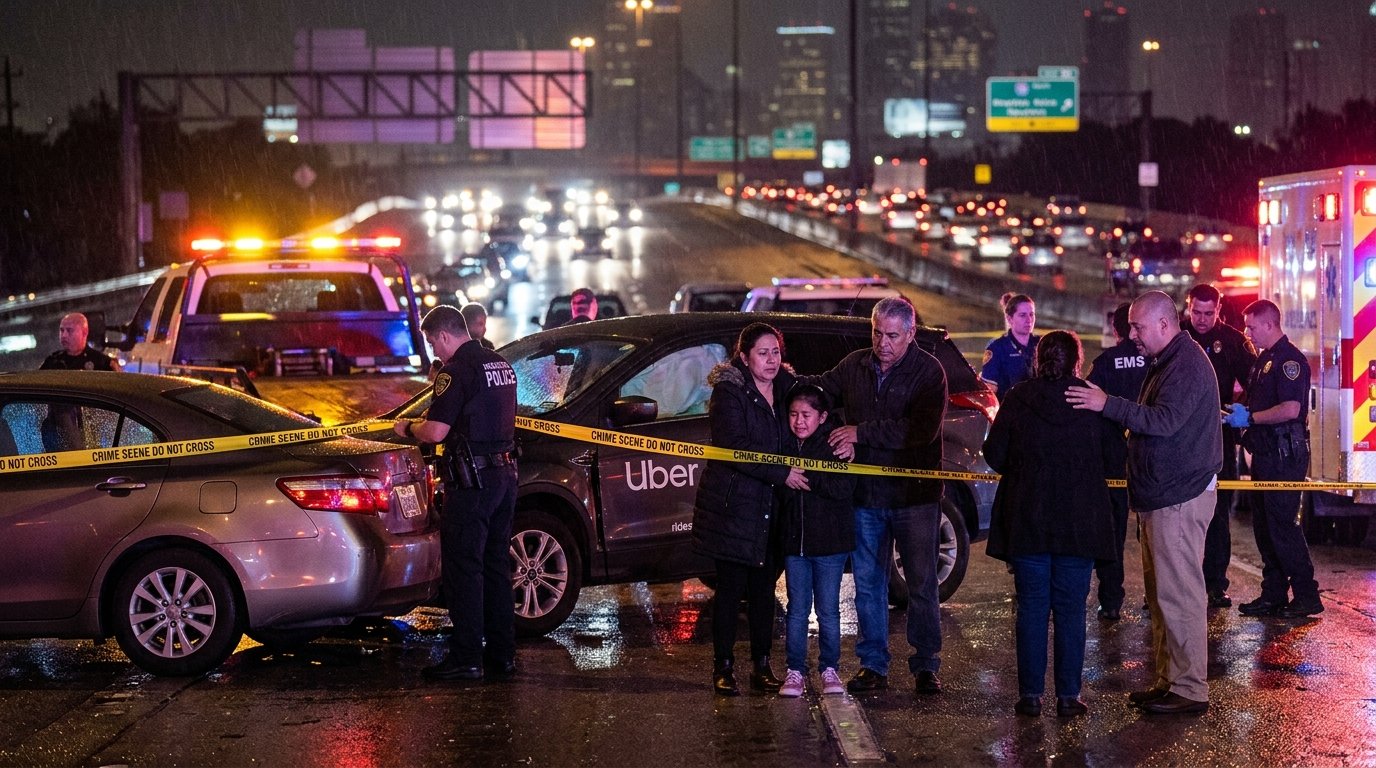
If you have driven I-10, I-45, or Highway 288 in the Houston area, you know the routine. Lanes shift, concrete barriers appear overnight, speed limits drop, and a once-familiar commute becomes an obstacle course. Highway construction is a permanent part of life in one of the fastest-growing regions in the country. It is also the setting for some of the most legally complicated crashes a driver or worker can be involved in.
I spent more than a decade as an insurance adjuster handling high-exposure casualty claims before I became an attorney. Construction-related losses were a regular part of that work. From the carrier’s side of the table, I saw how many parties can be involved in a single project and how quickly each one points at the others when something goes wrong. A work zone crash is rarely a simple two-car collision. Understanding who may be responsible starts with understanding how these projects are structured.
This article is general information about how work zone accidents and liability questions can work in Texas. It is not legal advice, and every crash turns on its own facts.
Why Work Zones Carry Elevated Accident Risk
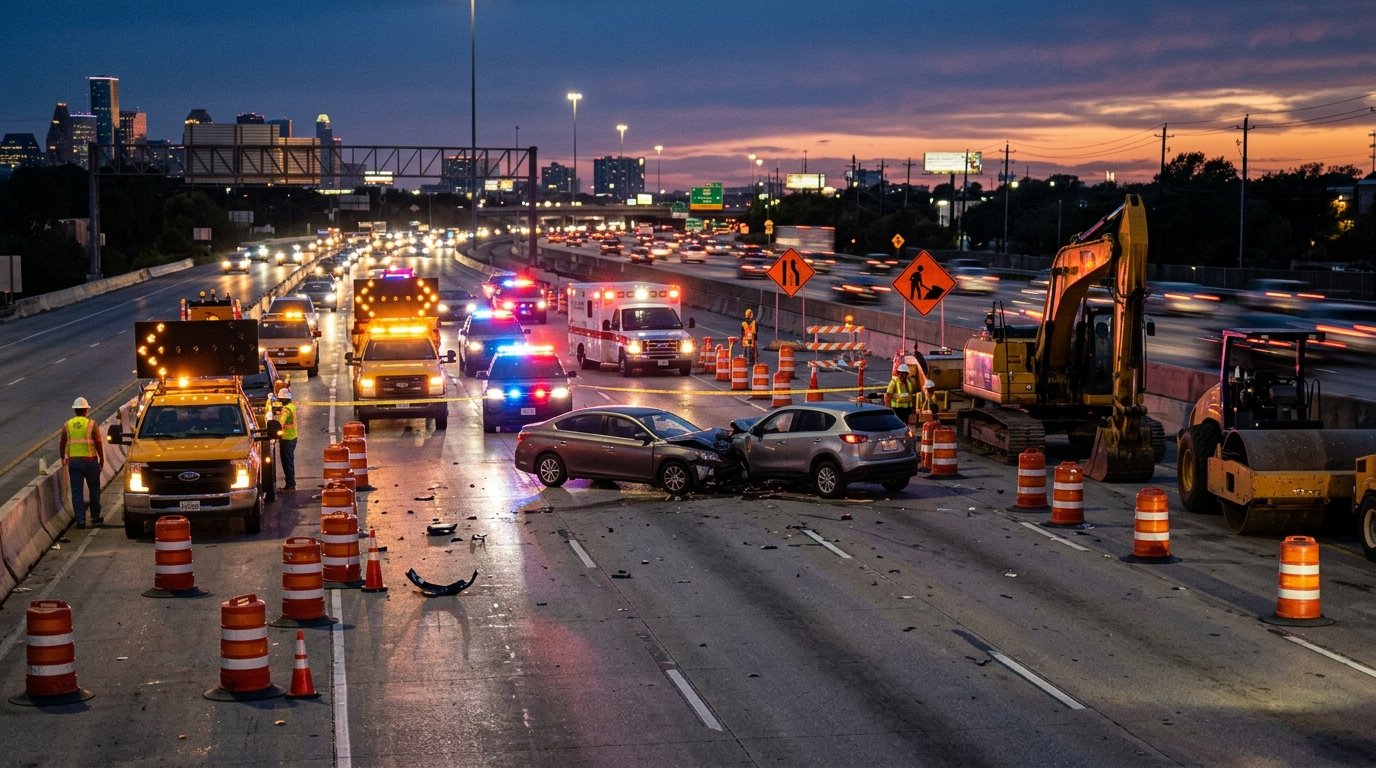
A highway work zone changes the rules of the road in real time. Drivers who are used to a certain stretch of roadway suddenly face reduced speed limits, merging lanes, narrowed shoulders, uneven pavement, and heavy equipment operating a few feet from moving traffic. Several factors tend to combine to raise the risk.
- Sudden changes in traffic flow: When several lanes funnel into one, traffic can compress quickly. Drivers who are distracted, following too closely, or traveling too fast may not have time to stop when vehicles ahead slow down. Rear-end collisions are a common result.
- Confusing or inadequate warnings: A work zone only works if drivers can see and understand it. Advance warning signs, lane closure notices, flashing arrow boards, and clear lane markings all depend on being placed correctly and maintained. When signage is missing, blocked, poorly positioned, or inconsistent with the actual lane configuration, drivers may not realize what is happening until it is too late.
- Narrow lanes and limited margin for error: Concrete barriers, cones, and drop-offs leave little room to correct a mistake. A small drift can turn into a collision with a barrier, a piece of equipment, or another vehicle.
- Mixed traffic: Passenger vehicles, commercial trucks, and 18-wheelers share the same compressed space. Large vehicles need more distance to stop, which raises the stakes for everyone around them. For more on injuries involving passenger vehicles, see our page on car accidents.
- Workers and equipment close to traffic: Unlike most roadways, a work zone includes people on foot and machinery in motion just beyond a line of cones or a barrier. That proximity raises the potential for severe injuries.
Because so many of these conditions are shaped by decisions made by people other than the driver, a work zone crash can raise liability questions that a typical highway collision does not.
TxDOT Contractor Responsibilities for Signage and Barriers
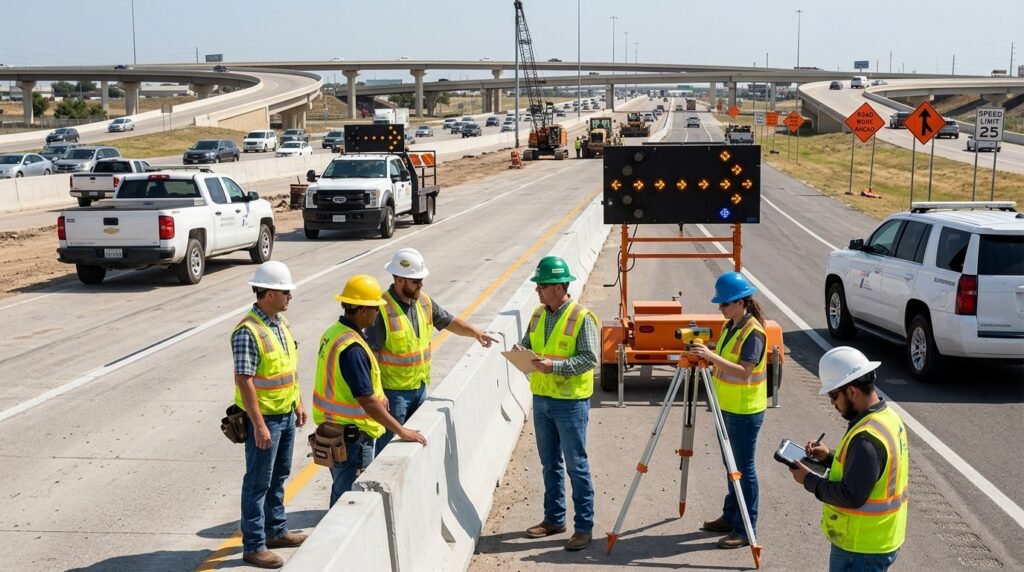
Most major highway projects in Texas are not carried out by the Texas Department of Transportation (TxDOT) directly. TxDOT typically oversees the project while private contractors and subcontractors carry out the construction work. Under TxDOT’s work zone requirements, the contractor is generally responsible for implementing and maintaining the approved traffic control plan, while TxDOT is responsible for designing the plan and approving changes to it.
Depending on the contract and the project, a contractor’s responsibilities may include:
- Placing advance warning signs at appropriate distances
- Setting up cones, barrels, and barricades to guide traffic
- Installing and maintaining concrete barriers
- Maintaining lane markings, including temporary striping
- Operating flashing arrow boards and message boards
- Keeping the roadway surface reasonably safe, including addressing debris, drop-offs, and uneven pavement
- Following the approved traffic control plan for the project
TxDOT’s guidance also calls for designated contractor and department representatives to manage work zone safety, inspect traffic control devices, report deficiencies, and take corrective action when needed. You can review TxDOT’s public guidance on work zone traffic control and its traffic control plan requirements.
When something goes wrong, one of the first questions is whether the traffic control measures in place matched the plan and the project requirements. Were signs placed where they were supposed to be? Were barriers installed and maintained properly? Did the lane configuration on the day of the crash match what drivers had been told to expect?
These are fact-intensive questions. Answering them often involves project plans, contracts, inspection records, daily logs, photographs, and witness accounts. That kind of documentation is also where my insurance background comes into play. I know what these files are supposed to contain, what carriers and contractors look for when they evaluate exposure, and how quickly records can become harder to obtain when no one is asking for them.
Contractors typically carry commercial liability insurance, and those policies are central to how these claims are evaluated and resolved. Coverage questions can become a battle of their own, which is one reason construction-related injury claims often look different from ordinary car accident cases.
Enhanced Penalties for Work Zone Violations Under Texas Law
Texas treats work zone safety seriously. When workers are present, Texas law generally doubles both the minimum and maximum fines for many traffic offenses committed in a construction or maintenance work zone, provided the citation states that workers were present. For speeding, the enhanced fine generally applies when the work zone is marked by a sign stating the applicable maximum lawful speed. This rule appears in Section 542.404 of the Texas Transportation Code.
For readers trying to understand how liability works, speed and other traffic violations matter for a few reasons.
- They may help show whether a driver acted unreasonably: If a driver was traveling faster than the posted work zone speed limit, that may be relevant to whether the driver was negligent. The facts of each crash still matter, including traffic conditions, visibility, and whether signage was adequate.
- They may affect how fault is divided: Texas follows a modified comparative negligence rule. An injured person can recover damages even if they share some fault for an accident, as long as they are not more than 50 percent responsible. Compensation is reduced by the percentage of fault assigned to the injured person. Insurance companies know this rule well, and they use it. In a work zone crash, an insurer may argue that the injured driver was speeding or inattentive to shift blame and reduce a claim.
- They do not end the inquiry: Even when speed played a role, other parties may also have contributed to the crash. Poor signage, an unsafe lane configuration, or a hazard left in the roadway can matter regardless of how fast any single driver was going. How much each factor contributed is a question of fact that depends on the evidence.
If you want to read more about how a stretch of road or a project is addressed in an injury case, our page on construction and industrial accidents describes how multi-party construction liability tends to work.
Government Immunity Questions When TxDOT Itself Is Involved
When a state agency is connected to a crash, the analysis changes. Governmental entities in Texas generally have immunity from lawsuits unless that immunity has been waived by statute. The Texas Tort Claims Act, found in Chapter 101 of the Texas Civil Practice and Remedies Code, addresses when and how governmental units may be sued. It provides a limited waiver of immunity in certain circumstances, and claims under it are subject to specific requirements and limitations.
That is why the question “Can I sue TxDOT directly?” does not have a simple yes-or-no answer. It depends on the facts, including the nature of the alleged negligence, the type of claim being made, and whether the claim falls within the circumstances the Act recognizes. Reading and applying the statute to a particular crash is a task for an attorney who has reviewed the details.
One point is worth knowing at a general level. Claims against government entities under the Texas Tort Claims Act generally require written notice within six months of the incident. The notice must reasonably describe the injury or damage claimed, the time and place of the incident, and the incident itself. There are exceptions, including situations where the governmental unit has actual notice of the death, injury, or property damage. That deadline is much shorter than the standard two-year statute of limitations that applies to most personal injury cases in Texas. A person who assumes they have two years to act could miss the notice window entirely when a government entity is involved.
Immunity questions are also a reason that private contractors matter so much in these cases. Even when a governmental entity’s role is limited by immunity, private companies working on the project may face different rules. Sorting out who falls on which side of that line is one of the central challenges in a work zone case.
Worker Injuries Within an Active Work Zone
Work zone crashes do not only affect motorists. Roadway workers, flaggers, equipment operators, and others on the project are exposed to traffic and heavy machinery every day. When they are injured, the legal picture can look quite different.
- Workers’ compensation intersections: Injured workers often have workers’ compensation considerations that interact with any claim against third parties. The claim against the employer may follow a different path than a claim against a negligent driver or another company working on the site. Understanding both the insurance and legal dimensions at the same time matters in these cases.
- Third-party claims: A worker hurt by a negligent motorist, an equipment operator employed by another company, or a subcontractor who failed to follow safety procedures may have options beyond the workers’ compensation system, depending on the facts. These cases often involve multiple parties and multiple insurers.
- Typical injury scenarios: Workers may be struck by passing vehicles, hit by equipment, injured in falls, or hurt by falling objects and debris. If you want to understand how these categories work in a broader construction setting, we have written about being struck by equipment on Texas construction sites, falls from heights, and falling objects and debris. Many of the same questions about responsibility apply on a highway project.
- Industrial and heavy-equipment settings: Some highway and infrastructure work overlaps with industrial environments, particularly in the Gulf Coast region. Our article on being injured in a Texas oilfield accident discusses a related category of workplace injury claims.
Because serious injuries are often life-altering, these cases tend to involve surgery, long-term medical needs, and lost income. That is the kind of case my practice focuses on.
Multiple Potentially Liable Parties on a Single Project
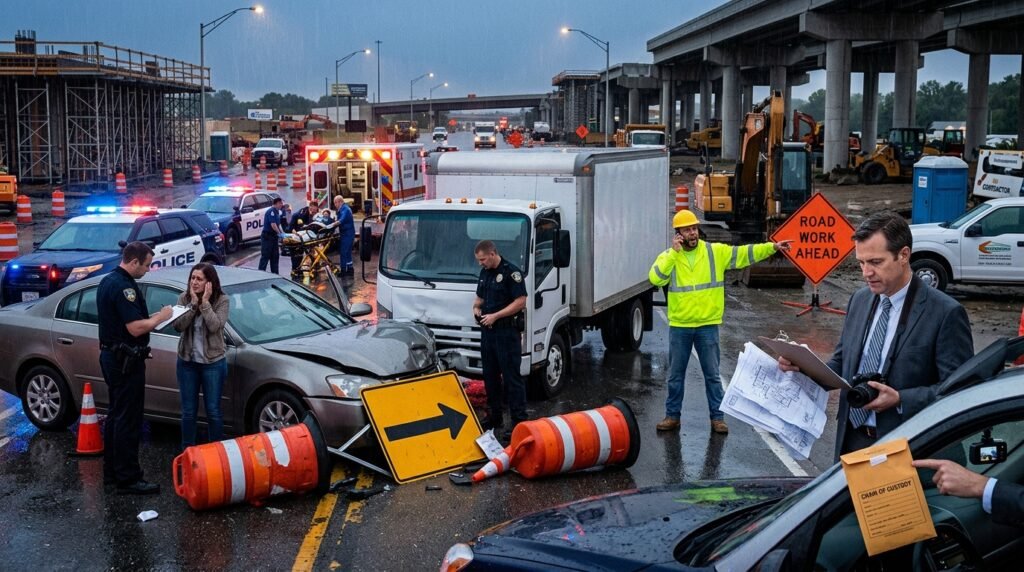
One of the defining features of a work zone accident is that more than one party may bear some responsibility. A single highway project can involve many companies, each with its own role, contract, and insurance. Depending on the facts, the parties examined in a work zone crash may include:
- The general contractor responsible for the overall project and, often, for implementing the traffic control plan
- Subcontractors responsible for specific tasks such as paving, striping, barrier installation, or traffic control
- Traffic control companies hired to place and maintain signs, cones, and barricades
- Equipment operators and their employers if a vehicle or machine contributed to the crash
- Engineers or designers whose plans shaped the work zone configuration
- Other drivers, including commercial truck drivers and the companies that employ them
- Governmental entities, subject to the immunity rules and notice requirements discussed above
Each of these parties may have its own insurance carrier, and each carrier will have its own view of the facts. It is common for every party to point at someone else. A contractor may blame a subcontractor. A subcontractor may blame a driver. An insurer may blame the injured person. The result can feel like a maze, especially for someone who is recovering from serious injuries.
This is where my background tends to be most relevant. Having spent over a decade managing claims from the insurance carrier’s side, I understand how these finger-pointing dynamics develop, how adjusters build their evaluations, and how coverage and liability questions overlap. I also handled insurance defense work at Rymer, Echols, and Nelson-Archer before founding Herrera PLLC, which gave me a close look at how defense counsel approach cases like these. Since every client matter at my firm is handled personally by me, that perspective goes into each case from the start.
Evidence is another major factor. In a multi-party case, the types of evidence that may matter include:
- Traffic control plans and project contracts
- Photographs and video of the work zone before and after the crash
- Police reports
- Inspection logs and daily project records
- Witness statements
- Medical records documenting the extent of the injuries
- Expert analysis, where necessary
Evidence like this can become harder to obtain as time passes, and Texas law generally sets a two-year statute of limitations for most personal injury claims, measured from the date of injury. In wrongful death cases, the two-year period generally runs from the date of death. Because the rules vary depending on who is involved, including the shorter six-month written notice period for claims against government entities under the Texas Tort Claims Act, timing is a serious issue in any work zone case.
Frequently Asked Questions
Why are work zones more dangerous?
Work zones change the normal flow of traffic. Lane shifts, merges, reduced speed limits, uneven surfaces, concrete barriers, heavy equipment, and workers close to moving vehicles all increase the risk of a crash. When signage or traffic control measures are inadequate, drivers may have less time to react to those changes. Conditions like these appear on busy corridors such as I-10, I-45, and Highway 288.
What are a TxDOT contractor’s responsibilities?
TxDOT typically oversees highway projects, while private contractors and subcontractors carry out much of the work. Under TxDOT’s requirements, the contractor is generally responsible for implementing and maintaining the approved traffic control plan. That can include placing warning signs, setting up barriers and cones, maintaining lane markings, and responding to traffic control deficiencies. Whether a contractor met its obligations in a particular case depends on the project documents and the facts of the crash.
Are penalties higher for speeding in a work zone?
Yes, in many cases. When workers are present, Texas law generally doubles the minimum and maximum fines for many traffic offenses in a construction or maintenance work zone if the citation states that workers were present. For speeding, the enhanced fine generally applies when the work zone is marked with a sign stating the applicable maximum lawful speed. In an injury case, speed may also affect how fault is evaluated under Texas’s modified comparative negligence rule.
Can I sue TxDOT directly?
It depends. Governmental entities in Texas generally have immunity unless it has been waived, and the Texas Tort Claims Act provides a limited waiver in certain circumstances. Claims against government entities generally require written notice within six months, which is much shorter than the two-year statute of limitations that applies to most personal injury cases. Whether a particular claim can proceed depends on its facts, and an attorney can evaluate those.
Who else could be liable in a work zone accident?
Depending on the facts, potentially responsible parties can include general contractors, subcontractors, traffic control companies, equipment operators and their employers, other drivers, commercial trucking companies, and, subject to immunity rules, governmental entities. Because multiple parties and insurers are often involved, identifying who may bear responsibility usually requires a careful review of the project and the crash.
This article is for general educational purposes and is not legal advice, and reading it does not create an attorney-client relationship. Every work zone accident turns on its own facts, and outcomes cannot be guaranteed. Anyone seriously injured in a construction zone crash, whether driving through a work zone or working at one, can reach Herrera PLLC through the contact page or by calling 832-891-3210 to schedule a free, confidential consultation and discuss the available options.
Jonathan Herrera, J.D.
Jonathan Herrera is the founder of Herrera PLLC in Houston, Texas. He earned his J.D. from South Texas College of Law Houston and is admitted to practice in Texas state courts, the U.S. District Courts for the Southern, Eastern, and Western Districts of Texas, and the U.S. Court of Appeals for the Fifth Circuit. He is a member of the Houston Trial Lawyers Association, the Texas Trial Lawyers Association, and the American Association for Justice.