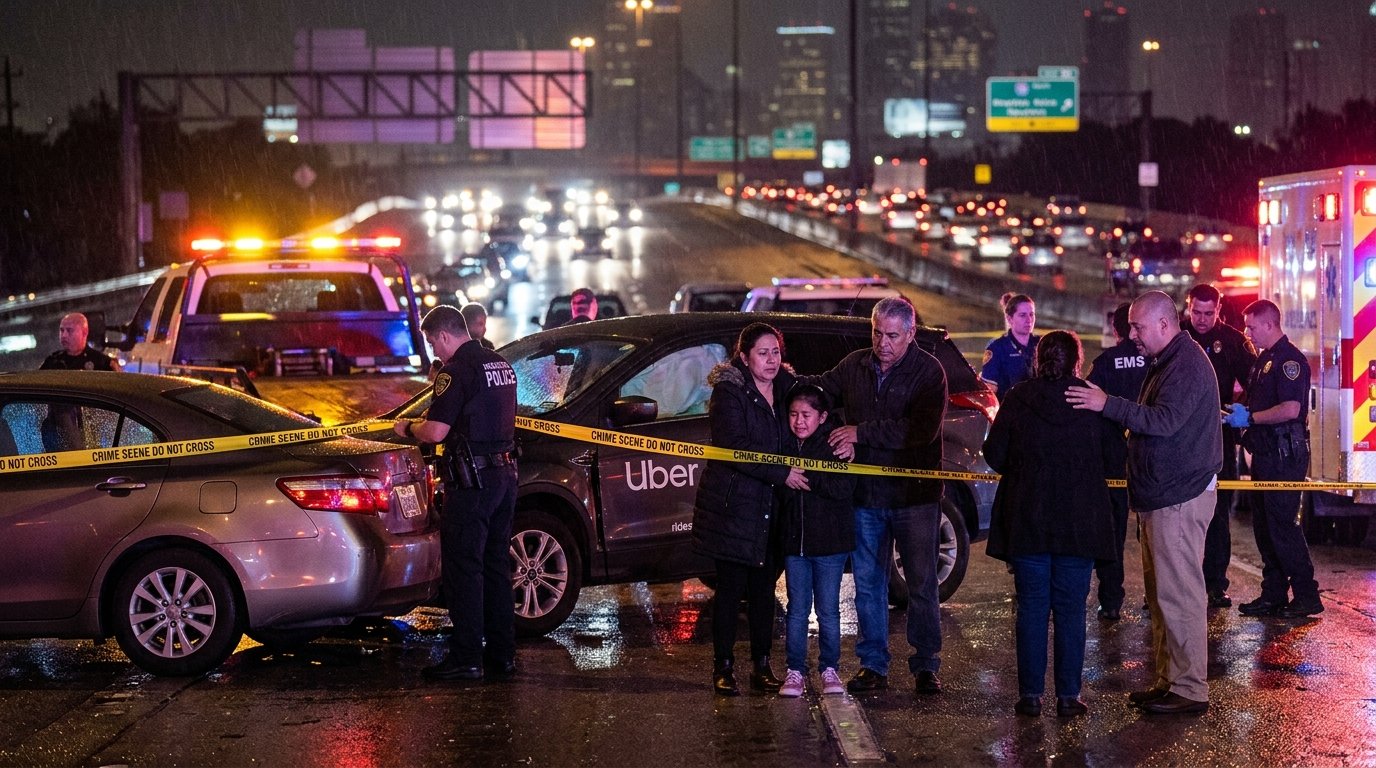

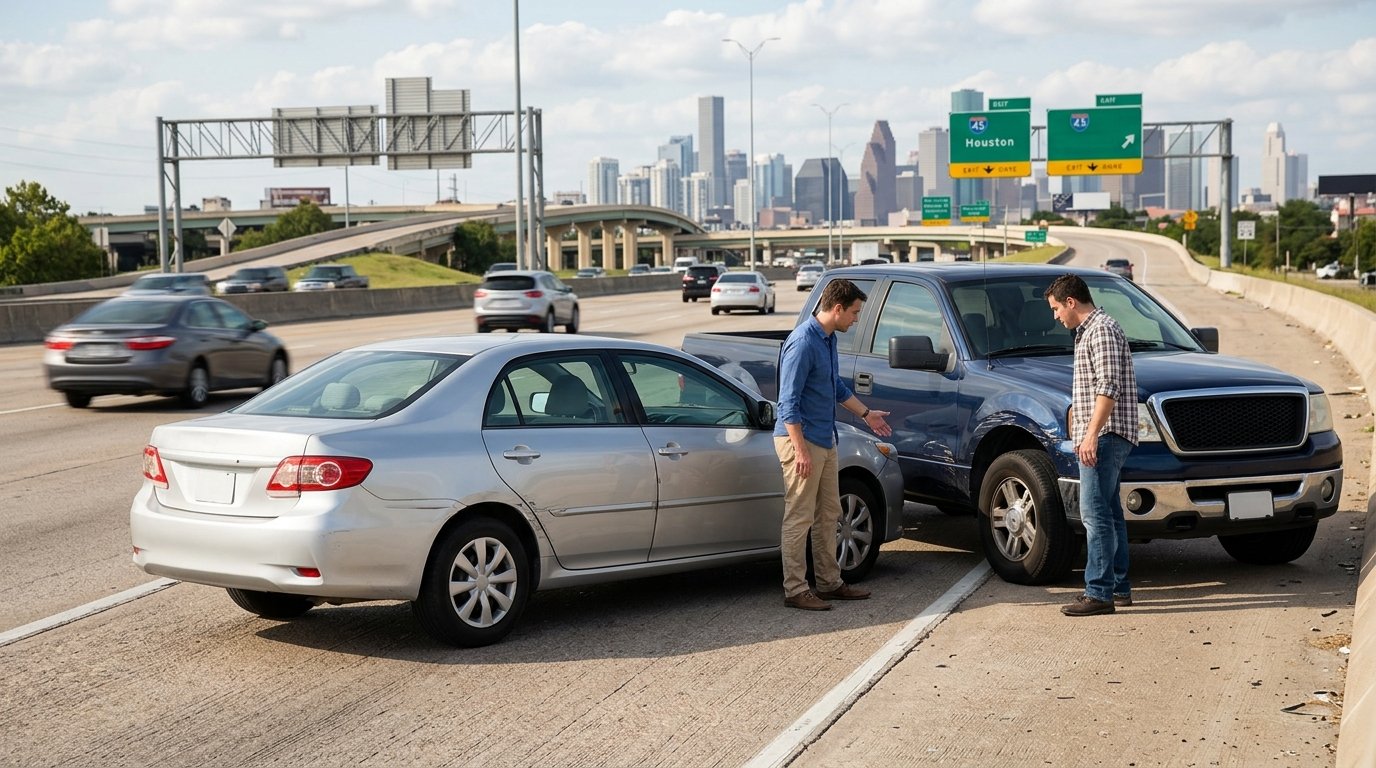

Most people have felt the moment. You are moving along I-45 or the Katy Freeway, and the car beside you begins to drift into your lane. You brake, swerve, or hear the scrape of metal. Sometimes a sideswipe is a fender-deep inconvenience. Other times it pushes a car into a barrier or another lane of traffic, and the person inside is seriously hurt.
Fault in these crashes is often disputed. Both drivers may say the other one moved. There is rarely a clean “rear-end” fact pattern to point to. Before becoming an attorney, I spent over a decade as an insurance adjuster handling high-exposure casualty claims. Later, I defended insureds at Rymer, Echols, and Nelson-Archer. In both roles, I reviewed claims where the central question was who left a lane and whether that move was safe. This article explains how Texas law approaches that question and what kinds of evidence tend to matter.
This article is general educational information. It is not legal advice and does not create an attorney-client relationship. Every case depends on its own facts.
Right of Way Rules for Lane Changes and Merging Under Texas Law
Many drivers assume there is a simple rule about who has the right of way in a lane change. The Texas Transportation Code does not frame it that way. Instead, the core rule is in Section 545.060 of the Texas Transportation Code, which addresses driving on a roadway laned for traffic. On a roadway divided into two or more clearly marked lanes, a driver:
shall drive as nearly as practical entirely within a single lane, and
may not move from that lane unless the movement can be made safely.
The second requirement is the one that matters most in a lane-change collision. The law does not say the driver already in the lane always wins. It places a duty on the driver who moves out of a lane to make sure the move is safe. If a driver changes lanes without confirming that the adjacent space is clear, that driver may be found negligent. The same section also allows official traffic-control devices to prohibit lane changes on certain stretches of road, which can matter in construction zones and at some interchanges.
That does not mean the other driver can never share responsibility. A driver who is speeding, drifting, tailgating, or lingering in someone’s blind spot may carry part of the blame. Our post on rear-end collision fault in Texas addresses a different kind of fault dispute, but the same principle applies. Fault is a question of what each driver did, not simply where each car ended up.
Merging adds another layer. Cars entering from an on-ramp are joining traffic that is already moving. Texas traffic law does not have a single statute that assigns automatic priority between a merging driver and through traffic on the freeway. The merging driver is bound by the same safe-movement rule in Section 545.060: a move into a through lane must be made safely. Yield signs may apply where posted, and under Section 545.153 a driver approaching a yield sign must slow to a reasonable speed and yield to traffic close enough to be an immediate hazard. Drivers already on the freeway likewise have a duty not to make an unsafe movement of their own. In practice, merging collisions often turn on whether each driver adjusted speed and position reasonably given the traffic around them.
Signal Use and Shoulder Checks as Evidence of Fault
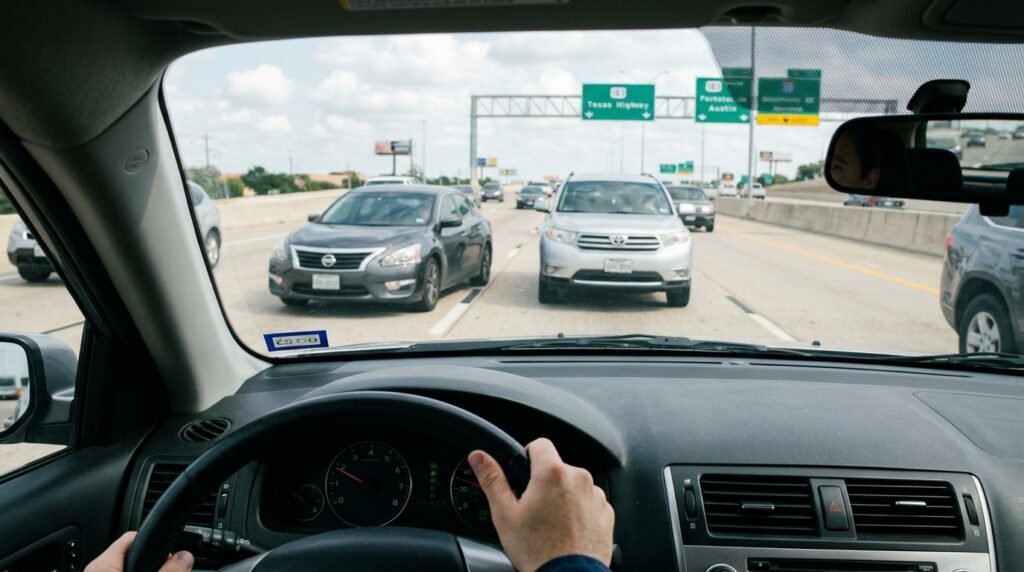
Texas law requires drivers to signal. Section 545.104(a) of the Transportation Code says an operator must use the proper signal to indicate an intention to turn, change lanes, or start from a parked position. The statute is part of the same chapter linked above.
Signal use matters in a sideswipe case for a few reasons:
- It shows whether the driver gave a warning. A driver who changed lanes without signaling gave the other driver no notice.
- It can show intent and awareness. A signal that was activated only a moment before the move may suggest the driver was not carefully checking traffic.
- It can cut the other way. A driver who signaled is not automatically blameless. A signal is a notification, not permission, and the duty to move only when safe remains.
Shoulder checks and mirror checks are harder to prove, because they are something a driver does, not something a camera necessarily records. Evidence of them often comes indirectly, through the driver’s account, dashcam footage showing head movement, the timing of the move, or physical evidence showing how quickly the car crossed into the lane. A driver who says “I checked” while the physical evidence shows a sudden, sharp move may face credibility questions.
In my years evaluating claims as an adjuster, I saw that signal and lane-change testimony was often the center of the file. Insurers look closely at inconsistencies. A driver who says one thing to the police officer, another to the adjuster, and something else in a deposition may give the other side real leverage. That is one reason accurate, early documentation of what happened matters in these cases.
Texas peace officers’ crash reports are maintained by the Texas Department of Transportation, and the TxDOT crash reports and records page explains how to request them. A crash report is useful evidence, but the officer’s opinion about fault does not decide a case.
Common Sideswipe Scenarios: Merging Ramps, Lane Splits, and Construction Zones
Sideswipes tend to cluster in certain parts of Houston’s road network. Some of the most common scenarios include the following.
- Merging ramps: Entrance ramps along I-10, I-45, Highway 288, and Loop 610 place drivers in a short space to match speed and find a gap. Collisions happen when a merging driver does not leave enough room, when a freeway driver does not adjust, or when two drivers merge into the same gap at once.
- Exits and lane splits: Freeways in the Houston area frequently split, shed lanes, or send an interior lane to an exit. Drivers who realize late that their lane is ending or exiting may cut across traffic. These sudden moves are a frequent source of lane-change collisions.
- Construction zones: Houston’s freeways are rarely free of construction. Lane shifts, narrowed lanes, temporary barriers, and changing markings leave little room for error. A sideswipe in a work zone can push a vehicle into a barrier. Questions in these cases may include whether signage and markings were clear and whether a driver was following the posted configuration.
- Heavy traffic and congestion: Stop-and-go traffic produces frequent small lane changes as drivers try to gain a few car lengths. A sideswipe at low speed may cause little visible damage but can still cause injuries, particularly neck and back injuries.
- Commercial vehicles. A sideswipe involving a tractor-trailer or delivery truck can be far more serious than one involving two passenger cars, given the difference in size and weight. Large trucks have blind spots, and a lane change by a truck driver who did not see a car can have severe consequences. Our Truck Accidents page discusses those cases.
- Motorcycles and pedestrians nearby: A sideswipe can also involve a motorcycle, which is far more vulnerable than a car. The firm’s motorcycle accident page addresses those cases. A sideswipe that forces a vehicle onto a shoulder can also endanger people outside vehicles. See our pedestrian accident page and our post on being hit by a car in a Houston crosswalk.
- Impaired and distracted drivers. Drifting across lines is a classic sign of impairment or distraction. Where alcohol is involved, the case may carry additional considerations, which our drunk driving accident page discusses.
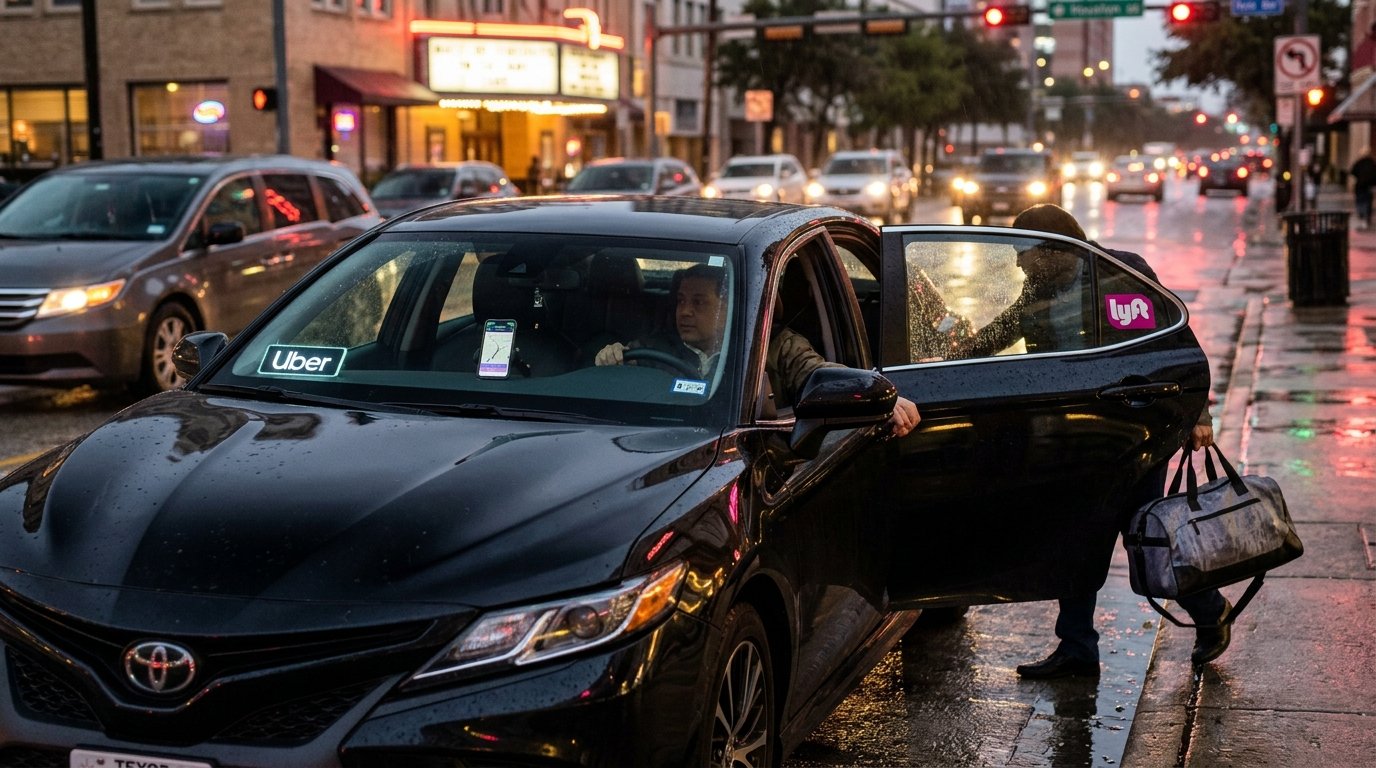
- Rideshare vehicles: Rideshare drivers change lanes constantly while watching navigation apps. A sideswipe involving an Uber or Lyft driver raises insurance questions. Our posts on Uber accident insurance coverage in Texas and third-party claims when hit by a rideshare driver cover this.
Shared Fault When Both Drivers Were Changing Lanes
One of the hardest sideswipe scenarios is the one where both drivers were moving at once. Two cars signal, both head for the same lane, and they meet in the middle. Each driver may truthfully say, “I looked and it was clear.” What now?
Texas applies a modified comparative negligence rule. An injured person can recover damages even if they share some responsibility for the crash, as long as they are not more than 50 percent at fault. Any compensation is reduced by the injured person’s percentage of fault. The proportionate responsibility rules are found in Chapter 33 of the Texas Civil Practice and Remedies Code.
In a two-driver lane-change dispute, that rule has real consequences:
- Both drivers may bear some fault: A fact-finder may conclude that each driver failed to confirm the space was clear.
- Percentages drive the outcome: If an injured driver is found 20 percent responsible, recovery is reduced by that amount. If the driver is found more than 50 percent responsible, Texas law does not allow recovery.
- Insurers use fault splits strategically: In my adjusting years, shared fault was one of the main ways carriers reduced what they paid. An insurer may argue that the injured driver also moved, was in a blind spot, was speeding, or failed to avoid the collision.
This is also where the evidence in the next two sections becomes important. When it is one driver’s word against another’s, objective evidence such as video and vehicle damage can carry significant weight. Establishing the sequence of movements, who began the lane change first, who was where, and at what speed, can shift the percentages.
Some of these disputes cannot be resolved by evidence alone. Reasonable people can disagree about what a driver should have noticed in a fraction of a second. Outcomes in shared-fault cases are genuinely uncertain, and no attorney can promise a particular result.
Dashcam and Traffic Camera Evidence in a Sideswipe Case
Video can be the most persuasive evidence in a lane-change case, because it shows what happened instead of describing it. Several sources may exist.
- Dashcams: Footage from a driver’s own dashcam, or one belonging to another driver nearby, may show the lane change, the signal, the relative speeds, and the impact. Footage from a vehicle that was not involved may be especially useful because it comes from a neutral source. Commercial trucks, rideshare vehicles, delivery fleets, and buses may have cameras of their own. Some cameras record over old footage within hours or days, so video can disappear quickly if it is not saved.
- Vehicle systems: Many newer vehicles contain forward and side cameras, lane-departure systems, blind-spot monitors, and event data recorders. These systems may capture speed, braking, steering input, or warnings. What data exists, and whether a sideswipe triggers it, varies by vehicle.
- Nearby businesses and properties: Cameras at gas stations, retailers, and buildings along service roads sometimes capture freeway-adjacent traffic. They usually retain footage for a limited time.
- Traffic cameras: Houston TranStar operates a system of more than 1,000 closed-circuit cameras on the area’s freeways. According to TranStar’s own published information, those cameras are used to monitor traffic and incidents in real time, and TranStar does not record video or save images from them. A family may assume that a freeway camera captured a sideswipe, but that footage generally does not exist to retrieve later. You can learn more about the system at Houston TranStar.
Witnesses and phones. Passengers, other drivers, and passersby may have photos, video, or recollections. Their contact information is easy to lose.
Because so much of this evidence is short-lived, early investigation matters. I personally handle every client matter at Herrera PLLC, and preserving evidence is a priority from the first conversation. For serious injury cases, that can include sending preservation requests to companies that may hold video or vehicle data.
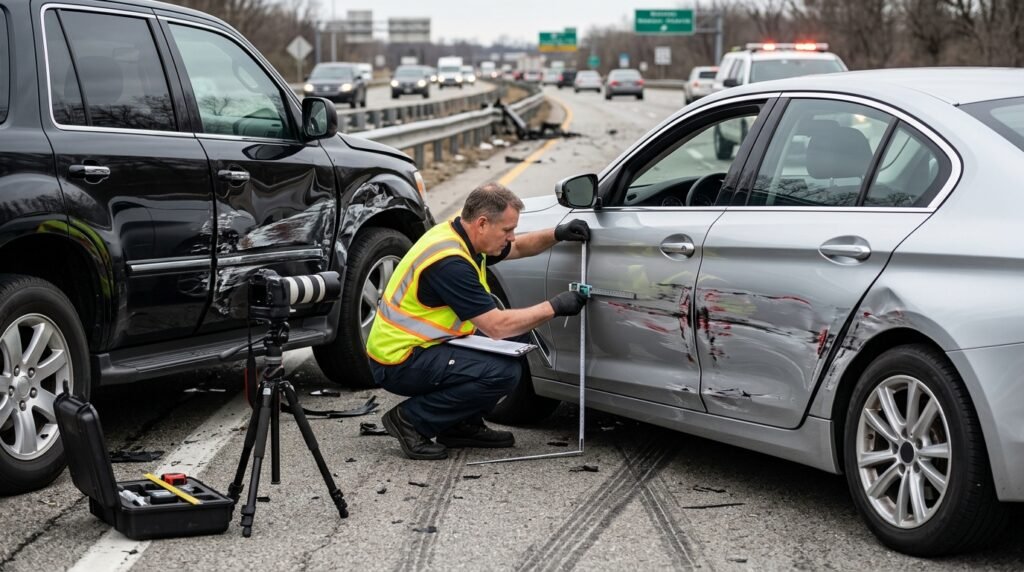
Property Damage Patterns That Reconstruct the Collision
The cars themselves tell a story. Property damage is physical evidence, and in a sideswipe it can often show how the collision happened. A trained reconstruction expert may use damage patterns to answer questions such as:
- Which vehicle moved into which? The location of the damage on each car, whether it is toward the front, middle, or rear, can indicate which vehicle was moving laterally.
- At what angle did the vehicles meet? Scrape direction, paint transfer, and the shape of crushed or dragged metal can reveal an angle of impact. A shallow, sliding scrape suggests a different movement than a sharp, angled hit.
- How fast was each vehicle moving relative to the other? The length and severity of the scrape pattern may help show relative speeds.
- Did the impact push a vehicle somewhere else? Secondary damage to a barrier, a guardrail, or another vehicle can show a chain of events.
- Were there multiple contacts? A repeated or progressive scrape may suggest a driver steered back into the other vehicle.
Photographs of the vehicles in their final positions, before they are repaired or moved to a salvage yard, can be as important as photos of the damage itself. Once a car is repaired, a key piece of physical evidence is gone. Insurers often send their own adjusters to photograph and appraise a vehicle quickly.
One note of caution: a damage pattern rarely answers every question on its own. Interpreting it takes training, and different interpretations may be offered by each side. Damage evidence is strongest when it is combined with video, witness accounts, the crash report, and vehicle data.
Frequently Asked Questions
Who has the right of way when changing lanes?
Texas law does not give one driver automatic priority in a lane change. Under Section 545.060 of the Transportation Code, a driver on a roadway with two or more marked lanes generally may not move out of a lane unless the movement can be made safely. That places responsibility on the driver making the move. A driver who is already in the lane may still share fault if, for example, they were speeding or drifting. Merging from a ramp involves the same safe-movement rule, and yield signs may apply where posted.
Does not signaling affect fault?
It can. Texas law requires drivers to use a signal to indicate an intention to change lanes. A driver who did not signal may be viewed as having given no warning, which can support a finding of negligence. A signal does not by itself make a lane change safe, though, and a driver who signaled can still be found at fault if the movement was unsafe.
What if both drivers were changing lanes at once?
Both drivers may share fault. Texas follows a modified comparative negligence rule under Chapter 33 of the Civil Practice and Remedies Code. A person can recover if not more than 50 percent responsible, but any recovery is reduced by their percentage of fault. In these cases, video, vehicle damage, and witness accounts often become important for sorting out the sequence of events.
Can dashcam footage help my case?
It can be very helpful, because it may show the signal, the speeds, and the movement of each vehicle. Footage can also be overwritten quickly, so preserving it matters. Video from other drivers, businesses, or commercial vehicles may exist too. Houston TranStar’s freeway cameras are generally used for live monitoring and, according to TranStar, do not record. An attorney can help evaluate what footage may be available in a particular case.
How do property damage patterns help reconstruct a sideswipe crash?
The location, angle, and severity of damage on each vehicle, along with scrape direction and paint transfer, can help show which vehicle moved into which and at what angle. Photographs of the vehicles before repair are important. A reconstruction expert may use this physical evidence together with video, the crash report, and witness accounts. Damage patterns rarely settle every question alone, so they are usually considered alongside other evidence.
This article is for general educational purposes and is not legal advice, and reading it does not create an attorney-client relationship. Every sideswipe collision turns on its own facts, and outcomes cannot be guaranteed. Anyone injured in a freeway collision involving a sideswipe, lane change, or merging vehicle can reach Herrera PLLC through the contact page or by calling 832-891-3210 to schedule a free, confidential consultation and talk through the available options.
Jonathan Herrera, J.D.
Jonathan Herrera is the founder of Herrera PLLC in Houston, Texas. A former licensed insurance adjuster with over a decade of experience managing high-exposure casualty and property claims, he founded JH Claims LLC, a multi-state independent adjusting firm, and later practiced insurance defense at Rymer, Echols, and Nelson-Archer. He now represents injured individuals and policyholders, and he is a member of the Texas Trial Lawyers Association and the American Association for Justice.