

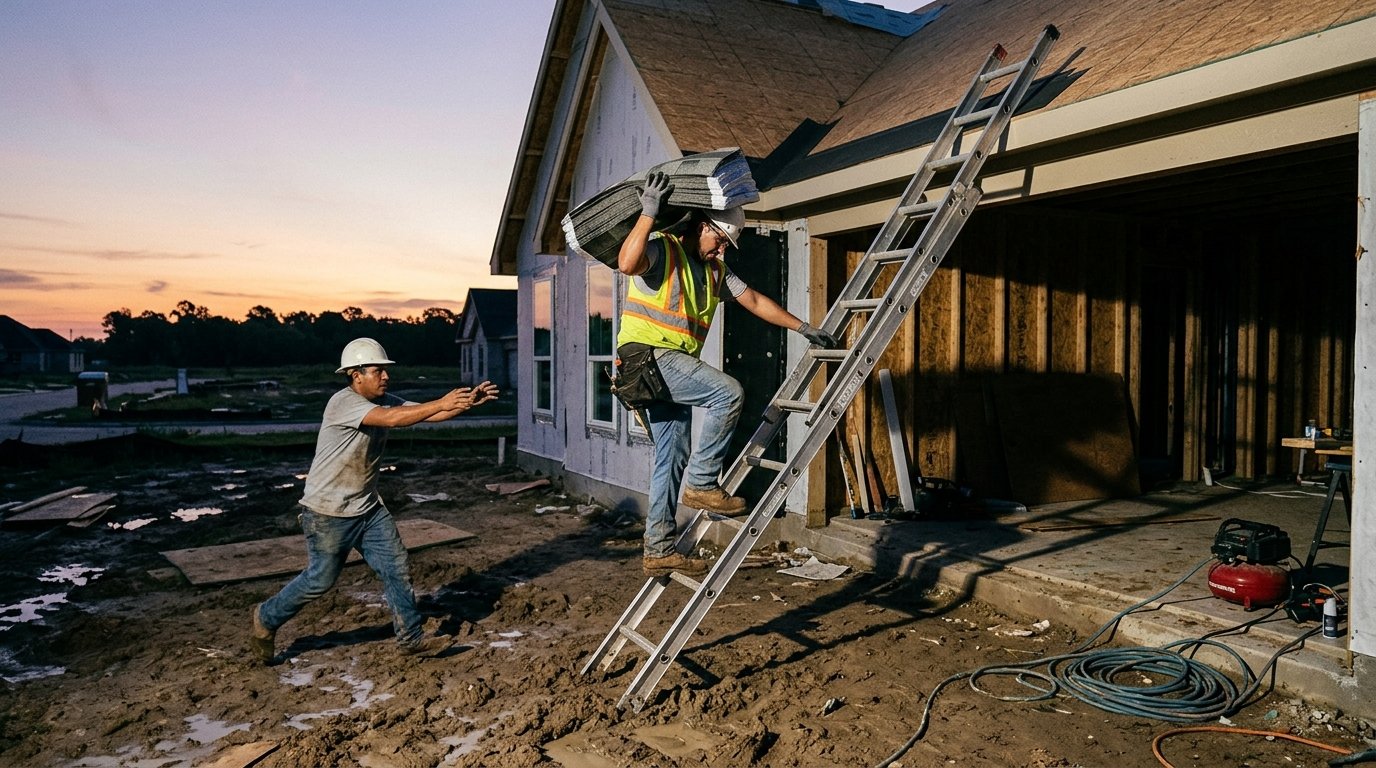

Picture a roofing crew in Katy setting an extension ladder against the fascia board before sunrise, hoping to finish ahead of the Gulf Coast heat. The ground at the base is still soft from overnight rain. A worker steps onto the rungs with a bundle of materials on his shoulder, the base shifts, and the fall that follows ends in surgery, months without a paycheck, and a recovery nobody planned for. Whether a fall starts on a ladder rung or at the edge of a roof, the consequences can reshape a worker’s life and a family’s finances in seconds.
In short, ladder and roofing falls in Texas are usually judged against federal OSHA rules on ladder use and fall protection, and responsibility can fall on an employer, a general contractor, a property owner, or an equipment maker, depending on the facts. These falls also differ from scaffold collapses and other elevated-platform failures, because the hazards, the equipment, and the responsible parties can look very different. This article explains how ladder and roofing falls happen, which federal safety rules commonly apply, and how responsibility is sorted out. Jonathan Herrera spent over a decade as an insurance adjuster managing high-exposure casualty and property claims before becoming an attorney, so he has seen how these cases are evaluated from the carrier’s side of the table. This article is part of Herrera PLLC’s coverage of construction and industrial accidents and the broader category of serious injuries the firm handles.
Why Ladder Falls Are So Common on Texas Job Sites
Ladders are among the most widely used tools on any construction project. They carry workers to roofs, soffits, framing, and mechanical equipment, and because a climb takes only seconds, it can feel like the least risky part of the day. That perception is part of the problem. Shortcuts tend to appear when a task seems quick: the wrong ladder for the height, a poor angle, an unsecured base, or a climb with both hands full of tools and materials.
Texas job sites add their own pressures. Houston has a large and busy construction market, and a single project may involve framers, roofers, electricians, and HVAC crews, each moving and borrowing equipment. A ladder left by one trade may be used by another with no one checking its condition. Gulf Coast weather adds wet ground, mud, and heat that can affect footing and fatigue. Ladders also appear at industrial facilities, where oilfield and refinery workers climb them to reach equipment, platforms, and elevated work areas.
The injuries can be severe. Falls from even moderate heights may cause fractures, spinal cord damage, or brain injuries, and some falls are fatal. When a worker dies, Texas law may allow certain family members to pursue a wrongful death claim, depending on the facts. Falls are also only one of several recurring dangers on active sites, alongside struck-by equipment incidents.
OSHA Ladder Safety Requirements Contractors Often Skip
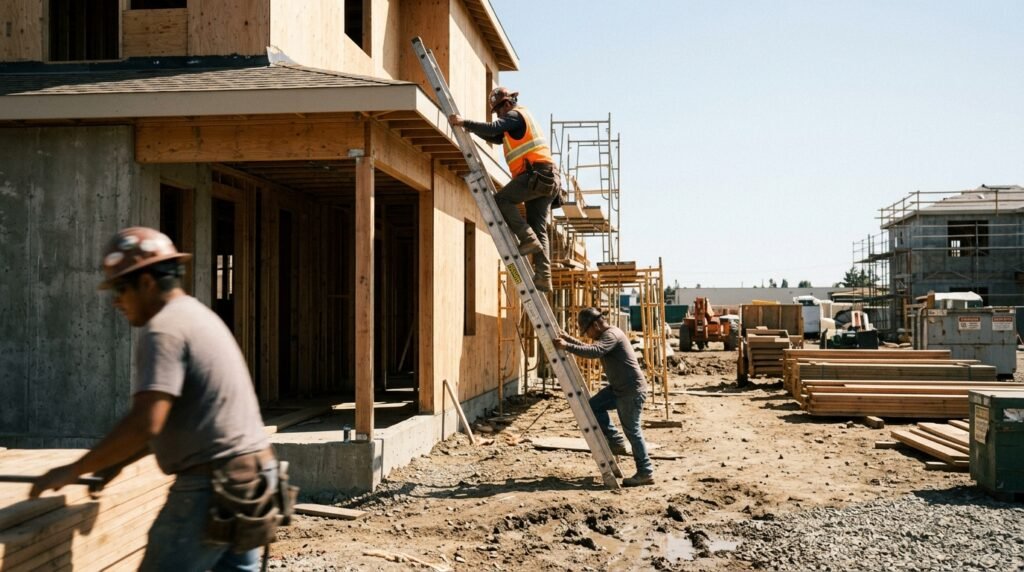
The federal construction standard for ladders is 29 CFR 1926.1053. It applies to ladders used in construction, including job-made ladders, and it sets requirements for how ladders are built, placed, used, and maintained. Texas does not run its own OSHA state plan, so these federal rules apply to private-sector construction work in the state.
The requirements are frequently missed. According to final OSHA data for fiscal year 2025 reported by Safety+Health magazine, the ladder standard was the third most frequently cited OSHA standard in the country, with 2,842 violations, and the general fall protection standard (1926.501) was first for the 15th consecutive year.
The provisions most often connected to injury claims include the following:
- Extension above the landing: When a portable ladder is used to reach an upper surface such as a roof, the side rails must extend at least 3 feet above that landing surface. If that is not possible, the ladder must be secured at the top to a rigid support that will not deflect, and a grasping device must be provided.
- Stable footing: Ladders are to be used on stable and level surfaces unless secured against accidental displacement, and they may not be used on slippery surfaces unless secured or fitted with slip-resistant feet.
- Proper angle: Non-self-supporting ladders must be positioned so the base sits about one foot out for every four feet of ladder length up to the point of support.
- Load limits: Ladders may not be loaded beyond their maximum intended load or the manufacturer’s rated capacity.
- No shifting while occupied: Ladders may not be moved, shifted, or extended while someone is on them.
- Removal of damaged ladders: Portable ladders with structural defects, such as broken or missing rungs or rails, must be marked or tagged “Do Not Use” and withdrawn from service until repaired.
- No improvised extensions: Ladders may not be tied or fastened together to create a longer section unless they were designed for that purpose.
A violation of an OSHA standard does not by itself decide a civil claim, but the standards can help show what a safe job site was expected to look like.
Roofing-Specific Fall Hazards: Slope, Weather, and Missing Anchor Points
Roofing falls involve a different set of rules. OSHA’s fall protection standard, 29 CFR 1926.501, generally requires protection when workers are exposed to unprotected sides and edges 6 feet or more above a lower level. For roofing, the requirements depend on the type of roof:
- Low-slope roofs (a slope of 4 in 12 or less) fall under 1926.501(b)(10). Employers may use guardrail systems, safety net systems, personal fall arrest systems, or certain combinations that include warning lines or safety monitoring.
- Steep roofs (steeper than 4 in 12) fall under 1926.501(b)(11), which calls for guardrail systems with toeboards, safety net systems, or personal fall arrest systems.
- Residential construction is addressed in 1926.501(b)(13), which also uses the 6-foot trigger and requires guardrails, safety nets, or personal fall arrest systems unless another provision allows an alternative.
Any fall protection that is required must also meet the criteria in 29 CFR 1926.502, and employers must train workers who may be exposed to fall hazards under 1926.503. Missing anchor points are where these rules often break down. A harness and lanyard protect a worker only if they connect to a secure anchorage, and crews working on repair jobs or unfamiliar roofs may arrive to find nothing suitable installed. Slope compounds the danger, since a steeper pitch leaves less margin for a slip.
Weather matters as well. Rain, wind, and heat can all affect traction and judgment, and roofing work often surges after Gulf Coast storms, when crews are under pressure to move quickly. Falls from roofs and other elevations are discussed further in Herrera PLLC’s article on falls from heights on Texas construction sites.
Defective or Improperly Secured Ladders as a Product or Negligence Claim
When a ladder fails, two broad questions tend to arise: was the equipment itself flawed, and did someone fail to use it or maintain it properly? The answers can support different kinds of claims, sometimes in the same case.
A product-based claim may be explored when a ladder breaks, collapses, or fails under a normal load, particularly if a rung, rail, hinge, or locking mechanism gave way. These claims commonly involve questions about how the product was designed, how it was manufactured, and whether warnings and instructions were adequate. Whether a defect claim is viable depends heavily on the physical evidence, which is why the condition and whereabouts of the ladder itself can matter so much.
A negligence-based claim looks at conduct rather than the product. Examples that may come up include a ladder placed on unstable ground, an unsecured base or top, a ladder too short to reach a roof safely, a damaged ladder left in service, or a failure to provide required fall protection at a roof edge. This is where unsecured ladder liability usually arises, and it can involve the worker’s employer, a contractor, a property owner, or more than one of them.
Texas applies a modified comparative negligence rule. An injured person may recover damages as long as they are not more than 50% responsible for the accident, but any recovery is reduced by their percentage of fault. Insurers often use this rule to argue that a worker misplaced the ladder or climbed carelessly, which is one reason evidence about site conditions and equipment can be so important.
Employer vs. General Contractor Responsibility for Ladder Safety
On a busy site, it is rarely obvious who was in charge of a ladder. OSHA’s multi-employer citation policy offers a useful way to think about the question for enforcement purposes. It sorts employers into four roles: the creating employer that caused a hazard, the exposing employer whose workers are exposed to it, the correcting employer responsible for fixing it, and the controlling employer with general supervisory authority over the site. A general contractor may be a controlling employer even when its own employees were not the ones who fell, and a subcontractor may fill more than one role. Which role applies depends on the facts, not the job title.
That framework governs OSHA citations, which are not the same as civil liability. Whether a safety standard or a multi-employer role supports a Texas injury claim depends on the specific facts and on who owed the injured worker a duty of care.
Workers’ compensation can change which claims are available. Texas does not require most private employers to carry workers’ compensation coverage. If the worker’s employer carries it, workers’ compensation is generally the exclusive remedy against that employer, though the worker may still bring a claim against a separate third party. A general contractor that provides coverage to its subcontractors’ workers may also be treated as their employer for this purpose. If the employer does not carry coverage, the worker may be able to sue the employer directly for negligence. Herrera PLLC has written about that overlap in its article on Houston construction site injuries beyond workers’ comp.
Other parties may enter the picture as well. A property owner may owe duties tied to the condition of its premises, which is the subject of the firm’s premises liability work. When a contractor’s worker is hurt while repairing or building an improvement on an owner’s property, Texas law (Chapter 95 of the Civil Practice and Remedies Code) generally limits the owner’s liability to situations where the owner controlled the work and knew of the danger. An equipment supplier or rental company may also be involved if a ladder came from outside the crew. Because Jonathan worked with coverage attorneys and defense counsel during his years on the carrier side, he is familiar with how multiple insurance policies, contracts, and indemnity arrangements can complicate a case with several potentially responsible parties.
Documenting a Ladder or Roofing Fall for a Third-Party Claim
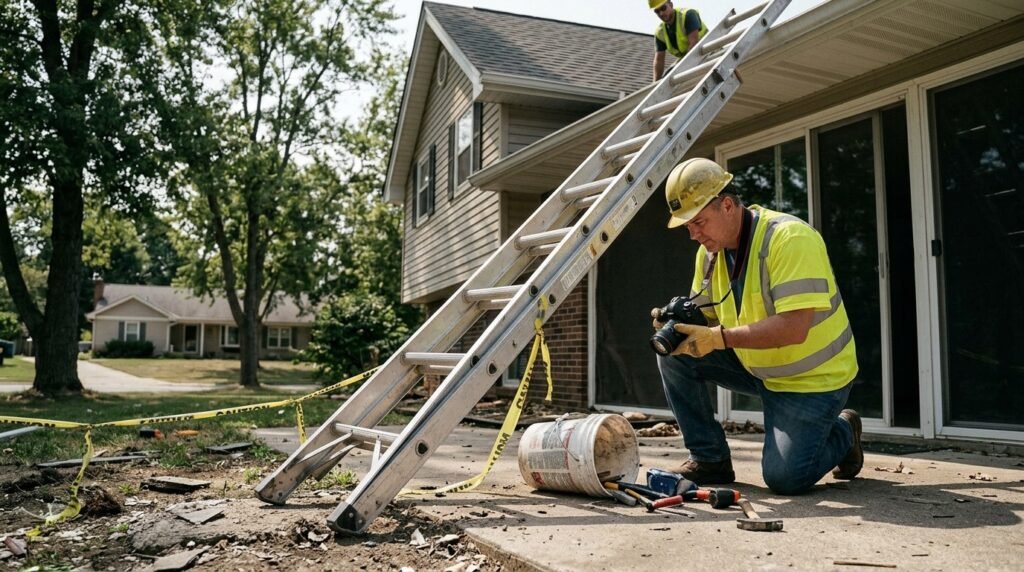
A third-party claim is a claim against someone other than the injured worker’s own employer, such as a general contractor, property owner, or ladder manufacturer. In these claims, the strength of the case often depends on what evidence survives. Material that tends to matter includes photographs of the ladder, its placement, the ground surface, the roof edge, and any anchor points or the absence of them. The ladder’s make, model, and condition can be significant, particularly if a defect is suspected. Witness names, incident reports, site safety logs, training and inspection records, and any OSHA documentation may also help show what was known and what was done before the fall. Medical records and employment records then connect the incident to the injuries and the lost income.
Time is a real factor. Ladders get repaired or thrown away, crews scatter to other projects, and memories fade. This is why a prompt investigation, including visiting the scene and speaking with witnesses while details are fresh, is part of how Herrera PLLC approaches serious injury matters. Other jobsite hazards generate their own evidence patterns, as the firm’s article on trench collapse and excavation accidents illustrates.
Herrera PLLC offers a free, confidential initial consultation with no obligation, and serious injury cases are handled on a contingency fee basis. That means no attorney’s fees are owed unless compensation is recovered, and the firm advances case costs, including expert fees, investigation expenses, and court costs. Texas generally allows two years from the date of injury to file a personal injury claim. Claims against government entities such as cities, counties, and state agencies often require written notice within six months, and some city charters set shorter deadlines, which may matter if a fall occurred on a public project. Because these deadlines can affect available options, an attorney can review the specific dates and circumstances.
Frequently Asked Questions
Why are ladder falls so common in construction work?
Ladders are used constantly and for quick tasks, so shortcuts become tempting. Poor placement, unstable ground, damaged equipment, overreaching, and carrying materials while climbing can each contribute. Shared equipment on multi-trade sites and changing weather conditions can add further risk.
What does OSHA require for ladder safety?
The ladder standard at 29 CFR 1926.1053 covers items such as extending side rails 3 feet above a landing, using stable and level footing, respecting load limits, and removing defective ladders from service. Roof work is separately governed by the fall protection rules in 29 CFR 1926.501.
Can a defective ladder support a product liability claim?
It may, depending on the facts. If a ladder failed during normal use because of how it was designed, made, or labeled, a product-based claim could be explored. The physical ladder and records about its history are often central, and an attorney can evaluate whether the evidence supports one.
Who is responsible for ladder safety on a job site?
Responsibility may rest with one party or several, including the worker’s employer, a general contractor with site control, a property owner, or an equipment supplier. OSHA’s multi-employer policy and Texas negligence principles each look at roles and conduct, and the answer depends on the specific facts.
How do I document a ladder or roofing fall?
Useful documentation often includes photos of the ladder and the scene, the ladder’s identifying details, witness information, incident and safety records, and medical records. Preserving the ladder itself can be important. An attorney can explain what additional evidence may matter in a particular situation.
This article is for general educational purposes and is not legal advice, and reading it does not create an attorney-client relationship. Every ladder or roofing fall depends on its own facts, and outcomes cannot be guaranteed. Anyone facing a serious injury from a construction fall can reach out to Herrera PLLC through the contact page or by calling 832-891-3210 to schedule a free, confidential consultation and talk through the available options.
Jonathan Herrera, J.D.
Jonathan Herrera is the founder of Herrera PLLC in Houston, Texas. A former licensed insurance adjuster with over a decade of experience managing high-exposure casualty and property claims, he founded JH Claims LLC, a multi-state independent adjusting firm, and later practiced insurance defense at Rymer, Echols, and Nelson-Archer. He now represents injured individuals and policyholders, and he is a member of the Texas Trial Lawyers Association and the American Association for Justice.