
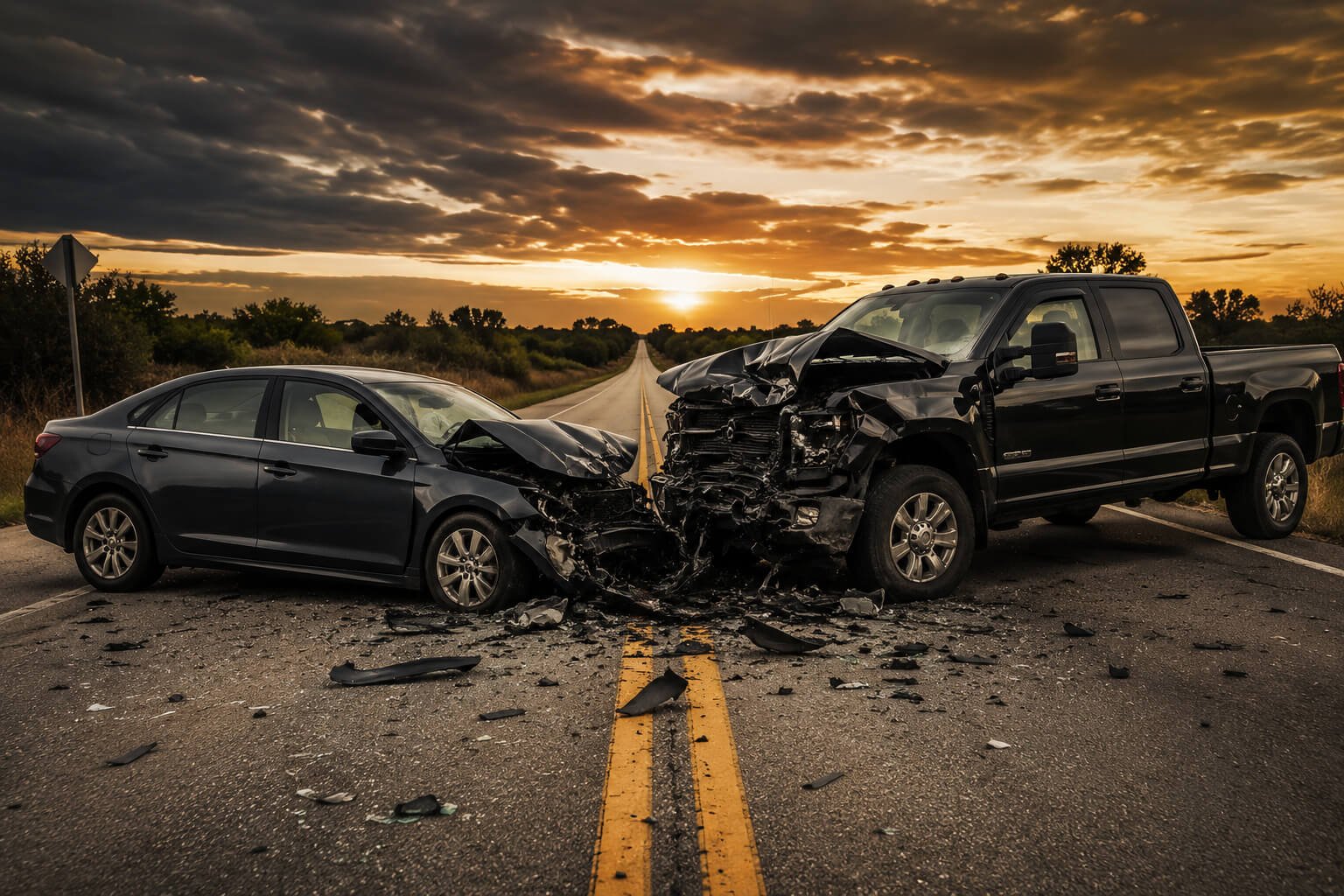

There’s a reason head-on collisions carry a different kind of fear than other types of crashes. Two vehicles closing at combined highway speeds leave little margin for the kind of protective systems that make other accidents survivable. On the rural two-lane highways that connect Texas towns and cities, these crashes happen with troubling regularity, and when they do, the injuries are frequently catastrophic.
Herrera PLLC represents individuals and families affected by head-on collisions throughout Houston and across Texas, including in our car accident and wrongful death practices.
Why Two-Lane Highways See a Disproportionate Share of Head-On Crashes
Two-lane rural highways carry a specific set of risk factors that don’t exist on divided, multi-lane roads. Without a physical barrier or median separating opposing traffic, a single lane departure is often all it takes to put two vehicles on a direct collision course. These roads frequently carry higher speed limits than urban streets, which means less time for either driver to react once a vehicle crosses into the opposing lane. Long stretches of rural highway, especially those connecting distant cities and towns, also mean drivers travel greater distances at speed, increasing exposure to fatigue and reducing attentiveness over time. Limited lighting, fewer passing opportunities, and higher truck traffic on many of these routes add further layers of risk that combine to make two-lane highways more dangerous, mile for mile, than their crash volume alone might suggest.
Wrong-Way Driving, Impairment, and Fatigue as Common Causes
A significant share of head-on collisions trace back to a driver ending up on the wrong side of the roadway, whether briefly or for an extended distance. Impaired driving, whether from alcohol, drugs, or medication, is a frequent factor, since impairment affects both a driver’s ability to stay in their lane and their reaction time if a hazard appears. Fatigue plays a similarly significant role, particularly on long rural stretches where a driver may be traveling for hours without a break. A driver who drifts across the center line while drowsy often has no time to correct before impact. Distraction, whether from a phone, a passenger, or something inside the vehicle, can produce the same result. Under Texas Transportation Code Section 545.051, drivers are generally required to stay on the right-hand side of the roadway, and a violation of this basic rule is often at the center of a head-on collision investigation.
Unsafe Passing and Failure to Maintain a Single Lane
Two-lane highways require drivers to use the opposing lane temporarily in order to pass slower vehicles, which introduces risk that doesn’t exist on multi-lane roads. Attempting to pass in a no-passing zone, misjudging the distance and speed of oncoming traffic, or passing on a curve or hill with limited visibility are all common causes of head-on crashes on these roads. A driver who fails to maintain their lane, whether while passing or during ordinary driving, bears responsibility for placing an oncoming vehicle at risk. Investigating this type of crash typically involves examining the road’s specific passing zone markings, sight lines at the crash location, and where each vehicle was positioned at the moment of impact.
Catastrophic Injury Patterns Unique to Head-On Impacts
Head-on collisions produce a distinct injury pattern compared to other crash types, largely due to the combined closing speed of two vehicles traveling toward each other. The forces involved are often far greater than in a rear-end or side-impact collision, even at moderate individual vehicle speeds. This frequently results in severe traumatic brain injuries, spinal cord injuries, multiple fractures, and internal organ damage. The severity of these crashes also means that fatalities are disproportionately common compared to other collision types. Because the physical forces involved are so significant, injuries from a head-on collision often require extensive surgery, long hospital stays, and ongoing rehabilitation, when they’re survivable at all.
Commercial Vehicles on Rural Texas Highways
Rural two-lane highways connecting major Texas cities often carry significant commercial vehicle and trucking accident traffic, and a head-on collision involving a commercial vehicle introduces additional layers of severity and legal complexity. The size and weight disparity between a passenger vehicle and a commercial truck means occupants of the smaller vehicle are at significantly elevated risk of catastrophic injury or death. These cases also often involve additional parties beyond the driver, including the trucking company, and sometimes a cargo loading company or vehicle maintenance provider, depending on what factors contributed to the crash. Having spent over a decade evaluating high-exposure claims from the insurance carrier’s side, including commercial and industrial exposure, before becoming an attorney, Jonathan Herrera brings that background to how these multi-party trucking cases are investigated at Herrera PLLC. Federal motor carrier regulations governing hours of service, vehicle maintenance, and driver qualification frequently become relevant when a commercial vehicle is involved in a head-on crash.
Multiple Defendant Scenarios in a Head-On Crash Investigation
A head-on collision investigation doesn’t always end with the driver who crossed the center line. Depending on the circumstances, liability may extend to an employer if the at-fault driver was working at the time of the crash, a vehicle owner who allowed an unsafe or unqualified driver to operate the vehicle, or a government entity responsible for road design or maintenance if a hazard like poor signage, inadequate lighting, or an obscured passing zone contributed to the crash. Claims against a government entity in Texas generally require written notice within a much shorter window than the standard filing deadline, so identifying this kind of claim early matters. In cases involving a commercial vehicle, the trucking company and any related contractors may also bear responsibility. Because head-on collisions often involve overlapping potential causes, from driver behavior to road conditions to vehicle maintenance, a thorough investigation typically examines all of these factors before liability is fully understood.
Timing and Cost Considerations
Most personal injury and wrongful death claims arising from a head-on collision in Texas are subject to a two-year statute of limitations. If a government entity may share responsibility due to a road design or maintenance issue, written notice is generally required within six months, a much shorter window than the standard deadline, which makes early investigation especially important in these cases. Car accident and wrongful death cases at Herrera PLLC are handled on a contingency fee basis, meaning there are no upfront attorney’s fees and no obligation to pay unless compensation is recovered.
If you or a family member has been affected by a head-on collision on a Texas highway, Herrera PLLC handles car accident cases, including those resulting in wrongful death. Consultations are free, confidential, and come with no obligation. Call 832-891-3210 or contact us online to discuss what happened.
Frequently Asked Questions
Why are head-on crashes so common on two-lane highways?
Two-lane highways lack a physical barrier separating opposing traffic, so a single lane departure can put two vehicles on a direct collision course. Higher speed limits, long travel distances, and limited passing opportunities on these roads all contribute to the elevated risk.
What causes a driver to cross the center line?
Common causes include impaired driving, fatigue, distraction, and unsafe passing attempts in areas with limited visibility or in designated no-passing zones. Drivers are generally required to stay on the right side of the roadway under Texas Transportation Code Section 545.051.
Are these crashes usually more severe?
Yes, head-on collisions typically produce more severe injuries than other crash types because of the combined closing speed of two vehicles traveling toward each other. This often results in traumatic brain injuries, spinal cord injuries, and a higher rate of fatalities compared to other types of collisions.
Could more than one party be liable?
Yes, liability can extend beyond the at-fault driver to an employer, a vehicle owner, a government entity responsible for road conditions, or a trucking company and its contractors if a commercial vehicle was involved. A thorough investigation typically considers all contributing factors.
What if a commercial vehicle was involved?
Head-on crashes involving a commercial truck often involve additional parties, such as the trucking company, and may be governed by federal motor carrier regulations covering driver hours, vehicle maintenance, and qualification standards. These cases tend to be more complex due to the number of potentially responsible parties.
This article is for general informational purposes only and does not constitute legal advice, and the facts of any specific accident can change how Texas law applies.
Jonathan Herrera, J.D. is a Houston-based attorney and the founder of Herrera PLLC, representing individuals and families across Texas in serious injury, insurance law, and civil litigation matters. Before practicing law, he spent over a decade as a licensed insurance adjuster managing high-exposure casualty and property claims, including commercial and industrial exposure, for carriers and third-party administrators across multiple states, and he later practiced insurance defense before founding Herrera PLLC. He is a member of the Texas Trial Lawyers Association and the American Association for Justice.