
Pool Injury at a Texas Apartment Complex or Hotel: When the Property Owner Is Legally Responsible

Texas summers drive families to apartment pools and hotel pools in enormous numbers. These facilities exist because they attract tenants and guests, and that attraction creates a legal obligation that most property owners prefer not to discuss.
When a child drowns in an apartment complex pool because the gate latch was broken for weeks, or an adult suffers a spinal injury from an unmarked shallow area, or a near-drowning causes permanent brain damage because no reaching pole was mounted as required by law, the question is not simply whether an accident occurred. The question is whether the property owner, manager, and every other responsible party met the specific obligations Texas law imposed on them, and what they owe when they did not.
How Texas Categorizes Apartment and Hotel Pools
Texas law treats apartment complex and hotel swimming pools differently from private residential pools. Under Texas Administrative Code Title 25, Chapter 265, Subchapter L, pools at apartments, condominiums, hotels, motels, private clubs, and homeowners associations are classified as Class C pools. This classification subjects them to the regulatory oversight of the Texas Department of State Health Services and imposes a set of operational, safety, and maintenance requirements that do not apply to private single-family residential pools.
The significance of this classification is that it creates a specific, documented set of legal obligations for the property’s owner, management company, and operator. When those obligations are not met and someone is injured as a result, the regulatory record of what was required and what was not provided becomes a central piece of evidence in the injury claim.
Jonathan Herrera represents seriously injured Texans and their families in premises liability claims, including pool injuries at apartment complexes, hotels, and commercial aquatic facilities across the Houston area.
What Texas Law Actually Requires of Apartment Complex and Hotel Pool Operators
The specific safety requirements that apply to Class C pools under Texas law cover several distinct categories, each of which can become the basis of a liability claim when violated.
Fencing and enclosure. Texas Health and Safety Code Chapter 757 requires a pool yard enclosure consisting of a fence, building wall, or other durable barrier at least 48 inches tall, measured from the outside ground surface. Openings in or under the barrier cannot allow a four-inch-diameter sphere to pass through. Gates must open outward, away from the pool yard, and must be self-closing and self-latching, with the latch positioned at least 60 inches above the ground. Chain-link fencing is prohibited for pools built after September 1, 1994, because its pattern creates easy climbing points.
Certified operator requirement. Under 25 TAC Section 265.194(b), all Class A, B, and C pools and spas must be maintained under the supervision and direction of a properly trained and certified operator. A pool operating without a certified pool operator overseeing maintenance is in violation of this requirement.
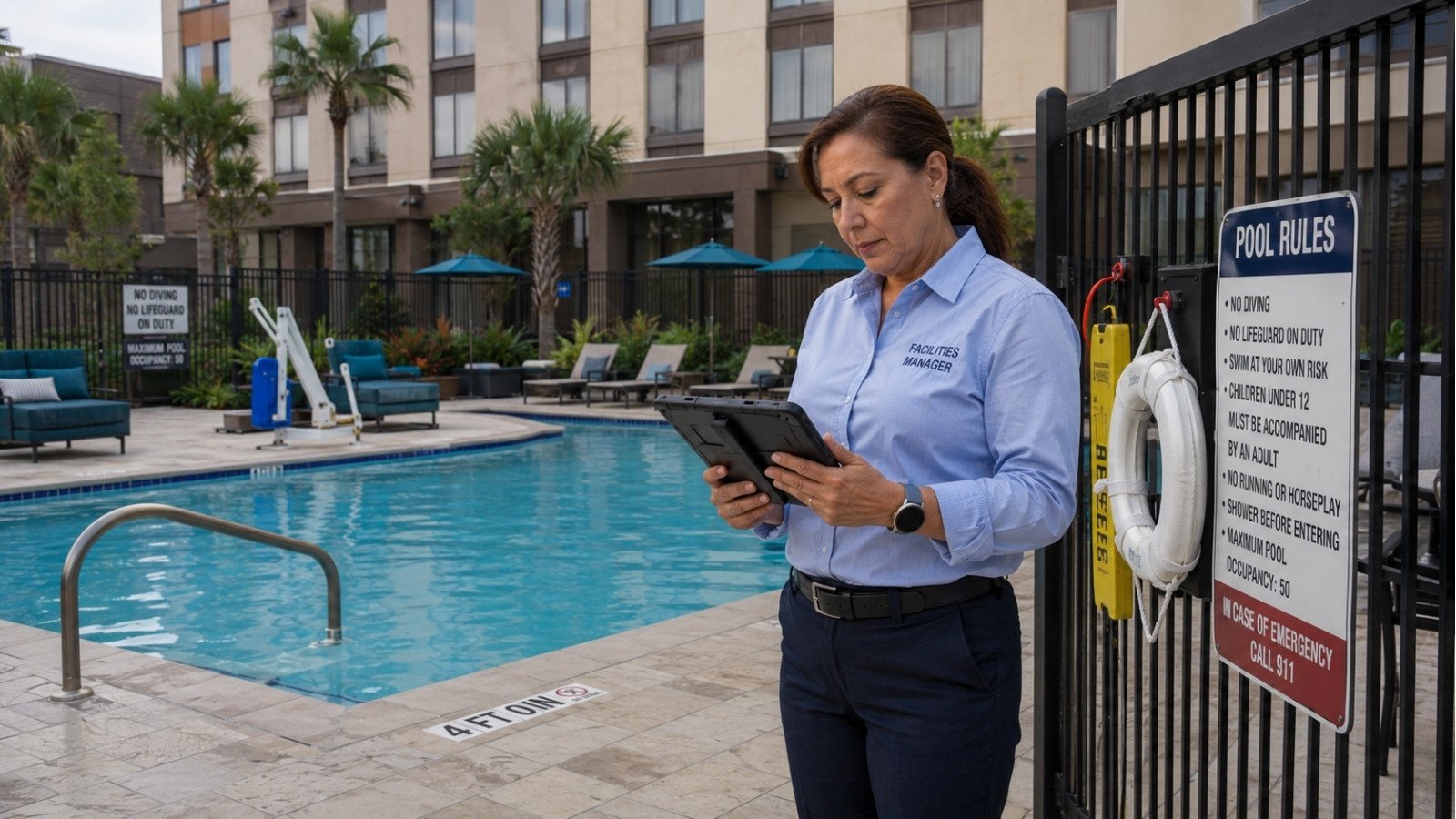
Safety equipment. Texas law requires reaching poles, ring buoys with throwing ropes, and specific emergency signage. For facilities where no lifeguard is provided, the law mandates a “Warning: No Lifeguard on Duty” sign with letters at least four inches high. Public facilities must provide an emergency summoning device such as a dedicated 911 phone located within 200 feet of the water.
Lifeguard requirements. For most hotel swimming pools, no lifeguard is required if the property posts proper signage indicating that no lifeguard is on duty. However, if the property has a water attraction such as a waterslide, diving board, diving platform, drop slide, starting platform, zip line, or climbing wall, the property is required to have at least two lifeguards.
Drain safety. Pools must have drain covers that comply with the federal Virginia Graeme Baker Pool and Spa Safety Act. If the pool has a single main drain that is not unblockable, the operator must either disable the drain or install a second anti-entrapment device or system, such as an automatic shut-off system, Safety Vacuum Release System (SVRS), or suction-limiting vent system. Drain entrapment, where a swimmer’s hair or body is pulled against a defective drain by suction, is a particularly catastrophic injury type that these requirements specifically address.
Injury reporting. Any incident resulting in death, near-drowning, or an injury requiring medical treatment must be reported to the DSHS or local health authority within 72 hours. This creates a documented record that is obtainable through the legal process.
The Three Categories of Victims Under Texas Premises Liability Law
Texas premises liability law determines what duty of care a property owner owes based on the status of the person who was injured. Understanding this framework is essential because it shapes the entire structure of a pool injury claim.
Invitees receive the highest duty of care under Texas law. An invitee is someone who enters property with the owner’s express or implied invitation and for a purpose connected to the owner’s business or for which the property is held open to the public. A tenant using the apartment complex’s pool is an invitee. A hotel guest using the hotel pool is an invitee. A guest visiting a tenant and using the pool is an invitee. The property owner owes invitees a duty to exercise ordinary care to reduce or eliminate an unreasonable risk of harm from conditions the owner knew about or reasonably should have known about, including through reasonable inspection, and to warn of dangers that are not obvious.
Licensees are people who enter property with the owner’s permission but for their own purpose rather than a business purpose connected to the owner. A licensee is owed a duty to warn of known, non-obvious dangers, but the owner is not required to inspect for unknown hazards.
Trespassers are generally owed only the duty not to intentionally, willfully, or wantonly harm them. Adult trespassers who enter a pool area without permission have limited rights under Texas law. However, child trespassers are governed by a critically important exception discussed below.
The Attractive Nuisance Doctrine: Why a Trespassing Child Can Still Have a Claim
One of the most important legal doctrines in pool injury cases involving children is the attractive nuisance doctrine, which operates as an exception to the ordinary trespasser rule and can make a property owner liable for injuries to children who entered the pool area without permission.
Texas courts apply a five-element test established by the Texas Supreme Court in Texas Utilities Electric Co. v. Timmons, 947 S.W.2d 191 (Tex. 1997): the place where the condition exists is one upon which the possessor knows or should know that young children are likely to trespass; the condition is one the possessor knows or should know involves unreasonable risk of death or serious bodily harm to such children; the children, because of their youth, do not discover the condition or realize the risk involved; the utility to the possessor of maintaining the condition and the burden of eliminating the danger are slight compared to the risk to young children; and the possessor fails to exercise reasonable care to eliminate the danger or otherwise protect the children.
Swimming pools are one of the most frequently cited examples of attractive nuisances in Texas case law. An unfenced or inadequately fenced apartment complex pool is a textbook scenario: children are predictably drawn to it, the risk of drowning is severe, young children do not appreciate that risk, the cost of proper fencing and self-latching gates is modest compared to the potential for catastrophic harm, and the property owner has both the legal obligation and the practical ability to prevent unauthorized access.
It is worth noting that the doctrine applies based on the child’s ability to appreciate the danger, not simply their age. A toddler and a young child who cannot swim both clearly lack that appreciation. An older child who is a capable swimmer may face a different analysis, and courts evaluate the specific circumstances of each case.
Who Else Besides the Pool Owner Can Be Held Liable
On apartment complex and hotel properties, the chain of responsibility for pool safety typically extends beyond the entity that owns the real estate, and identifying every potentially responsible party is one of the most important tasks in a pool injury case.
The property management company. In most apartment complex and hotel settings, the day-to-day operation and maintenance of the property, including the pool, is delegated to a management company. Texas Administrative Code defines the operator of a pool to include any business manager, complex manager, property owner’s association manager, or other individual in charge of the day-to-day operation or maintenance of the property. A management company that was responsible for ensuring the fence was maintained, the gate latch was functional, and safety equipment was in place bears its own direct liability for failures in those areas, separate from the property owner’s liability.
The pool service contractor. Many apartments and hotels contract with a pool maintenance company to perform chemical testing, cleaning, equipment inspection, and routine maintenance. When a pool injury is caused or contributed to by a failure in the pool’s chemical balance, equipment condition, or drain function, the pool service contractor who was responsible for those systems may bear independent liability, depending on the scope of their maintenance contract and what inspections they performed.
Equipment manufacturers. Defective diving boards, defective drain covers, defective ladders, and defective pool circulation systems that fail due to a manufacturing or design defect can create product liability claims against the manufacturer, entirely separate from any negligence claim against the property owner or management company.
The diving board installer or contractor. Where a specific piece of pool equipment was improperly installed by a contractor, and that improper installation contributed to the injury, the installing contractor may bear liability independent of the equipment manufacturer.
The Specific Injury Types Most Likely to Support a Claim
Pool injuries at Texas apartment complexes and hotels take several distinct forms, and the specific injury type affects which legal theories apply and what evidence needs to be preserved.
Drowning and near-drowning with hypoxic brain injury. The most catastrophic pool injuries involve oxygen deprivation, either in cases where a victim drowns or in cases where a near-drowning victim is resuscitated but suffers permanent brain damage. Near-drowning brain injuries are among the most medically complex and legally significant injuries in premises liability, because the extent of the neurological damage may not be fully apparent for days, weeks, or months after the event.
Drain entrapment injuries. Suction entrapment occurs when a swimmer’s hair, limb, or body is pulled against an inadequately designed or maintained pool drain. These incidents can trap a swimmer underwater. The Virginia Graeme Baker Act’s drain cover requirements and the SVRS or dual-drain requirements exist specifically to prevent this type of injury.
Diving injuries with spinal cord damage. Inadequate depth markings, misleading pool configurations, or unmarked shallow water at the base of a diving structure create the conditions for catastrophic cervical spine injuries. Texas Administrative Code Section 265.199 requires specific depth markers for Class C pools, and failure to comply with those requirements is directly relevant in diving injury cases.
Slip and fall injuries on pool decks. Wet surfaces around pool decks must be maintained with appropriate non-slip materials and proper drainage. Cracked, uneven, or inadequately maintained pool deck surfaces that cause falls are premises conditions the owner is obligated to address.
The premises liability practice at Herrera PLLC approaches pool injury cases by evaluating the regulatory compliance record, the operator’s maintenance history, the specific injury mechanism, and every potentially responsible party before any claim is submitted.
Frequently Asked Questions About Pool Injury Liability in Texas
Is a Texas apartment complex or hotel legally responsible if someone drowns or is injured in their pool?
A Texas apartment complex or hotel can be held legally responsible for a pool drowning or injury if it failed to meet its obligations under Texas premises liability law and the applicable safety regulations. Tenants and hotel guests are invitees who are owed the highest duty of care under Texas law, which requires the property to be maintained in a reasonably safe condition and to warn of non-obvious dangers. When a regulatory violation, such as a broken gate latch, missing drain cover, or absent required safety equipment, contributes to an injury, that violation is significant evidence of negligence.
What are the Texas laws that require apartment complexes and hotels to maintain safe swimming pools?
The primary regulatory framework for apartment and hotel pools is Texas Administrative Code Title 25, Chapter 265, Subchapter L, which governs Class C pools operated at these facilities. Texas Health and Safety Code Chapter 757 establishes the pool yard enclosure requirements, including the 48-inch minimum fence height and self-latching gate requirements. The federal Virginia Graeme Baker Pool and Spa Safety Act imposes drain cover and anti-entrapment device requirements. Together, these frameworks create a documented set of obligations that an injured party’s attorney can measure the property’s actual condition against.
Can a child who trespasses into a Texas pool still have a legal claim against the property owner?
Yes, under the attractive nuisance doctrine. Texas courts apply a five-element test established by the Texas Supreme Court in Texas Utilities Electric Co. v. Timmons, 947 S.W.2d 191 (Tex. 1997). The central questions are whether the property owner knew or should have known children were likely to trespass in the area, whether the pool presented an unreasonable risk of death or serious injury to children who would not appreciate that risk, and whether the owner failed to take reasonable steps to eliminate the danger or protect children from it. A swimming pool that was accessible to neighborhood children through an inadequate fence or broken gate latch is a common factual basis for this doctrine.
Who else besides the pool owner can be held responsible for a swimming pool accident in Texas?
Multiple parties can bear independent responsibility. The property management company that was responsible for day-to-day maintenance is a frequent additional defendant, particularly in apartment complex cases. A pool service contractor whose maintenance failures contributed to the injury may bear separate liability. Equipment manufacturers can be held strictly liable for defective drain covers, diving boards, or other pool components. The specific party or parties responsible depends on the contractual structure of the property’s maintenance and what each party’s obligations were at the time of the incident.
What types of injuries can lead to a swimming pool lawsuit against a Texas property owner?
The most legally significant pool injuries include drowning, near-drowning with hypoxic brain injury, drain entrapment causing underwater entrapment or hair avulsion, diving injuries causing cervical spine damage or paralysis, and slip and fall injuries on inadequately maintained pool decks. These injury types tend to involve catastrophic, long-term consequences that health insurance alone cannot fully address, making a premises liability claim against the responsible property owner and operators critically important.
The Time to Understand This Framework Is Before an Offer Arrives
Insurance companies that represent apartment complexes and hotels retain experience in handling pool injury claims. They understand the regulatory framework, the documentation they are required to maintain, and the arguments available to them when a claim is made. A family navigating a pool injury or drowning case without an understanding of the full legal framework and the full set of potentially responsible parties is negotiating from a significant informational disadvantage.
For any family dealing with a pool drowning, near-drowning, or serious pool injury at a Texas apartment complex or hotel, speaking with an attorney who understands both the premises liability framework and the specific regulatory obligations that apply to these facilities is a meaningful step toward understanding what happened, who is responsible, and what recovery is available.
Jonathan Herrera, J.D. is a Houston-based attorney who represents seriously injured Texans and their families in premises liability, personal injury, and civil litigation matters across the state. Before practicing law, he spent over a decade as a licensed insurance adjuster managing high-exposure casualty claims for carriers and third-party administrators across multiple states. He is the founder of Herrera PLLC and a member of the Texas Trial Lawyers Association and the American Association for Justice.