
Texas Wrongful Death Lawsuits: Who Can File, What They Can Recover, and When the Clock Starts

There is no good time to learn that your legal rights have a deadline attached to them. But the reality of Texas wrongful death law is that the clock starts running from the day a family member dies, and the decisions made in the months that follow can shape whether the family ever gets the opportunity to hold the responsible party accountable in court.
This guide explains how Texas wrongful death law works, written for the families who need to understand it most. It covers who can bring a claim, what those claims are worth in legal terms, how the survival action differs from the wrongful death claim, how settlements and verdicts are divided when multiple family members have rights, and what the filing deadlines are, including the exceptions that apply when minor children are involved.
The Foundation: What Texas Wrongful Death Law Actually Does
Texas wrongful death law exists under Chapter 71 of the Texas Civil Practice and Remedies Code. Its purpose is straightforward: when a person dies because of another party’s wrongful act, negligence, carelessness, or default, the law allows certain surviving family members to seek compensation for the losses they suffer as a result of that death.
A wrongful death claim is a civil action, not a criminal one. Criminal prosecution, if any, proceeds separately and independently. The burden of proof in a civil wrongful death case is a preponderance of the evidence, meaning it is more likely than not that the defendant’s wrongful conduct caused the death. This is a significantly lower standard than the beyond-a-reasonable-doubt threshold required in a criminal case, which is why civil wrongful death claims can succeed even when no criminal conviction results.
Jonathan Herrera handles wrongful death cases arising from construction and industrial accidents, commercial truck crashes, and DUI fatalities across Texas and the Greater Houston area. These cases involve corporate defendants, multiple insurance policies, and federal regulatory frameworks that require a fundamentally different approach than general negligence claims. That experience grounds the guidance in this blog.
Who Can File a Wrongful Death Claim in Texas
Texas law is specific about who has the legal right to bring a wrongful death claim. Under Texas Civil Practice and Remedies Code Section 71.004, only three categories of people are eligible:
• The surviving spouse of the deceased, including a common-law spouse recognised under Texas law
• The children of the deceased, biological and legally adopted, regardless of their age
• The parents of the deceased, biological and adoptive
These are the only three categories. Siblings, grandparents, aunts, uncles, cousins, stepparents, and unmarried partners who were not in a recognised common-law marriage have no standing to file a wrongful death claim under Texas law, regardless of how close the relationship was. Stepchildren who were not legally adopted are similarly excluded. This is one of the stricter wrongful death statutes among U.S. states, and it surprises many families who expected broader rights.
One or more eligible family members can bring the claim on behalf of all. They do not all need to file separately, and one person can pursue the action for the benefit of everyone entitled to recover.
The Three-Month Window: When the Estate Steps In
If none of the eligible family members, spouse, children, or parents, file a wrongful death lawsuit within three months of the date of death, the personal representative or administrator of the deceased’s estate must file the claim, unless all eligible family members specifically request in writing that no claim be filed.
This three-month rule exists to prevent wrongful death claims from being permanently abandoned when families are in the depths of grief or are unaware of their rights. It is not a deadline for the family to lose their rights. The standard two-year statute of limitations still controls when the claim must actually be filed in court. The three-month window simply determines whether the family or the estate representative controls the litigation.
The practical significance is real. A family that waits past three months without filing cedes control of the lawsuit to the estate representative, who is legally required to pursue it on the family’s behalf. Understanding this distinction early avoids confusion about who is actually driving the case.
The Two-Year Statute of Limitations and Its Exceptions
Texas Civil Practice and Remedies Code Section 16.003 imposes a two-year statute of limitations on wrongful death claims, running from the date of the person’s death. Missing this deadline, in virtually all circumstances, results in permanent dismissal of the claim regardless of the facts or the strength of the evidence.
Texas law recognises several circumstances where the two-year deadline may be tolled, meaning paused or delayed:
Minor children. When a child loses a parent and is under 18 at the time of the death, the two-year statute of limitations does not begin to run on that child’s individual claim until the child turns 18. This means a minor child could potentially file their own claim up until their 20th birthday. A surviving parent or court-appointed guardian can and should file on the minor’s behalf well before that. This tolling provision protects the child’s individual rights if no one acts sooner, not as a reason to delay.
Discovery rule. In cases where the cause of death or the defendant’s role in it was not reasonably discoverable at the time of death, the two-year clock may not begin until a reasonable person would have known they had a cause of action. Texas courts apply this narrowly and require specific factual support.
Fraudulent concealment. If the responsible party deliberately concealed their role in the death, the statute of limitations may be extended to the point when the family discovered or reasonably should have discovered the concealment.
Legal incapacity. A surviving family member who is legally incapacitated at the time of the death may receive additional time to file.
The Wrongful Death Claim and the Survival Action: Two Different Things
This is the distinction that causes the most confusion for families and has the most significant practical consequences. Texas law allows for two separate but related legal actions arising from the same death, and they are not interchangeable.
The wrongful death claim belongs to the family. It compensates the surviving spouse, children, and parents for the losses they personally suffer as a result of the death, the forward-looking harm to the people left behind. Lost financial support, lost companionship, mental anguish, loss of guidance for minor children: these are the losses the wrongful death claim addresses.
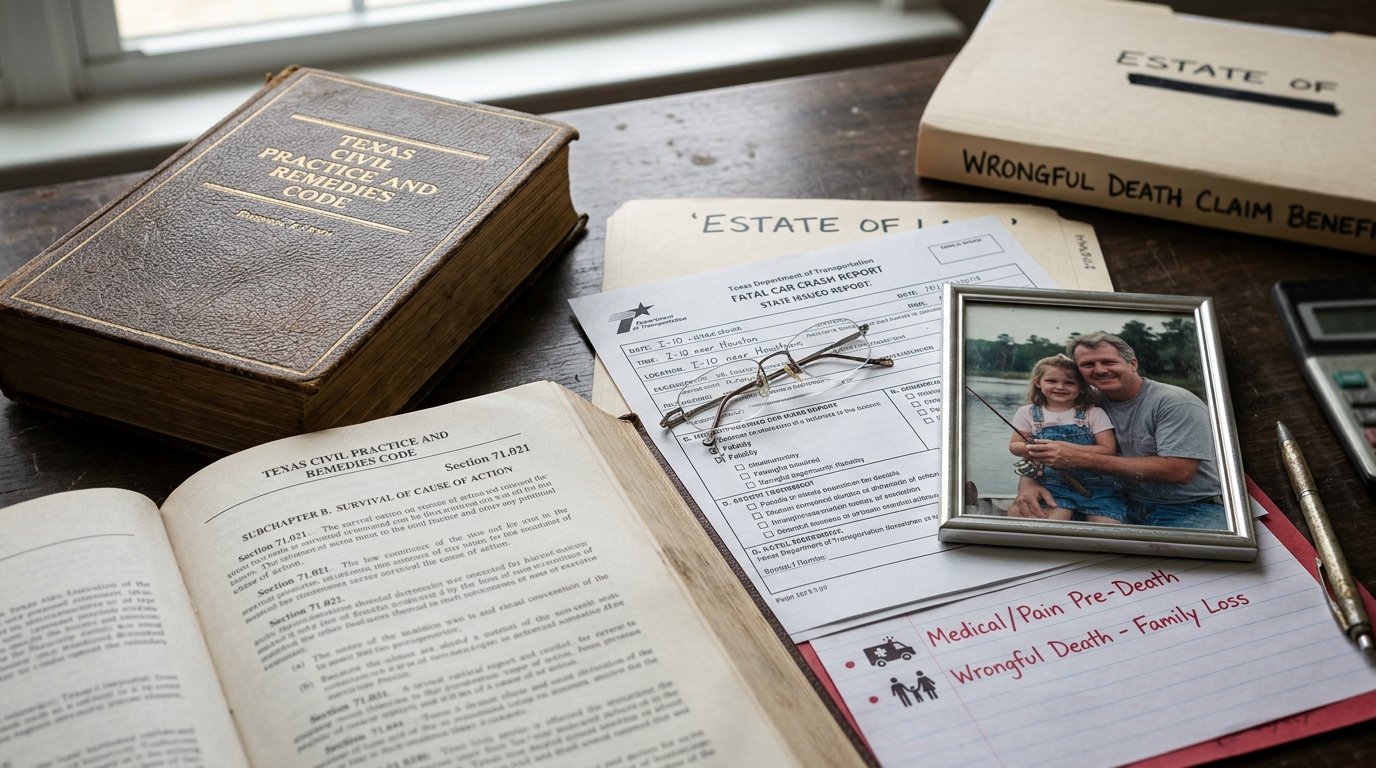
The survival action belongs to the deceased’s estate. It recovers the damages the deceased person would have been entitled to sue for had they survived their injuries. If someone is seriously injured in a crash on Monday and dies from those injuries on Friday, the four days of pain and suffering, the medical expenses incurred during treatment, and the income lost during that period are all recoverable through a survival action, because those are the deceased’s own losses, not the family’s.
As explained by Nolo’s legal reference on Texas wrongful death law, both actions often arise from the same event and are frequently filed together in the same lawsuit. But they are legally distinct: the wrongful death claim compensates the family for their losses, while the survival action compensates the estate for the deceased’s losses between injury and death.
The proceeds of a survival action go to the estate and are distributed to heirs according to the will or, if there is no will, under Texas intestacy law. They are not automatically distributed to the wrongful death beneficiaries, and they are subject to the deceased’s debts in ways that wrongful death proceeds are not.
What Damages Are Recoverable Under Texas Wrongful Death Law
Texas Civil Practice and Remedies Code Section 71.010 provides that the jury may award damages in an amount proportionate to the injury resulting from the death. Those damages fall into three categories.
Economic damages address the measurable financial losses the family sustains because of the death. These include:
• Lost earnings and earning capacity, the income the deceased would have provided over their remaining working life
• Loss of household services, the contributions to childcare, home maintenance, and other domestic labour the deceased provided
• Funeral and burial expenses
• Medical expenses incurred between the injury and the death, typically pursued through the survival action but recoverable in the overall litigation
Calculating lost earning capacity in a wrongful death case requires economic analysis, including the deceased’s education, career trajectory, age, health, and expected retirement date. In cases involving young professionals or primary earners with dependant children, the economic damage projection can be substantial.
Non-economic damages address losses that cannot be assigned a precise dollar value but are real, legally recognised, and often constitute the largest portion of a wrongful death recovery. These include:
• Loss of companionship and society the love, comfort, guidance, and presence the deceased provided to their family
• Mental anguish the emotional pain and suffering experienced by surviving family members
• Loss of consortium for a surviving spouse, the loss of the marital relationship including companionship and intimacy
• Loss of guidance and counsel for minor children who lose a parent, the loss of parental advice, instruction, and support they would have received over their lives
Texas places no general cap on economic or non-economic damages in wrongful death cases arising from negligence. The jury has full discretion on the amount, subject to post-verdict review.
Exemplary damages, also called punitive damages, are available under Section 71.009 when the death was caused by a wilful act or omission or gross negligence. Their purpose is punitive, to punish conduct that goes beyond ordinary negligence and deter similar conduct. They are subject to caps under Chapter 41 of the Texas Civil Practice and Remedies Code. One important constitutional limitation applies: under Article XVI, Section 26 of the Texas Constitution, the right to recover exemplary damages in a wrongful death case extends to the surviving spouse and children only. Surviving parents may recover all actual economic and non-economic damages but are constitutionally excluded from exemplary damages under current Texas law.
How Wrongful Death Proceeds Are Divided Among Multiple Family Members
When more than one eligible family member has a wrongful death claim, the question of how the proceeds are divided is governed by Section 71.010 of the Texas Civil Practice and Remedies Code.
In a trial, the jury determines both the total damages and how those damages are apportioned among the eligible claimants based on the proportionate injury each person suffered. A surviving spouse who was the deceased’s primary companion and financial partner may receive a larger share than an adult child who lived independently. A minor child who lost a parent may receive a substantial allocation reflecting the years of guidance, support, and companionship lost. The court retains oversight over any apportionment involving minor children to ensure their interests are protected.
In settlement, which is how most wrongful death cases resolve, adult beneficiaries are given the opportunity to work out the division among themselves. If they can agree, that agreement governs. If they cannot, the dispute over apportionment may itself require resolution through the legal process. Wrongful death damages recovered are not subject to the deceased’s debts, meaning creditors of the estate cannot reach the family’s recovery.
This apportionment question is one of the most practically important issues in wrongful death cases involving large families or complex relationships, and it is worth understanding early rather than after a settlement offer arrives.
The Types of Cases Where Jonathan Herrera Handles Wrongful Death Claims
Wrongful death cases have a specific legal framework, but the facts that give rise to them vary widely. Jonathan Herrera handles wrongful death claims in several specific contexts where his background adds direct value.
Construction and industrial accidents. When a worker is killed on a Houston-area construction site or industrial facility, the wrongful death case frequently involves multiple parties, the general contractor, subcontractors, the property owner, and equipment manufacturers, each with separate insurance structures and defences. Jonathan’s adjusting background specifically included high-exposure industrial claims, giving him direct insight into how carriers assess and manage these cases internally.
Commercial truck crashes. Fatal commercial truck crashes involve corporate defendants, FMCSA regulatory frameworks, and carrier insurance structures that make them structurally different from standard wrongful death cases. The evidence preservation timeline is compressed and the carrier’s rapid response team begins building its defence immediately. Jonathan’s decade evaluating commercial vehicle claims from the carrier side provides a distinct advantage in these cases.
DUI fatalities. When a wrongful death results from a drunk driver, the factual basis for exemplary damages under Section 71.009 is often present. Texas law also recognises dram shop liability under the Texas Alcoholic Beverage Code, the potential responsibility of a bar or restaurant that over-served the driver. DUI wrongful death cases can involve both the driver and the establishment as defendants.
Across all three contexts, the serious injury and wrongful death practice at Herrera PLLC is built around the understanding that these cases require earlier action, more thorough investigation, and a deeper understanding of how the defendant’s side is building its defence than a standard negligence claim.
Frequently Asked Questions About Texas Wrongful Death Lawsuits
Who is legally entitled to file a wrongful death lawsuit in Texas and who is excluded?
Under Texas Civil Practice and Remedies Code Section 71.004, only the surviving spouse, biological or adopted children, and biological or adoptive parents of the deceased may file a wrongful death claim. Siblings, grandparents, stepparents, stepchildren who were not legally adopted, and unmarried partners outside of a recognised common-law marriage do not have standing under Texas law. If none of the eligible family members file within three months of the death, the estate’s personal representative must file unless all eligible family members request otherwise.
What is the difference between a wrongful death claim and a survival action in Texas?
A wrongful death claim belongs to the family and compensates them for their own forward-looking losses, lost financial support, lost companionship, and mental anguish. A survival action belongs to the estate and recovers the losses the deceased person suffered between the injury and the moment of death, pain and suffering, medical expenses, and lost income during that period. Both claims frequently arise from the same event and are pursued together in the same lawsuit, but they are legally distinct, governed by different provisions of Chapter 71, and their proceeds are distributed differently. Wrongful death proceeds go directly to the eligible family members and are not subject to the deceased’s debts. Survival action proceeds go into the estate and are distributed under the will or intestacy law, and can be reached by the deceased’s creditors.
What types of financial compensation can a Texas family recover after a preventable death?
Texas wrongful death damages include economic damages such as lost earning capacity, loss of household services, and funeral expenses, as well as non-economic damages including loss of companionship and society, mental anguish, loss of consortium for a surviving spouse, and loss of parental guidance for minor children. Texas places no general cap on economic or non-economic damages in negligence-based wrongful death cases. Exemplary damages are also available under Section 71.009 when the death resulted from gross negligence or a wilful act, subject to statutory caps, though under Article XVI, Section 26 of the Texas Constitution they are limited to the surviving spouse and children. Surviving parents may recover all actual economic and non-economic damages but are constitutionally excluded from exemplary damages under current Texas law.
How is a wrongful death settlement divided if multiple family members have claims in Texas?
In a trial, the jury apportions damages among eligible claimants based on each person’s proportionate loss under Section 71.010. In a settlement, adult beneficiaries first have the opportunity to agree on the division among themselves. If they cannot agree, the dispute may require further legal process. When minor children are among the claimants, the court oversees the apportionment to protect their interests. Wrongful death proceeds are not subject to the deceased’s debts, so creditors of the estate cannot claim any portion of the family’s recovery.
What is the deadline to file a wrongful death lawsuit in Texas and are there any exceptions for minors?
The standard deadline is two years from the date of death under Texas Civil Practice and Remedies Code Section 16.003. For minor children, this deadline is tolled until the child turns 18, meaning a minor child’s individual claim does not expire until their 20th birthday. This protection applies to the minor’s individual claim only. Other eligible family members, such as a surviving spouse, must still file within the standard two-year window. Additional tolling may apply in cases involving fraudulent concealment, delayed discovery of the cause of death, or legal incapacity.
What This Framework Means in Practice
Texas wrongful death law creates a clear but strict framework. The right people must bring the right claims within the right windows. The wrongful death claim and the survival action operate in parallel but serve different purposes. Damages are real and meaningful, both the economic losses that can be calculated and the non-economic losses that reflect the depth of what a family has actually lost.
What the framework cannot do on its own is preserve the evidence, identify every responsible party, or navigate the insurance structures that sit between a family and a fair recovery. That is where legal representation in the months immediately following a death makes the difference between what the law provides in theory and what a family actually receives.
For any family currently navigating these questions, speaking with an attorney who handles wrongful death cases across the construction, industrial, and commercial vehicle contexts is a meaningful first step toward understanding what Texas law provides in their specific situation.
Jonathan Herrera, J.D. is a Houston-based attorney who represents families in wrongful death cases and seriously injured Texans across the state. Before practicing law, he spent over a decade as a licensed insurance adjuster managing high-exposure casualty claims, including fatal commercial vehicle and industrial cases, for carriers and third-party administrators across multiple states. He is the founder of Herrera PLLC and a member of the Texas Trial Lawyers Association and the American Association for Justice.