

Left-turn crashes rank among the most common types of intersection accidents in Houston, and they carry a legal wrinkle that catches many drivers off guard: Texas law places a specific duty on the driver making the turn. Understanding that duty, and the exceptions to it, matters both for what happened at the scene and for how an insurance company will evaluate the claim afterward.
Herrera PLLC represents drivers and passengers hurt in left-turn collisions throughout Houston and across Texas.
Right of Way Rules for Unprotected Left Turns in Texas
Under Texas Transportation Code Section 545.152, a driver turning left at an intersection must yield the right-of-way to oncoming traffic that is in the intersection or close enough to it to be an immediate hazard. That is the core rule, and it places the legal burden on the turning driver, not the driver going straight through.
At an unprotected intersection, one without a dedicated left-turn arrow, a driver waiting to turn left has to judge the speed and distance of oncoming traffic on their own, often while a line of cars waits behind them. The statute does not require the oncoming driver to slow down, swerve, or otherwise accommodate a car attempting to turn in front of them. It requires the turning driver to wait until the way is genuinely clear. At busy Houston intersections, including corridors along I-10, I-45, and Highway 288, where traffic volume can make judging a safe gap difficult, this rule is often the starting point for determining fault after a crash.
Why the Left-Turning Driver Is Usually, But Not Always, at Fault
Because Section 545.152 places the yield obligation on the turning driver, that driver is often presumed to have failed to yield when a left-turn collision occurs. Insurance adjusters and investigators frequently start from this presumption, and in many cases the evidence supports it. A driver who misjudges an oncoming vehicle’s speed, turns during a gap that was not actually safe, or turns without a clear view of the intersection has generally violated the statutory duty.
Having spent over a decade evaluating high-exposure claims from the insurance carrier’s side before becoming an attorney, Jonathan Herrera has seen how adjusters apply this presumption, and how quickly it can be applied in a way that overlooks the full picture. The presumption is not an automatic fault. It can be challenged, and the specific facts of the intersection, the timing, and both drivers’ conduct all factor into a proper evaluation of the claim.
When the Oncoming Driver Shares Responsibility
Texas follows a modified comparative negligence rule, meaning fault in a left-turn crash does not have to fall entirely on one driver. The oncoming driver can share responsibility, and in some cases bear the majority of it, depending on what they were doing in the moments before impact.
Common scenarios where the oncoming driver’s conduct becomes relevant include excessive speed that made the turning driver’s judgment of the gap inaccurate, running a red light or entering the intersection after the light had already changed, and distraction that delayed a reaction the driver could otherwise have made in time. Under Texas’s modified comparative negligence rule, an injured party can still recover damages even if they were partly at fault, as long as they are not found more than 50% responsible, though any recovery is reduced by their assigned percentage of fault. This is why a full investigation into both drivers’ speed, positioning, and timing matters just as much as the initial presumption against the turning driver.
Yellow Light Timing and Intersection Design as Evidence
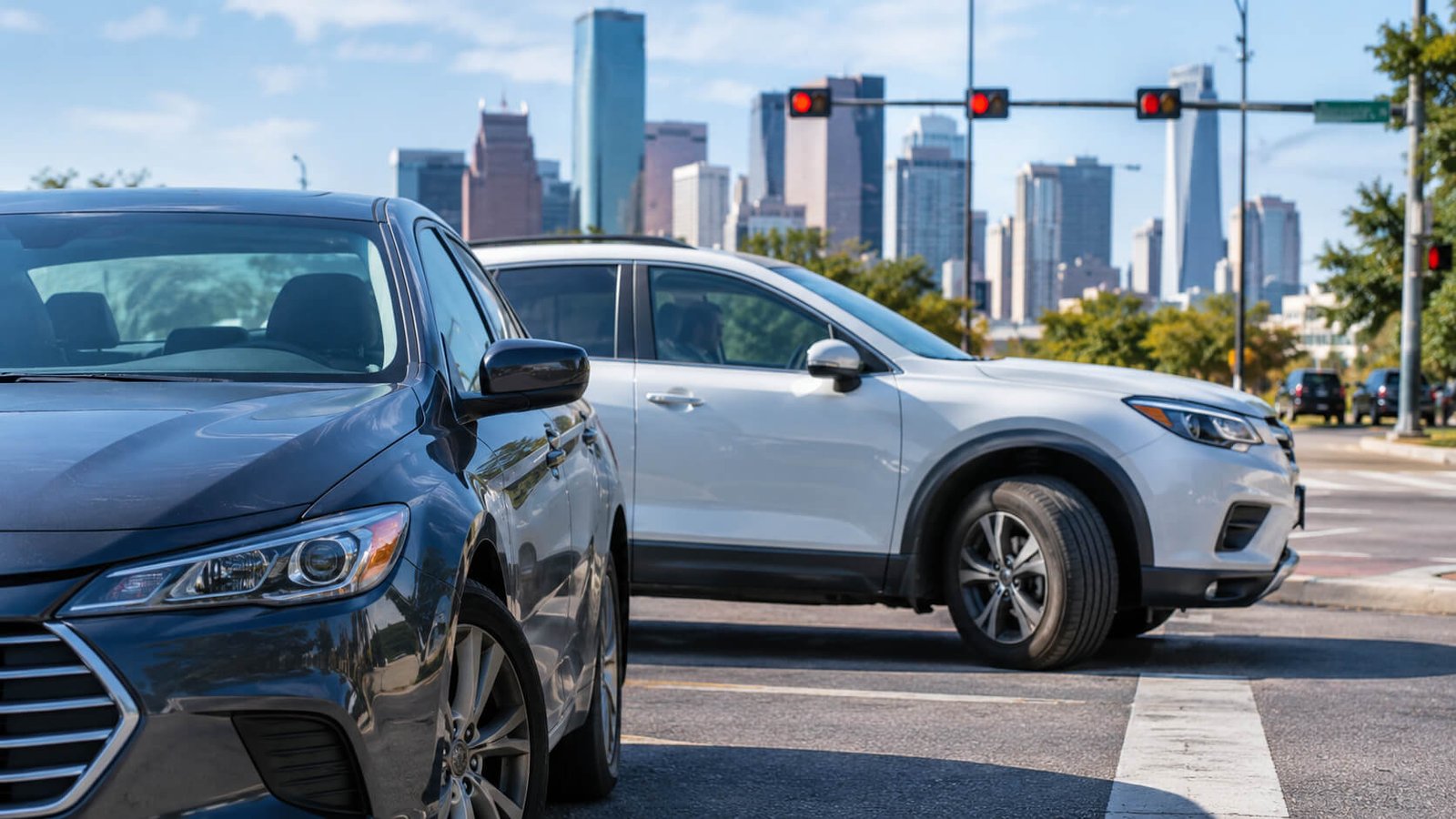
Signal timing plays a direct role in many left-turn disputes. A driver who begins a turn believing they have adequate time may find that the yellow light changed to red faster than expected, or that a permissive left-turn phase left ambiguity about who had the right-of-way at that moment. Signal timing records, when available, can help establish exactly what each driver was facing at the intersection.
Intersection design is also frequently relevant, including:
- Limited sightlines caused by landscaping, parked vehicles, or the angle of the roadway
- Whether a dedicated turn lane or protected arrow phase was present
- The physical layout and condition of the intersection itself
Houston’s mix of older, unsignalized intersections in neighborhoods like the East End and Greater Heights and newer signalized ones along major thoroughfares means the physical layout of the crash site is often worth documenting closely as part of building the case.
Motorcycle and Pedestrian Vulnerability in Left-Turn Crashes
Left-turn crashes carry heightened risk for motorcyclists and pedestrians, who are harder to see and far more vulnerable to serious injury than an occupant of another passenger vehicle. A motorcycle’s narrower profile can make it more difficult for a turning driver to judge its speed and distance accurately, and a pedestrian crossing with the signal can be struck by a driver focused on gaps in oncoming vehicle traffic rather than on people already in the crosswalk.
These cases often involve the same right-of-way analysis under Section 545.152, but the injuries tend to be more severe given the lack of protection available to a rider or a person on foot. Evaluating a left-turn claim involving a motorcyclist or pedestrian generally requires close attention to sightlines, the timing of the pedestrian or turn signal, and the point of impact.
Building a Left-Turn Accident Case With Traffic Camera Footage
Traffic camera footage, when it exists, can be some of the most valuable evidence in a left-turn crash. Footage from traffic management cameras or nearby business security systems can show the actual positions and speeds of both vehicles in the moments before impact, rather than relying solely on driver accounts or witness memory.
Because this footage is often overwritten or deleted within days, requesting and preserving it early is one of the most time-sensitive steps in a left-turn case. Combined with the police report, witness statements, and any available signal timing data, camera footage can help establish a clearer picture of fault than either driver’s account alone.
What to Do After a Left-Turn Accident
What happens in the hours and days after a left-turn collision often shapes how the claim gets evaluated later. A police report documenting the scene, medical records showing the extent of any injuries, photographs of vehicle positions and damage, and any nearby camera footage all become part of the evidence an insurance company or court will eventually weigh. The earlier this information is gathered and preserved, the more complete a picture it gives of what actually happened at the intersection.
Most personal injury claims arising from a left-turn collision in Texas are subject to a two-year statute of limitations. Car accident cases at Herrera PLLC are handled on a contingency fee basis, meaning there are no upfront attorney’s fees and no obligation to pay unless compensation is recovered.
Frequently Asked Questions
Who has the right of way in an unprotected left turn?
Under Texas Transportation Code Section 545.152, a driver turning left must yield the right-of-way to oncoming traffic that is in the intersection or close enough to it to be an immediate hazard. The driver going straight through generally has the right-of-way in this situation.
Is the left-turning driver always at fault?
Not always. The left-turning driver is often presumed to have failed to yield, but that presumption can be challenged depending on the oncoming driver’s speed, whether a traffic signal was obeyed, and other facts specific to the crash.
Can the oncoming driver share fault?
Yes. Under Texas’s modified comparative negligence rule, fault can be shared between both drivers. An injured party can still recover damages if they are not found more than 50% at fault, though their recovery is reduced by their percentage of responsibility.
Does traffic camera footage help my case?
It can be significant evidence. Camera footage from traffic systems or nearby businesses may show vehicle speed and positioning at the time of the crash, but this footage is often only available for a limited time, so requesting it early matters.
Are motorcyclists at higher risk in left-turn crashes?
Motorcyclists and pedestrians generally face a higher risk of serious injury in left-turn collisions due to their limited visibility and lack of protection compared to occupants of a passenger vehicle. The same right-of-way rules under Section 545.152 typically apply to these cases.
What if there’s no camera footage or witnesses?
Fault can still be established through the police report, the physical damage to both vehicles, and the position of the vehicles at the scene, even without camera footage or independent witnesses.
How long do I have to file a claim after a left-turn accident in Texas?
Most personal injury claims in Texas must be filed within two years of the date of the accident. Certain circumstances can affect this timeline, so it’s worth discussing the specific facts of your case early.
This article is for general informational purposes only and does not constitute legal advice, and the facts of any specific accident can change how Texas law applies. If you or a family member has been hurt in a left-turn collision at a Houston intersection, Herrera PLLC offers a free, confidential consultation with no obligation. Call 832-891-3210 or contact us online to discuss what happened.
Jonathan Herrera, J.D. is a Houston-based attorney and the founder of Herrera PLLC, representing individuals and families across Texas in serious injury, insurance law, and civil litigation matters. Before practicing law, he spent over a decade as a licensed insurance adjuster managing high-exposure casualty and property claims for carriers and third-party administrators across multiple states, and he later practiced insurance defense before founding Herrera PLLC. He is a member of the Texas Trial Lawyers Association and the American Association for Justice.