
What the Trucking Company Does in the First 24 Hours After a Crash — And Why That Should Worry You

You’re still at the crash scene. Maybe you’re waiting for an ambulance. Maybe you’ve already been taken to the hospital. Either way, while you’re focused on surviving the next few hours, something else is already happening, and it isn’t happening in your favour.
Within hours of a serious commercial truck crash in Texas, the carrier’s insurer has activated a rapid response team. Investigators. Adjusters. Often a defence attorney. These are professionals whose job is to reach the scene before evidence disappears, before witnesses disperse, and before you have anyone working on your side. They are not there to help you. They are there to build the carrier’s defence while the facts are still fresh and malleable.
This isn’t speculation. It’s standard industry practice. Jonathan Herrera spent over a decade on the carrier side of commercial vehicle claims before becoming an attorney, evaluating exactly these kinds of high-exposure cases. He knows what that response team is doing because he worked within the same system. What follows is what that first 24 hours actually looks like, from the inside.
Texas Is the Worst State in America for Truck Crashes. The Numbers Are Not Abstract.
Before getting into what the trucking company does, it’s worth understanding the scale of what’s happening on Texas roads.
According to TxDOT data, Texas reported 39,393 total commercial vehicle crashes in 2024, resulting in 608 fatalities and 1,601 serious injuries. Texas has led the nation in fatal commercial vehicle accidents for ten consecutive years. That’s not a statistical anomaly. It reflects the state’s position as the primary freight corridor for the country, with thousands of commercial vehicles crossing daily on I-10, I-45, and the state’s major freight routes.
The concentration of crashes around Houston is particularly significant. According to TxDOT’s Commercial Motor Vehicle (CMV) Involved Crashes and Injuries by County data, Harris County logged 6,313 commercial vehicle crashes in 2024 with 41 deaths and hundreds of serious injuries. That’s more than double the crash count of the next highest county in Texas, and it reflects the sheer volume of commercial traffic moving through one of the country’s largest port and distribution hubs.
Behind every one of those numbers is a crash scene where two very different timelines began running simultaneously: the injured person’s timeline, focused on survival and recovery, and the carrier’s timeline, focused on evidence and liability management.
What the Rapid Response Team Does When It Arrives
Large trucking companies and their insurers maintain what are commonly called rapid response teams: pre-arranged groups of investigators, accident reconstruction specialists, insurance adjusters, and often defence attorneys who can be deployed to a serious crash scene within hours of notification. The carrier’s insurer is typically notified faster than any other party. The driver calls dispatch. Dispatch calls the carrier’s safety department. The safety department calls the insurer. By the time law enforcement has finished its initial report, the carrier’s team may already be on the way.
What that team does on arrival is methodical and purposeful.
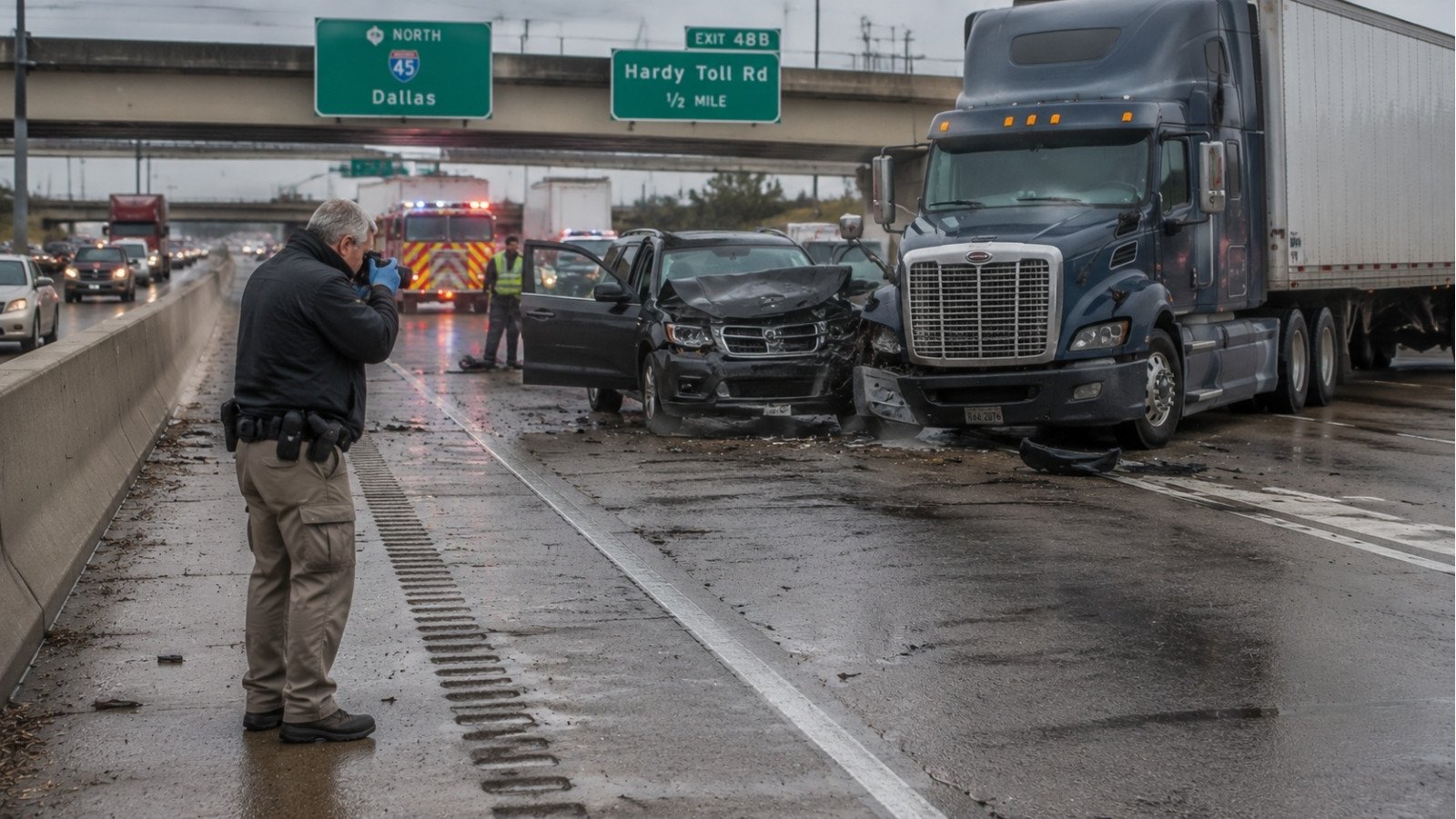
Scene documentation, from their perspective. The team photographs the scene, the vehicles, the road conditions, the debris field, and the surrounding environment. These photographs are taken to document what helps the carrier’s defence, not to establish a neutral record. The angle, framing, and selection of what gets photographed is controlled by people whose job is to minimise the carrier’s liability exposure. If something in the scene supports the injured party’s account, it may not make it into the carrier’s documentation.
Witness interviews, while memories favour them. Witnesses at a crash scene are approached and interviewed while the event is still immediate. In a serious crash, the injured party is frequently unavailable, in an ambulance, in surgery, or in a hospital bed. The carrier’s team has access to the witnesses first. Statements taken in the immediate aftermath of a crash carry significant weight. What those witnesses say in the hours after a crash shapes the evidentiary record in ways that are difficult to revise later.
Driver interview and narrative control. The carrier’s attorney or representative interviews the driver while the crash is still fresh. The driver is an employee of the carrier. Their account of events is shaped in the context of that relationship, and they have access to legal guidance that the injured party does not. The driver’s contemporaneous account, given to people working for the carrier, becomes part of the record the carrier relies on.
Black box download, before the clock runs out. This is the most time-sensitive action the carrier’s team takes, and it’s the one with the most direct impact on the injured party’s ability to prove their case.
The Black Box: What It Records and Why the Carrier Moves Fast to Access It
Modern commercial trucks carry multiple electronic data systems. The Electronic Control Module (ECM), sometimes called the black box, records the truck’s speed, braking inputs, throttle position, engine fault codes, and operational data in the seconds before a crash. The Electronic Logging Device (ELD), mandatory for most commercial carriers under FMCSA regulations since December 2017, records the driver’s hours of service history, creating a tamper-resistant record of how long the driver had been on the road before the crash.
Together, these two data sources can reconstruct what the truck was doing before impact with forensic precision. They can confirm or contradict the driver’s account. They can show whether the driver was fatigued, speeding, or braking late. They can reveal FMCSA violations that the carrier would prefer never see the inside of a courtroom.
ECM data overwrites automatically on a cycle of 14 to 30 days, depending on the carrier and the truck’s make and model. Once the truck returns to service, the clock on that data begins running immediately. Some systems overwrite in as little as two weeks.
The carrier’s response team knows this. Their investigators are trained to download and preserve this data for the carrier’s use. Once downloaded, the carrier controls what they share and when. Unless a formal legal preservation demand is served on the carrier, creating a documented legal duty to retain all electronic evidence, that data can be overwritten through ordinary business operations without consequence.
ELD records carry a longer federal retention requirement. Under 49 CFR § 395.8(k)(1), motor carriers must retain records of duty status and supporting documents for six months. That window is longer, but it isn’t permanent. For an injured party without legal representation, six months can pass before anyone thinks to demand preservation.
The FMCSA Regulations That Create Evidence and Exposure
Federal Motor Carrier Safety Administration regulations govern commercial trucking operations across the United States, including in Texas. These regulations exist to create minimum safety standards. In the context of a serious crash, they also create a documented record of whether the carrier and driver were operating in compliance, and non-compliance with FMCSA regulations is among the most powerful evidence available in commercial truck crash litigation.
The key regulatory frameworks relevant to crash evidence include:
• Hours of Service regulations. Federal rules limit how many hours a commercial driver can operate a vehicle before mandatory rest periods. A driver who was operating in violation of HOS limits at the time of a crash was driving in a fatigued state that federal law specifically prohibits. The ELD captures this.
• Electronic Logging Device mandate. Since December 2017, most carriers operating in interstate commerce are required to use ELDs. These devices create records that are significantly harder to falsify than the paper logbooks they replaced. Discrepancies between ELD data and other records, such as fuel receipts, GPS pings, and toll records, can establish that a driver falsified their hours.
• Driver qualification file requirements. Carriers must maintain records of each driver’s qualifications, including licence status, medical certifications, and training records. Deficiencies in these files can establish negligent hiring or retention.
• Vehicle maintenance records. Federal regulations require carriers to maintain systematic inspection and maintenance records for each commercial vehicle. Brake failures, tyre deficiencies, and mechanical issues that contributed to a crash may appear in maintenance records the carrier would prefer to keep quiet.
Each of these regulatory frameworks creates records subject to specific federal retention periods. Each is also a target for the carrier’s legal team to assess in the immediate aftermath of a crash, to understand what exposure exists and how to manage it.
Why Early Contact from the Carrier’s Representative Is Not in Your Interest
In the hours and days following a serious truck crash, it’s common for an injured party to receive a call from a representative of the trucking company’s insurer. The call is often framed as helpful, checking on your wellbeing, offering to process the claim quickly, asking a few routine questions.
What that call actually represents is an early attempt to obtain information that benefits the carrier’s position before the injured party has legal representation or a full understanding of their rights.
Several things can happen in that call that are difficult to undo.
Recorded statements. The adjuster may ask for a recorded statement about the crash. A statement given in the immediate aftermath of a serious injury, when the injured party is in pain, medically compromised, and without legal counsel, captures an account that is inevitably incomplete. The carrier’s team then has a recorded baseline they can use to challenge any subsequent account that is more fully developed.
Early settlement offers. In high-exposure commercial truck cases, early settlement offers are sometimes made before the full extent of injuries is known, before diagnostic imaging has been completed, and before any analysis of FMCSA violations has been done. The gap between an early offer and the full value of a case is often significant, and that gap is rarely apparent to an injured party navigating the process alone.
Characterisation of the crash. What the injured party says about how the crash happened, even casually or conversationally, becomes part of the record. Statements that seem innocuous can be used to assign contributory fault, which under Texas’s modified comparative negligence rule can reduce recovery proportionally or eliminate it entirely if the injured party is found more than 50% responsible.
Jonathan Herrera evaluated commercial vehicle claims on the carrier’s side for over a decade. He knows what adjusters are listening for in those early calls. He knows what language gets flagged in a claim file and how it shapes the carrier’s internal assessment of their liability exposure. The early contact from a carrier’s representative is not a neutral customer service gesture. It is a claims management tactic.
The Evidence That Disappears Fastest
Beyond the black box, other categories of evidence in commercial truck crashes operate on short timelines that work against an injured party who isn’t represented.
Dashcam and forward-facing camera footage. Many commercial trucks are equipped with inward and outward-facing cameras. Footage showing the driver distracted, drowsy, or on a phone in the moments before a crash is among the most compelling evidence available. Like ECM data, camera footage is typically stored on a rolling overwrite cycle. Carriers preserve footage selectively; footage that helps them may be kept, footage that doesn’t may not survive.
Scene evidence. Skid marks, debris patterns, road conditions, and vehicle positions tell a story that begins degrading the moment the crash scene is cleared. Weather conditions, road treatment, and traffic management changes can alter or eliminate physical evidence within days.
Witness availability. Witnesses identified at the scene and not formally contacted quickly become difficult to locate. Without documented contact information and a contemporaneous statement, witness testimony becomes reliant on memory that fades over time.
Post-accident drug and alcohol testing. Federal regulations under 49 CFR Part 382.303 require post-accident drug and alcohol testing of commercial drivers, but the trigger conditions matter and they contain gaps that work against injured parties. Testing is mandatory regardless of citation when a crash results in a fatality. For crashes involving bodily injury requiring medical treatment away from the scene, or disabling vehicle damage requiring a tow, testing is only mandatory if the driver received a citation for a moving traffic violation. That means a serious crash in which the investigating officer does not cite the driver may produce no mandatory drug or alcohol test at all. The alcohol test window is eight hours from the crash. The drug test window is 32 hours. If those windows close without testing being conducted, the evidence of the driver’s condition at the time of impact may never be formally established. That is precisely why the carrier’s team moves fast and why the gaps in mandatory testing are worth understanding.
What Levels the Playing Field
The carrier’s response team has one structural advantage that operates regardless of fault: they move first. They have resources, experience, and a clear mandate. The injured party typically has none of those things in the first 24 hours.
What changes that dynamic is the same mechanism the carrier’s team is trying to prevent: a legal hold. A formal preservation demand sent to the carrier by an attorney creates a documented legal obligation to retain all evidence, including ECM data, ELD records, camera footage, maintenance records, driver files, and communications. If the carrier allows evidence to be destroyed after receiving that demand, courts may sanction them and instruct juries to draw adverse inferences about what the destroyed evidence would have shown.
The 14-to-30-day ECM window is a real deadline, not a theoretical one. The carrier’s team understands its significance better than most injured parties do, which is one of the structural imbalances that legal representation in commercial truck cases is specifically designed to address.
The serious injury practice at Herrera PLLC is built around the understanding that commercial truck cases require a different approach than standard vehicle crashes. Federal regulations, carrier insurance structures, multi-party liability questions, and the evidence timelines specific to commercial vehicles all require someone who has evaluated these cases from the other side of the table, not just as an attorney, but as the adjuster who decided what those claims were worth.
Frequently Asked Questions About Trucking Company Accident Response
Why does the trucking company’s insurance team arrive at the accident scene before I even leave the hospital?
Large commercial carriers and their insurers maintain rapid response teams specifically for serious crash events. The driver notifies dispatch immediately after a crash, and the insurer is activated within minutes. Their goal is to reach the scene while evidence is intact, while witnesses are still present, and before any other party has begun building a competing account of what happened. The injured party is almost always at a disadvantage in this window, receiving medical care while the carrier’s team is working the scene.
How long does a Texas trucking company have to preserve the truck’s black box data before it is overwritten?
There is no federal law requiring a carrier to preserve ECM data simply because a crash occurred. Without a formal legal preservation demand, the data can be overwritten as quickly as 14 days after the crash, depending on the truck’s systems and whether the vehicle returns to service. ELD records carry a longer federal retention minimum of six months under FMCSA regulations. The timeline for both data types is one of the key structural imbalances in commercial truck crash cases, and it is one the carrier’s team is well aware of.
Why should I never give a recorded statement to a trucking company’s insurance adjuster in Texas?
A recorded statement given in the immediate aftermath of a serious injury is almost always incomplete. The injured party doesn’t yet know the full extent of their injuries, hasn’t reviewed any evidence, and doesn’t have legal representation. The carrier’s adjuster uses that statement to establish a baseline account that can be used to challenge more fully developed accounts later. In high-exposure commercial truck cases, the early recorded statement is one of the most valuable tools available to the carrier’s defence team, which is precisely why it’s requested so quickly.
What federal regulations apply to Texas truck drivers and how do violations help an injury case?
Commercial truck drivers operating in Texas are governed by Federal Motor Carrier Safety Administration regulations, which include Hours of Service limits on consecutive driving time, Electronic Logging Device requirements that create tamper-resistant duty records, vehicle maintenance and inspection mandates, and driver qualification requirements. When a carrier or driver was in violation of these regulations at the time of a crash, that violation is evidence of negligence that goes beyond ordinary carelessness. It establishes that the carrier was operating in a manner that federal law specifically prohibits.
What evidence disappears fastest after a commercial truck accident in Texas and how is it preserved?
ECM black box data can be overwritten in as little as 14 to 30 days. Dashcam footage operates on a similar cycle. Physical scene evidence begins degrading as soon as the roadway is cleared. Post-accident drug and alcohol testing has mandatory windows of 8 hours for alcohol and 32 hours for drugs, and testing is only required in injury and property damage crashes if the driver was cited, meaning evidence of driver impairment can go uncaptured entirely in cases where no citation was issued. The formal mechanism for preserving electronic evidence is a legal hold letter, a written demand served on the carrier creating a documented legal duty to retain all relevant evidence. The timeframe in which that mechanism is most effective is measured in days rather than weeks, which reflects how quickly the evidence window closes on the carrier’s side.
The 24-Hour Advantage Is Real, But It Can Be Countered
Texas leads the nation in commercial truck crash fatalities. Harris County alone accounts for more truck crashes than any other county in the country by a wide margin. Every serious truck crash on I-10, I-45, or Highway 288 sets off two simultaneous timelines: the carrier’s response, and whatever response the injured party can mount.
The carrier’s 24-hour head start matters. It shapes the evidence record, the witness statements, and the early narrative around the crash. But it isn’t permanent. A legal hold issued quickly enough catches the electronic data before it’s gone. Proper investigation recovers what the carrier’s team didn’t take. FMCSA records, driver files, and maintenance logs exist in parallel with the carrier’s carefully curated documentation, and they tell their own story.
For anyone who has been injured in a commercial truck crash in Texas and has already been contacted by a carrier representative, speaking with an attorney who has evaluated these cases from both sides of the table is the logical next step before that conversation goes any further.
Jonathan Herrera, J.D. is a Houston-based attorney and licensed appraisal umpire who represents seriously injured Texans in commercial truck crash cases and insurance disputes across the state. Before practicing law, he spent over a decade as a licensed insurance adjuster managing high-exposure casualty claims, including commercial vehicle cases, for carriers and third-party administrators across multiple states. He is the founder of Herrera PLLC and a member of the Texas Trial Lawyers Association and the American Association for Justice.