
Multi-Vehicle Pileups on Houston Freeways: How Fault Gets Divided Among Several Drivers

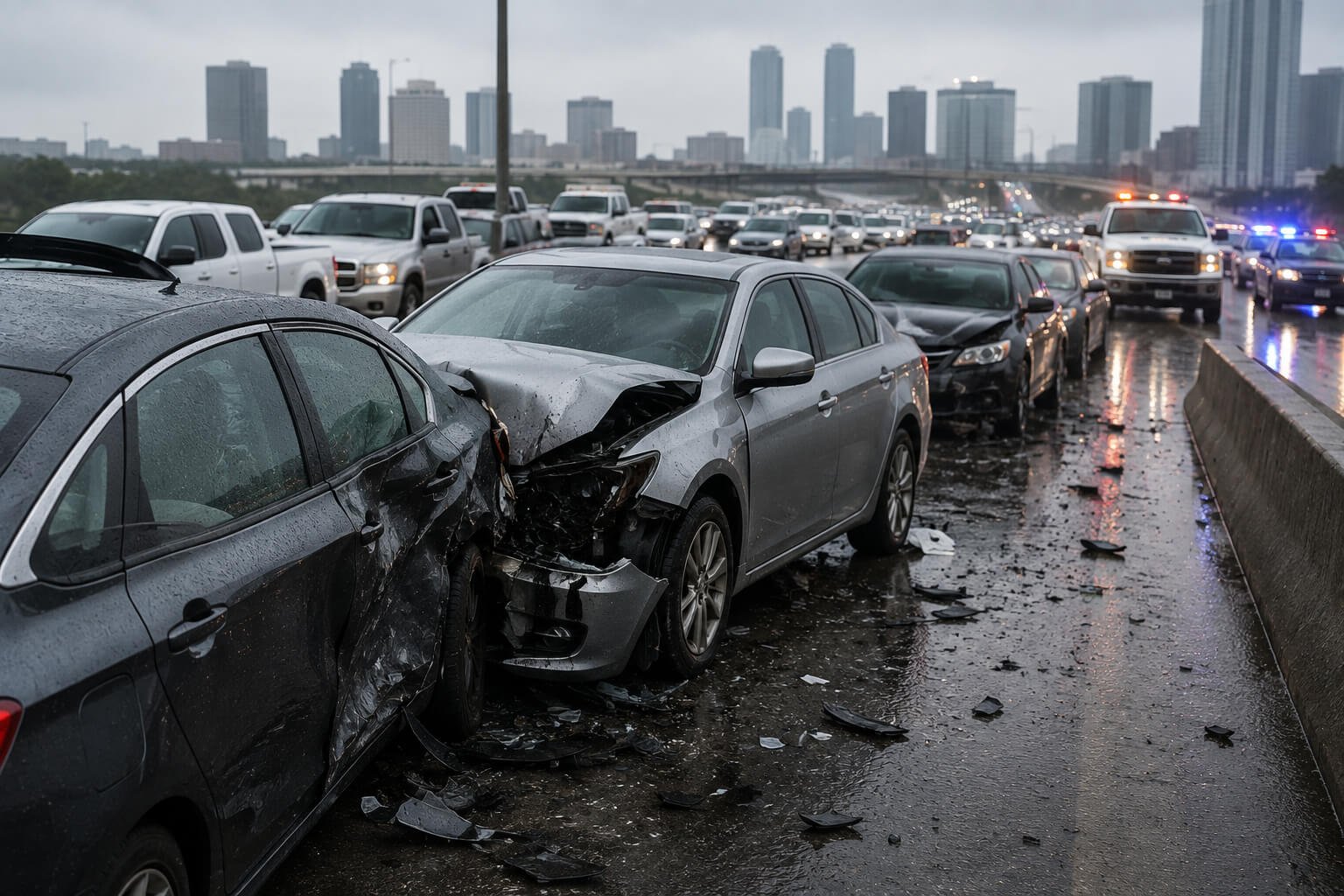
Multi-vehicle pileups can develop in seconds on Houston’s busy freeway system, particularly when rain, sudden braking, or limited visibility leaves drivers with little time to react. When several vehicles collide in succession, determining who is responsible can be far more complicated than in a typical two-car accident. Each driver’s actions may need to be examined alongside the timing and sequence of the collisions, while multiple insurance companies may become involved in the claim.
Under Texas law, responsibility for a multi-vehicle crash can be divided among multiple parties based on each party’s percentage of responsibility. Determining how that responsibility should be allocated requires looking closely at the evidence, including the sequence of impacts, vehicle damage, witness accounts, photographs, video, and other available evidence.
At Herrera PLLC, Jonathan Herrera brings a background evaluating complex, high-exposure casualty claims as a former insurance adjuster to serious and catastrophic injury matters. This article looks at how fault can be determined in a Houston multi-vehicle pileup, why the sequence of impacts matters, how multiple drivers and insurers may affect a claim, and what injured people should understand before accepting an insurance company’s assessment of responsibility.
Why Fault Gets Complicated When Three or More Vehicles Are Involved
A standard rear-end collision often has a straightforward answer: the trailing driver failed to maintain a safe following distance. Add a third car, and that simplicity disappears. Did the third vehicle strike the second car independently, or was it pushed into the second car by a fourth vehicle behind it? Did one driver’s sudden lane change start the chain, even if that driver’s car was never touched? Each additional vehicle adds another set of facts, another insurance policy, and another party with an incentive to minimize its own share of responsibility.
Houston’s freeway corridors, including I-45, I-10, and Highway 288, see a steady volume of these chain-reaction crashes, particularly during heavy rain or sudden congestion. When several vehicles are involved, insurers on all sides typically conduct their own investigations, and those investigations do not always agree with one another.
Reconstructing the Sequence of Impact
Before fault percentages can be assigned, someone has to establish the actual sequence of events. This usually involves reviewing the police crash report, examining vehicle damage patterns to determine the direction and order of impacts, gathering witness accounts, and, where available, pulling data from vehicle event recorders or nearby traffic cameras. A Texas crash report can be a useful investigative starting point, but it generally is not admissible in a civil case as proof of who was at fault. In some cases, accident reconstruction experts are brought in to model how the vehicles collided and in what order.
This reconstruction work matters because Texas law requires a specific factual finding, not a general impression, before responsibility can be divided. Under Texas Civil Practice and Remedies Code Section 33.003, the trier of fact, meaning the judge or jury deciding the facts of the case, is responsible for determining the percentage of responsibility for each party involved in a case. That determination has to be built on evidence, not assumptions about who was probably to blame.
Comparative Fault Percentages Under Texas’s 51 Percent Bar
Texas follows a modified comparative negligence system, sometimes called proportionate responsibility, under Chapter 33 of the Texas Civil Practice and Remedies Code. Under Section 33.001, an injured person generally cannot recover damages if their own percentage of responsibility is found to be greater than 50 percent. Someone found 50 percent responsible or less may still recover compensation, but the total is typically reduced by their assigned percentage of fault.
In a multi-vehicle pileup, this rule gets applied to every driver involved, not just the person bringing the claim. A jury ultimately makes this determination under Section 33.003, though insurance adjusters often apply the same framework informally when evaluating a settlement. For example, an insurance adjuster may evaluate a claim by assigning 40 percent responsibility to one driver, 35 percent to another, and 25 percent to a third, depending on the facts developed during the investigation. Section 33.013 also provides that a defendant found more than 50 percent responsible can, in some circumstances, be held jointly and severally liable, meaning responsible for the full amount of certain damages, not just their own percentage of fault. That detail alone helps explain why insurers work hard to keep their own driver’s assigned percentage as low as possible in a pileup involving several parties. An attorney can evaluate how these percentages are likely to be argued in a specific case, but the outcome always depends on the individual facts.
Herrera PLLC represents injured drivers and passengers in car accident cases throughout the Houston area, including the multi-vehicle scenarios that raise these more layered fault questions.
Commercial Vehicles in the Chain: Added Insurance Layers
When a commercial vehicle, such as a delivery van or an 18-wheeler, is part of a chain-reaction crash, the claim often becomes more complex rather than simpler. Commercial vehicles are frequently covered by policies with significantly higher limits than a standard personal auto policy, and the company that owns or dispatches the vehicle may also have separate corporate liability exposure. Federal motor carrier regulations can come into play as well, depending on the type of vehicle and the circumstances of the crash.
Having spent over a decade evaluating claims from the insurance carrier’s side, including commercial and trucking claims, before becoming an attorney, Jonathan Herrera understands how differently these policies get evaluated compared to a standard passenger vehicle claim. Herrera PLLC’s truck accident practice specifically addresses the added layers that come with a commercial vehicle in a pileup, including how multiple insurers coordinate, or fail to coordinate, on a shared loss.
Weather, Visibility, and Road Conditions as Contributing Factors
Houston’s Gulf Coast climate is a recurring factor in freeway pileups. Sudden heavy rain, standing water, low visibility from fog, and glare from wet pavement can all contribute to a chain-reaction crash. Weather does not automatically excuse a driver from responsibility. Texas law generally expects drivers to adjust their speed and following distance to match road conditions, so a driver who continues at highway speed through a downpour may still be found at least partially responsible for a resulting collision, depending on the specific facts.
At the same time, weather conditions can be relevant to how fault gets divided among several drivers, particularly when visibility played a role in why a driver could not stop in time. This is another area where the sequence-of-events reconstruction becomes important, since it can help clarify whether a driver’s reaction time was reasonable under the conditions or fell short of what Texas law expects.
Why Insurers From Multiple Companies Often Blame Each Other First
In a two-car crash, one insurer often has a fairly clear incentive to accept some responsibility once the facts are established. In a multi-vehicle pileup, several insurance companies may be involved at once, and each one has a financial incentive to argue that another driver in the chain bears the larger share of fault. It is not unusual for the first offers or positions taken by each carrier to shift blame toward someone else in the pileup, sometimes before a full investigation has even been completed.
This dynamic is one of the reasons insurance companies value getting statements from injured claimants early, before the full sequence of events has been reconstructed. Jonathan Herrera’s background as a licensed insurance adjuster, and his prior experience on the insurance defense side, gives him insight into how carriers evaluate these multi-party claims internally and where they tend to look for ways to reduce their own exposure.
Frequently Asked Questions
How is fault divided in a multi-car pileup?
Fault is generally divided based on a reconstruction of how the crash occurred, including the order of impacts and each driver’s actions leading up to the collision. Under Texas’s proportionate responsibility system, each involved driver may be assigned a percentage of responsibility based on the evidence developed during the investigation.
What is Texas’s 51 percent bar rule?
Under Texas Civil Practice and Remedies Code Section 33.001, an injured person generally cannot recover damages if they are found more than 50 percent responsible for the accident. If their responsibility is 50 percent or less, they may still recover compensation, though the amount is typically reduced by their assigned percentage of fault.
Does a commercial vehicle in the crash change my claim?
It can. Commercial vehicles are often covered by policies with different limits than personal auto insurance, and additional parties, such as the vehicle’s owner or dispatching company, may also be involved. These claims often require a closer look at the applicable insurance layers.
How does weather affect fault in a pileup?
Weather conditions do not automatically excuse a driver from responsibility. Texas law generally expects drivers to adjust to road conditions, so a driver’s response to rain, fog, or wet pavement can factor into how fault is ultimately assigned, depending on the specific facts.
Why do insurers blame each other after a chain-reaction crash?
When several insurance companies are involved in the same pileup, each one has a financial incentive to minimize its own driver’s share of responsibility. This can lead to early positions or offers that shift blame toward other drivers before a full investigation is complete.
This article is provided for general informational purposes and does not constitute legal advice. Every multi-vehicle accident case depends on its own specific facts, and reading this article does not create an attorney-client relationship with Herrera PLLC. If you were injured in a chain-reaction crash on a Houston freeway, Jonathan Herrera offers a free, confidential consultation to help you understand your options, with no fee unless a recovery is made. Call 832-891-3210 or visit the contact page to get started.
Jonathan Herrera, J.D. Jonathan Herrera is the founder of Herrera PLLC, a Houston, Texas law firm representing individuals in serious personal injury, insurance law, and civil litigation matters. Before becoming an attorney, he spent over a decade as a licensed insurance adjuster handling high-exposure casualty and property claims before practicing insurance defense and founding Herrera PLLC. He is a member of the Texas Trial Lawyers Association, the American Association for Justice, and the Houston Trial Lawyers Association.