
Child Drowning at a Texas Pool: How the Attractive Nuisance Doctrine Protects Your Family’s Right to Sue

The worst call a parent can receive is the one they never imagined. A child slips away for a few minutes. A gate is unlatched. A pool at a neighbor’s house, an apartment complex, or a friend’s yard has no fence or a broken one. And in less than five minutes, a life changes forever.
Many families who find themselves in this situation are told, directly or indirectly, that they have no legal claim because their child was not supposed to be near the pool. This belief is wrong under Texas law, and the consequences of accepting it are permanent.
This guide explains the legal doctrine that protects families in exactly this situation, what Texas law requires of pool owners, and what a family’s rights are when a child drowns or suffers a near-drowning at someone else’s property.
Why “My Child Wasn’t Supposed to Be There” Is Not the End of the Legal Analysis
In standard Texas premises liability law, trespassers have limited rights. A property owner who never invited someone onto their land generally owes that person only the duty not to intentionally or willfully harm them. For adult trespassers, this framework often ends the analysis.
For children, Texas law applies a fundamentally different principle: the attractive nuisance doctrine. This doctrine recognizes something every parent already knows, which is that young children do not reason about danger the way adults do. A bright blue pool on a hot summer day is not a hazard to a four-year-old; it is an irresistible invitation. The law holds property owners responsible for that reality.
Texas courts apply a five-element test for attractive nuisance claims, established by the Texas Supreme Court in Texas Utilities Electric Co. v. Timmons, 947 S.W.2d 191 (Tex. 1997), which adopted the framework of Restatement (Second) of Torts Section 339. A property owner can be held liable for injuries to a child trespasser when all five elements are established:
The place where the dangerous condition exists is one upon which the property owner knows or should know that young children are likely to trespass. The condition is one that the owner knows or should know involves an unreasonable risk of death or serious bodily harm to such children. The children, because of their youth, do not discover the condition or appreciate the risk involved. The utility to the owner of maintaining the condition and the burden of eliminating the danger are slight compared to the risk to the children. And the owner fails to exercise reasonable care to eliminate the danger or otherwise protect the children.
Swimming pools satisfy essentially every element of this test as a matter of legal reality. Pools predictably attract children. Drowning is among the most severe risks a young child faces. Toddlers and young children do not appreciate the danger of falling into deep water. The cost of proper fencing, functioning gate latches, and maintained barriers is modest. And the property owner has both the ability and the legal obligation to provide those protections.
What “Appreciating the Danger” Actually Means
The third element of the attractive nuisance test, whether the child appreciated the risk, is often the focus of a defense challenge in pool drowning cases. It is worth understanding what Texas courts actually examine here.
The analysis is not simply about the child’s age, though age is relevant. It concerns whether this particular child, given their developmental stage and understanding, could have recognized the specific danger presented by the pool. A two-year-old who cannot swim and does not understand depth has no meaningful ability to appreciate the risk of drowning. A seven-year-old who knows how to swim but does not understand that they can become exhausted or disoriented in deep water may also lack sufficient appreciation of the full danger.
What a defense rarely succeeds in arguing is that a young child who wanders unaccompanied into a pool area through an improperly secured gate was capable of weighing and accepting the risk of drowning. The doctrine was designed for exactly this scenario.
Texas Pool Fencing Requirements: What Applies Where
One of the most significant and least understood aspects of Texas pool law is that the state’s primary fencing statute does not apply uniformly to all pools. This distinction matters enormously for both the legal claim and for understanding what obligation existed.
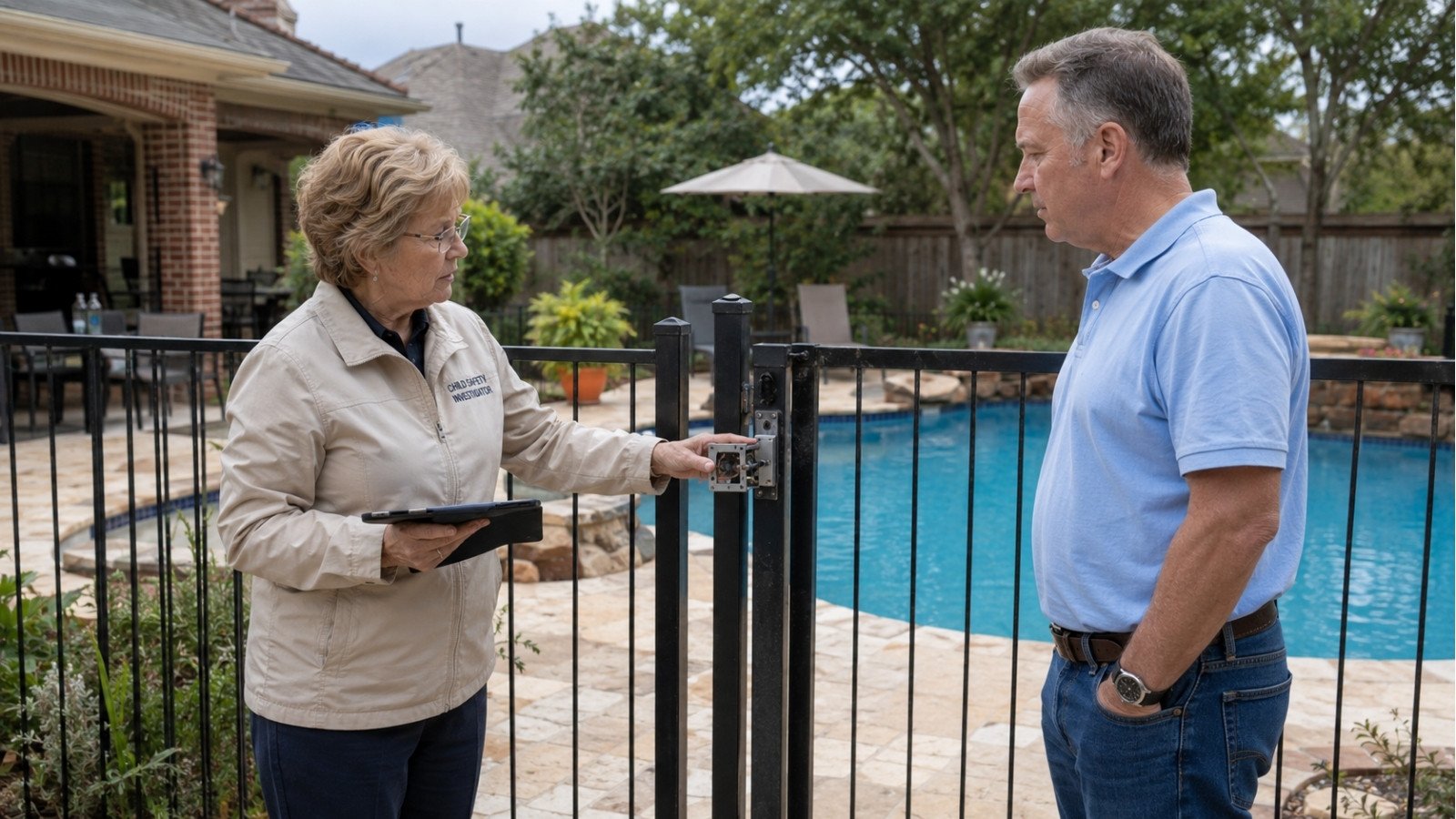
Texas Health and Safety Code Chapter 757, which establishes the 48-inch minimum fencing requirement, self-closing and self-latching gate requirements, and prohibitions on climbable fence materials, applies specifically to pools at multi-unit rental complexes and property owners associations, including apartment complexes, condominiums, and HOAs. An apartment pool with a broken gate latch is in violation of Chapter 757. An apartment pool without adequate fencing is in violation of Chapter 757. These are documented, verifiable legal obligations that become central evidence in a claim.
For private single-family residential pools, Texas state law does not impose the same requirements directly. Private residential pools are instead governed by local municipal building codes and ordinances, which vary by city. Houston, Dallas, San Antonio, and Austin have each adopted safety standards for residential pools through local ordinance, typically requiring 48-inch fencing and self-latching gates, but the specific requirements depend on when the pool was built, what code was in effect at the time, and what the local jurisdiction currently enforces.
This does not mean that a residential pool with no fence carries no legal obligation. It means the source of that obligation is local code rather than state statute, and the analysis requires examining what the specific city or county required for that property. It also means the attractive nuisance doctrine remains fully available regardless of which fencing regime applies, because the doctrine operates under Texas common law independently of statutory compliance. A residential pool owner who did not fence their pool because no state law technically required it can still face liability under the attractive nuisance doctrine if the five-element test is satisfied.
Drowning and Near-Drowning as Distinct Legal Categories
The legal consequences of a pool drowning and a near-drowning that causes brain injury are distinct from one another in important ways, and families navigating these situations deserve to understand both.
When a child dies in a pool, the applicable legal framework is Texas wrongful death law under Chapter 71 of the Texas Civil Practice and Remedies Code. The surviving spouse, children, and parents of the deceased may bring wrongful death claims for lost earnings and earning capacity, loss of companionship and society, mental anguish, and funeral expenses. For a child victim, the wrongful death claim belongs to the child’s parents. Exemplary damages are available where the pool owner’s conduct amounts to gross negligence, subject to the constitutional limitation that exemplary damages in wrongful death cases extend only to the surviving spouse and children, not parents, under Article XVI, Section 26 of the Texas Constitution.
When a child survives a near-drowning but suffers hypoxic brain injury from oxygen deprivation during submersion, the legal framework is a personal injury claim brought on the child’s behalf. The damages in a near-drowning brain injury case can be among the most substantial in all of personal injury law, because the affected child may require lifelong medical care, specialized education, therapeutic support, and assistance with daily living. A complete damages analysis in a near-drowning brain injury case evaluates the projected lifetime cost of that care, the loss of earning capacity the child will experience, the pain and suffering endured, and the impact of the injury on every dimension of the child’s life going forward.
The two-year statute of limitations under Texas Civil Practice and Remedies Code Section 16.003 applies to personal injury claims from the date of injury. For wrongful death claims, the two-year period runs from the date of death. There is an important tolling provision for minor children: the statute of limitations on the injured child’s own personal injury claim does not begin to run until the child turns 18, meaning a minor child’s individual claim does not expire until their 20th birthday. This tolling provision applies to the child’s personal injury claim, not to the wrongful death claims brought by the parents, which remain subject to the standard two-year period.
Who Can Be Held Responsible
The property owner whose pool was involved in a drowning is the most obvious defendant, but they are rarely the only potentially responsible party.
In apartment complex drownings, the same framework established in the prior blog in this series applies: the property owner, the management company responsible for day-to-day operations, the pool service contractor responsible for maintenance, and any equipment manufacturer whose defective drain, gate hardware, or pool structure contributed to the incident may each bear independent liability.
In residential drownings at a neighbor’s pool, the homeowner is the primary defendant, typically through their homeowners insurance policy, which generally covers premises liability claims including pool accidents. A homeowners insurer will typically engage quickly once a serious pool injury or drowning is reported, and the claims handling process in these cases has its own dynamics that are worth understanding before any communication with the insurer.
Where the pool fence or gate hardware was defective, a product liability claim against the manufacturer may provide an additional avenue of recovery, particularly in cases where a latch or hinge failed despite appearing to be properly maintained.
The premises liability practice at Herrera PLLC approaches pool drowning and near-drowning cases with the understanding that the specific circumstances of how the child reached the water, what barrier was or was not in place, what the property owner knew about the hazard, and who else may have had responsibility for the site, all need to be evaluated before the full picture of accountability is clear.
Frequently Asked Questions About Child Pool Drowning Claims in Texas
Can I sue a neighbor or apartment complex if my child drowned in their pool even if my child wasn’t supposed to be there?
Yes, in many cases. Texas’s attractive nuisance doctrine creates liability for property owners whose dangerous conditions injure child trespassers when the owner knew or should have known children were likely to trespass, when the condition posed an unreasonable risk of death or serious injury that children would not appreciate, and when the burden of eliminating the danger was slight compared to the risk. Swimming pools are a classic basis for attractive nuisance claims in Texas. The fact that a child was not formally invited to the pool does not, by itself, eliminate the property owner’s responsibility.
What does Texas’s attractive nuisance doctrine mean for my child’s pool drowning case?
The attractive nuisance doctrine, as applied by the Texas Supreme Court in Texas Utilities Electric Co. v. Timmons, 947 S.W.2d 191 (Tex. 1997), is the legal principle that allows families to pursue claims on behalf of children who were injured trespassing on a property containing a hazard that predictably attracts children. A swimming pool that was accessible to a young child through an unsecured gate or inadequate fencing is a textbook attractive nuisance scenario. The doctrine applies regardless of whether the pool owner posted “no trespassing” signs, because the legal issue is whether the owner took reasonable steps to eliminate the danger, not whether they announced it.
What are the Texas fence and gate requirements for residential and apartment swimming pools?
Texas Health and Safety Code Chapter 757 requires apartment complexes and property owners associations to maintain pool fencing at least 48 inches tall, with self-closing and self-latching gates and no openings that allow a four-inch sphere to pass through. Chain-link fencing is prohibited for pools built after September 1, 1994 because of its climbability. For private single-family residential pools, state law does not impose these requirements directly. Instead, residential pools are governed by local municipal ordinances, which vary by city. Houston and other major Texas cities have adopted local pool safety requirements that include fencing standards. Regardless of which fencing regime applies, the attractive nuisance doctrine operates under Texas common law independently of statutory compliance.
What legal rights does my family have after a near-drowning that caused brain damage to my child in Texas?
When a child survives a near-drowning but suffers hypoxic brain injury, the family can pursue a personal injury claim on the child’s behalf against the responsible property owner and any other negligent parties. Recoverable damages include the projected lifetime cost of medical care, therapy, and supportive services; the child’s lost earning capacity over a working lifetime; pain, suffering, and mental anguish; and the impact of the brain injury on every aspect of the child’s life going forward. Near-drowning brain injury cases frequently involve the largest damage calculations in premises liability law because the affected child may require support for decades. The two-year statute of limitations on the injured child’s own claim is tolled until the child turns 18, meaning the individual claim does not expire until the child’s 20th birthday.
How long does a family have to file a lawsuit after a child drowning or near-drowning accident in Texas?
The standard Texas statute of limitations for personal injury and wrongful death claims is two years from the date of injury or death under Texas Civil Practice and Remedies Code Section 16.003. For a wrongful death claim brought by parents after their child drowns, this two-year period runs from the date of death. For a personal injury claim brought on behalf of a child who survived a near-drowning, the statute of limitations on the child’s own claim is tolled until the child turns 18, meaning the individual claim does not expire until the child’s 20th birthday. Parents should not rely on this tolling provision as a reason to delay. Evidence, including the condition of the fence, the gate latch, and any pool maintenance records, can deteriorate or be lost, and early investigation preserves options that cannot be recovered later.
What a Family Deserves to Know
The law that protects children who drown or nearly drown at someone else’s pool exists for exactly the reason it sounds like: because children are not capable of protecting themselves from dangers they do not understand, and because the adults who own those dangerous conditions have both the ability and the obligation to secure them.
A broken gate latch, a fence that a toddler can climb, a pool at an apartment complex accessible after hours without adequate barriers, these are not acceptable risks that the law asks families to absorb in silence.
For any family navigating the aftermath of a child drowning or near-drowning at someone else’s pool in Texas, speaking with an attorney who understands both the attractive nuisance doctrine and the full scope of damages available for brain injury and wrongful death is a meaningful step toward understanding what the law actually provides.
Jonathan Herrera, J.D. is a Houston-based attorney who represents seriously injured Texans and their families in premises liability, personal injury, and wrongful death matters across the state. Before practicing law, he spent over a decade as a licensed insurance adjuster managing high-exposure casualty claims for carriers and third-party administrators across multiple states. He is the founder of Herrera PLLC and a member of the Texas Trial Lawyers Association and the American Association for Justice.