What Counts as Bad Faith Insurance in Texas? A Policyholder’s Guide to Chapter 542

When a Texas homeowner or business owner files an insurance claim, the wait that follows can feel almost as damaging as the original loss. A roof remains exposed to the weather, repairs are delayed, and bills keep arriving while the insurance company requests more documents or leaves questions unanswered.
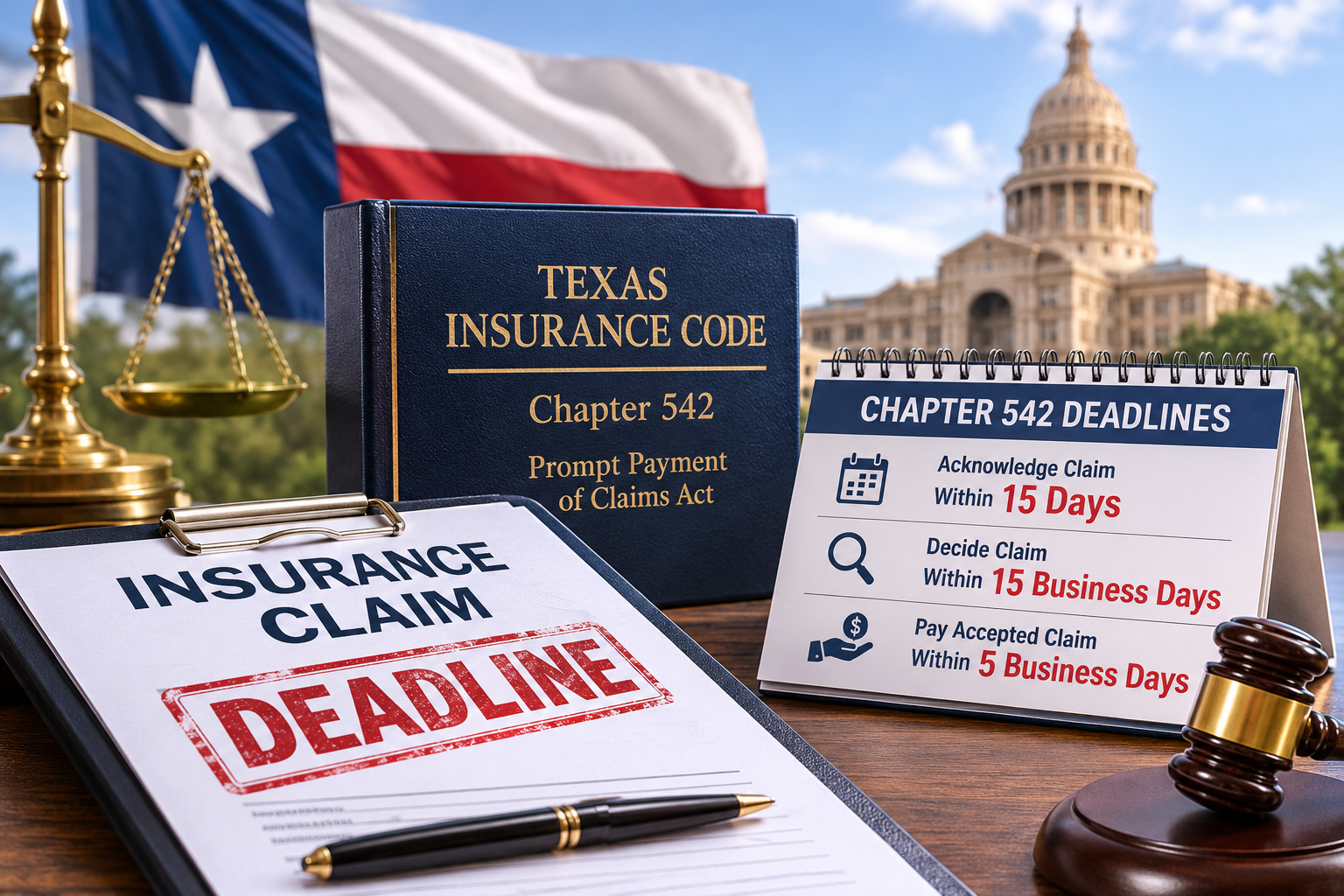
Many policyholders assume they have no choice but to wait. Texas law, however, establishes rules for how insurance companies must handle certain claims. The Texas Prompt Payment of Claims Act, found in Chapter 542 of the Texas Insurance Code, sets deadlines for acknowledging, investigating, deciding, and paying eligible insurance claims.
I spent over a decade as an insurance adjuster handling high-exposure, litigated casualty and property claims before becoming an attorney. I also practiced insurance defense. That experience gave me a firsthand understanding of how claims are evaluated, how files are documented, and what happens behind the scenes when an insurance company makes decisions about a policyholder’s loss.
In this guide, I’ll explain what Chapter 542 requires, what may happen when an insurer misses a deadline, and how conduct beyond late payment can raise concerns about insurance bad faith under Texas law.
What Is Chapter 542 of the Texas Insurance Code?
Chapter 542 of the Texas Insurance Code addresses unfair claim settlement practices and prompt payment of insurance claims. Its purpose is to establish standards for insurance companies handling claims and to provide legal remedies when applicable requirements are violated.
The prompt payment provisions generally apply to first-party claims. These are claims a policyholder submits directly to their own insurance company under an insurance policy. For example, when a homeowner files a claim for storm damage under a homeowners insurance policy, that is generally a first-party claim.
Third-party claims are different. These involve claims made against another person’s insurance policy, such as when someone seeks compensation from the at-fault driver’s insurer after a car accident. The Prompt Payment of Claims Act does not generally govern those claims in the same way.
Certain insurance arrangements and types of claims are also subject to different rules or exceptions. Whether Chapter 542 applies depends on the type of insurance, the policy, and the circumstances of the claim.
The law matters because policyholders should not have to wait indefinitely for an insurer to respond. Chapter 542 establishes specific time frames that can be examined against the actual handling of a claim.
The complete statute is available through the Texas Legislature’s website. Although the legal language can be difficult to follow, understanding its basic requirements can help policyholders recognize when they may need further assistance.
The Deadlines Insurers Must Follow Under Chapter 542
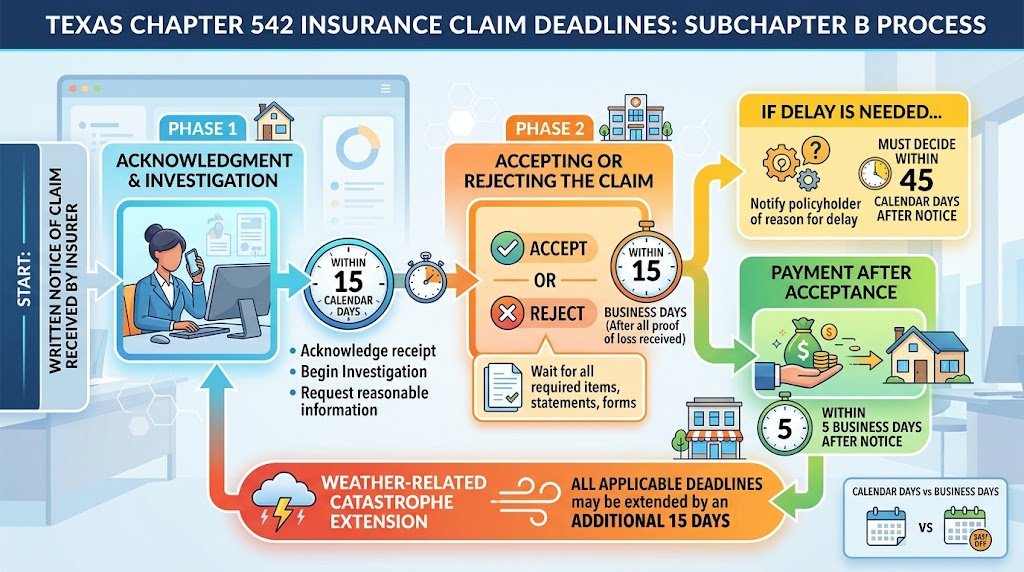
Chapter 542, Subchapter B, establishes a series of deadlines for processing eligible insurance claims. These obligations generally begin when the insurance company receives written notice of a claim.
The main deadlines include the following:
- Acknowledgment and investigation: Generally, within 15 days after receiving notice of a claim, an insurer must acknowledge receipt, begin its investigation, and request the information it reasonably believes it needs. Certain insurers may be subject to a different period.
- Accepting or rejecting the claim: Generally, within 15 business days after receiving all required items, statements, and forms needed to establish proof of loss, the insurer must notify the policyholder in writing whether it accepts or rejects the claim.
- Additional time to decide: If the insurer cannot make a decision within the applicable period, it must notify the policyholder of the reason for the delay. It must then accept or reject the claim within 45 days after providing that notice.
- Payment after acceptance: Generally, an insurer must pay an accepted claim within five business days after notifying the policyholder, subject to statutory exceptions.
Following a weather-related catastrophe or major natural disaster, the claim-handling deadlines under the applicable provisions may be extended by an additional 15 days.
Each deadline serves a different purpose. The acknowledgment requirement confirms that the insurer has received the claim and started processing it. The decision deadline prevents claims from remaining unresolved indefinitely after the insurer has received the required documentation. The payment deadline ensures that accepting a claim is followed by payment within the required period.
Two details are particularly important.
First, calendar days and business days are not interchangeable. Some deadlines are measured in calendar days, while others are measured in business days. Business days generally exclude Saturdays, Sundays, and recognized state holidays.
Second, the decision deadline depends on the required documentation. The clock generally begins after the insurer receives the items, statements, and forms it reasonably requires to establish proof of loss. That makes it important to maintain records of what the insurer requested, when the policyholder submitted it, and when the insurer received it.
These requirements can apply to various first-party insurance claims, including homeowners claims. Policyholders dealing with a denied claim can learn more about homeowners insurance claims that were denied. Those experiencing disputes over the amount offered may also find information about underpaid homeowners insurance claims.
Commercial policyholders may face similar issues when pursuing underpaid business insurance claims.
Acknowledging, Investigating, and Deciding a Claim on Time
Understanding the deadlines is easier when we look at how they apply throughout the claims process.
Acknowledging the Claim
After receiving notice of a claim, an insurer generally has 15 days to acknowledge receipt, begin an investigation, and request the information it reasonably believes is necessary.
Acknowledgment may come through a letter, email, or claims portal. The insurer may also assign a claim number and an adjuster.
If acknowledgment is not provided in writing, the law requires the insurer to maintain a record of the date, manner, and content of the acknowledgment.
This documentation can become important when determining whether the insurer complied with its obligations. The date a claim was reported is often one of the first details examined when reviewing the claim’s timeline.
Investigating the Claim
The investigation is a critical part of the insurance claims process. It may involve inspecting the damaged property, reviewing the insurance policy, collecting documents, determining the cause of the loss, and evaluating the estimated repair costs.
Chapter 542 requires insurers to begin investigating within the applicable initial deadline. However, beginning an investigation does not automatically mean the insurer will approve the claim. The investigation must still evaluate the available information and the coverage provided by the policy.
Disputes can arise when an insurer attributes damage to pre-existing conditions, wear and tear, or an excluded cause of loss. They can also arise when the insurer’s repair estimate is substantially lower than the actual cost of restoring the property.
Having worked as an adjuster, I understand how damage assessments are prepared and why estimates can differ. A policyholder who believes an insurer’s estimate does not adequately account for the damage may need to examine the basis for that evaluation.
For more information, see our guides on underpaid homeowners insurance claims and underpaid business insurance claims.
Deciding the Claim
Once the insurer receives all required items, statements, and forms needed to establish proof of loss, it generally must accept or reject the claim within 15 business days.
If the insurer rejects the claim, it must provide written notice explaining its reasons. If it needs additional time, it must explain why and follow the applicable extension requirements.
A claim that remains under review is not automatically evidence of bad faith. However, repeated delays, unexplained requests for information, or prolonged silence may warrant closer examination of whether the insurer complied with its legal obligations.
The Texas Department of Insurance’s claim tips and its consumer publication on insurance claims provide additional information about the claims process and what policyholders can expect.
What Happens When a Carrier Misses a Deadline?
Missing a deadline does not automatically mean the insurance company must pay the entire amount requested by the policyholder. Coverage and the amount of the covered loss must still be established.
However, when an insurer is liable for a claim and fails to comply with the applicable prompt payment requirements, Chapter 542 may impose additional financial consequences.
Under Section 542.060, the insurer may be required to pay interest on the amount of the claim as damages, along with reasonable and necessary attorney’s fees. The applicable interest rate depends on whether Chapter 542A governs the action.
The statute also addresses delays in payment after an insurer has received the items, statements, and forms reasonably requested and required to establish proof of loss. When payment is delayed beyond the applicable statutory period or, in certain circumstances, more than 60 days, additional liability may arise.
Attorney’s fees are particularly significant. A policyholder may be concerned about the cost of hiring an attorney to challenge a delayed, underpaid, or denied claim. Chapter 542 provides for reasonable and necessary attorney’s fees when its statutory requirements for liability are met.
Determining whether an insurer violated the law requires a careful review of the claim’s history. Relevant information may include:
- The date the policyholder reported the claim
- The date the insurer acknowledged receipt
- The insurer’s requests for documents or additional information
- The dates the policyholder provided the requested materials
- The date the insurer accepted or rejected the claim
- The date payment was made, if applicable
One of the first things I look for when evaluating an insurance dispute is the insurer’s complete claim file. It can reveal what the adjusters documented, what information they relied on, and how the decision was reached.
My background in insurance claims gives me insight into how those files are assembled and what information may be important when evaluating a dispute.
Every insurance claim is different. Whether a statutory violation occurred depends on the applicable law and the specific facts. An attorney can review the timeline and determine whether the insurer met its obligations.
The 18 Percent Interest Penalty Explained
The 18 percent interest rate is one of the most widely discussed provisions of Texas insurance law. However, it is important to understand when it applies.
Under Section 542.060(a), when an insurer is liable for a claim under an insurance policy and fails to comply with the applicable prompt payment requirements, it may be required to pay interest at 18 percent per year on the amount of the claim, in addition to the claim itself. The statute also provides for reasonable and necessary attorney’s fees.
However, the 18 percent rate does not apply to every insurance dispute.
Claims governed by Chapter 542A follow a different calculation. Under Section 542.060(c), the applicable rate is the interest rate determined under Section 304.003 of the Texas Finance Code, plus five percentage points. The statute specifies simple interest on the amount of the claim as damages.
Chapter 542A generally applies to certain first-party property damage claims involving covered real property or improvements damaged by forces of nature, including wind, hail, hurricanes, and other qualifying events.
Because many property insurance disputes in Texas involve weather-related damage, determining which statutory provision applies is an important part of evaluating a claim.
A few additional points deserve clarification:
- The insurer must be liable for the claim. Statutory interest does not automatically apply to an amount that is not covered under the policy.
- The deadline violation must be established. The applicable statutory requirements and claim timeline must be evaluated.
- Other remedies may be available. Section 542.061 states that the statutory remedies are in addition to other remedies or procedures available under law or common law.
- The outcome depends on the facts. No specific interest award, attorney’s fee recovery, or legal result can be guaranteed.
The full text of Chapter 542A is available through the Texas Legislature’s website for those who want to review the law directly.
Bad Faith Beyond the Statute: Misrepresentation and Delay Tactics
Missing a prompt payment deadline is one issue. Insurance bad faith is a broader legal concept involving an insurer’s conduct when handling a claim.
Depending on the facts, an insurer’s unreasonable denial of a valid claim, inadequate investigation, misrepresentation of policy provisions, or conduct that improperly delays payment may raise questions under Texas law.
Texas law also addresses unfair claim settlement practices through provisions of Chapter 541 of the Texas Insurance Code. Section 541.060 identifies certain practices relating to the handling and settlement of insurance claims.
However, not every disagreement over coverage, every low settlement offer, or every delay automatically establishes bad faith. The specific conduct, available evidence, policy language, and applicable legal standards matter.
Here are some examples of conduct that may warrant closer examination.
Unreasonable Denials
An insurer may deny a claim based on an exclusion or policy condition that does not apply to the circumstances. Whether a denial is legally justified requires reviewing the policy language and the facts surrounding the loss.
Insurance policies contain declarations, coverage provisions, conditions, exclusions, and endorsements. These provisions must be read together to determine the scope of coverage.
Texas courts apply established rules of contract interpretation when examining insurance policies. When policy language is genuinely ambiguous, courts may apply rules of construction that favor the policyholder. However, whether a particular provision is ambiguous is a legal question that depends on the language and circumstances.
Failure to Investigate Properly
An insurer’s investigation should consider the relevant evidence concerning the loss and the coverage available under the policy.
Potential concerns may arise when an insurer denies a claim without adequately investigating the damage, disregards relevant evidence, or relies on an assessment that does not reasonably account for the circumstances.
A dispute over the investigation does not automatically establish bad faith, but the quality and completeness of the insurer’s evaluation may become important when examining the claim.
Misrepresenting Policy Provisions
Misrepresenting relevant facts or policy provisions can raise concerns under Texas insurance law.
For example, a policyholder may receive an explanation of coverage that appears inconsistent with the language of the policy. Determining whether the explanation was inaccurate, material, or legally significant requires examining the policy and the communications between the parties.
Chapter 541 includes provisions addressing certain unfair insurance practices, including misrepresentations relating to coverage and claim settlement.
Delay Tactics
Communication problems can become especially frustrating when a claim remains unresolved for months.
Repeated requests for documents that have already been submitted, shifting explanations for a denial, unexplained reassignment of adjusters, or extended periods without meaningful updates may raise questions about how the claim is being handled.
The significance of these actions depends on the circumstances. A delay may have a legitimate explanation, but a pattern of conduct that unreasonably prevents a claim from moving forward may warrant further review.
These issues can affect different types of insurance claims. Business owners experiencing delays in recovering lost income may need to evaluate their business interruption claims.
Policyholders facing a denial of commercial property coverage can learn more about denied commercial and business property insurance claims.
Other disputes may involve third-party property damage claims in Texas, which involve different coverage and legal considerations.
The Texas Legislature also publishes Chapter 541 of the Insurance Code, which addresses deceptive, unfair, and prohibited insurance practices. Whether a particular provision applies to a claim depends on the facts and the relevant legal requirements.
How to Document a Bad Faith Claim From Day One

Documentation can play an important role in an insurance dispute. Records of communications, requests for information, submitted documents, and decisions can help establish what happened during the claims process.
Maintaining organized records can also make it easier to evaluate whether the insurer complied with the deadlines under Chapter 542.
The following documents may be useful:
- Claim filing confirmation: Keep the date the claim was reported, along with any confirmation number, email, or portal receipt.
- Communications with the insurer: Save letters, emails, text messages, and other written communications. For phone calls, record the date, time, and name of the representative, along with notes about the conversation.
- Requests for information: Maintain copies of documents requested by the insurer and proof of when and how you submitted them.
- Photographs and videos: Document the damage as soon as reasonably possible after the loss. Additional photographs may help show how conditions change over time.
- Repair estimates and invoices: Keep estimates from independent contractors and records of repair expenses. These may be useful when comparing the insurer’s assessment with the actual cost of repairs.
- Insurance policy documents: Retain the complete policy, including the declarations page, endorsements, exclusions, and any reservation of rights or denial letters.
- Additional expenses: Keep records of expenses associated with the loss, including temporary repairs, relocation, and other costs that may be relevant under the policy.
Some policyholders also consult public adjusters for assistance with documenting and presenting an insurance claim. For more information, see our page on public adjusters.
Policyholders may also submit complaints to the Texas Department of Insurance. The department provides information about filing homeowners and renters insurance complaints.
It is also important to be aware of deadlines for filing legal actions. The applicable limitations period may depend on the insurance policy, the type of claim, and the legal basis for the dispute. Some policies contain contractual limitations provisions that may affect the time available to bring a lawsuit.
Because missing a deadline can affect a policyholder’s legal options, reviewing the policy and seeking legal guidance promptly can be important.
Frequently Asked Questions
What is Chapter 542 of the Texas Insurance Code?
Chapter 542 addresses unfair claim settlement practices and the prompt payment of insurance claims. Its prompt payment provisions establish deadlines for insurers handling eligible first-party claims and provide for additional damages and attorney’s fees when statutory requirements are violated.
How many days does an insurer have to acknowledge my claim?
Generally, an insurer must acknowledge receipt of a claim, begin an investigation, and request the information it reasonably believes it needs within 15 days after receiving notice. Certain insurers may be subject to different deadlines. After a qualifying weather-related catastrophe or major natural disaster, the applicable deadlines may be extended by an additional 15 days.
What happens if my insurer misses a deadline?
If an insurer is liable for a claim and fails to comply with the applicable prompt payment requirements, it may be required to pay additional statutory damages, including interest and reasonable and necessary attorney’s fees. Whether these remedies apply depends on the facts, the policy, and the applicable legal requirements.
What is the 18 percent interest penalty?
For claims governed by Section 542.060(a), the statutory damages may include interest at 18 percent per year on the amount of the claim, together with reasonable and necessary attorney’s fees.
Claims governed by Chapter 542A follow a different calculation based on the applicable Texas Finance Code interest rate plus five percentage points. The applicable rate depends on the type of claim and the governing statute.
What else counts as bad faith besides missed deadlines?
Depending on the circumstances, unreasonable claim denials, inadequate investigations, misrepresentations about policy provisions, and improper delay tactics may raise concerns under Texas insurance law.
Whether an insurer’s conduct constitutes bad faith depends on the facts, the available evidence, and the legal standards that apply to the claim.
This article is for general educational purposes and is not legal advice or a substitute for advice about a specific situation. Every insurance claim depends on the facts, the applicable policy language, and the circumstances surrounding the insurer’s handling of the claim. Policyholders with delayed, underpaid, or denied insurance claims are welcome to call Herrera PLLC at 832-891-3210, email jherrera@jh-lawpllc.com, or reach out through the contact page to schedule a free, confidential consultation.
Jonathan Herrera, J.D.
Jonathan Herrera is the founder of Herrera PLLC in Houston, Texas. He spent more than a decade working as an insurance adjuster, founded JH Claims LLC, and practiced insurance defense at Rymer, Echols, and Nelson-Archer before opening his own firm representing injury victims, policyholders, and businesses.