
Injured in a Texas Oilfield Accident? The Company That Hired You Isn’t Always the One You Can Sue

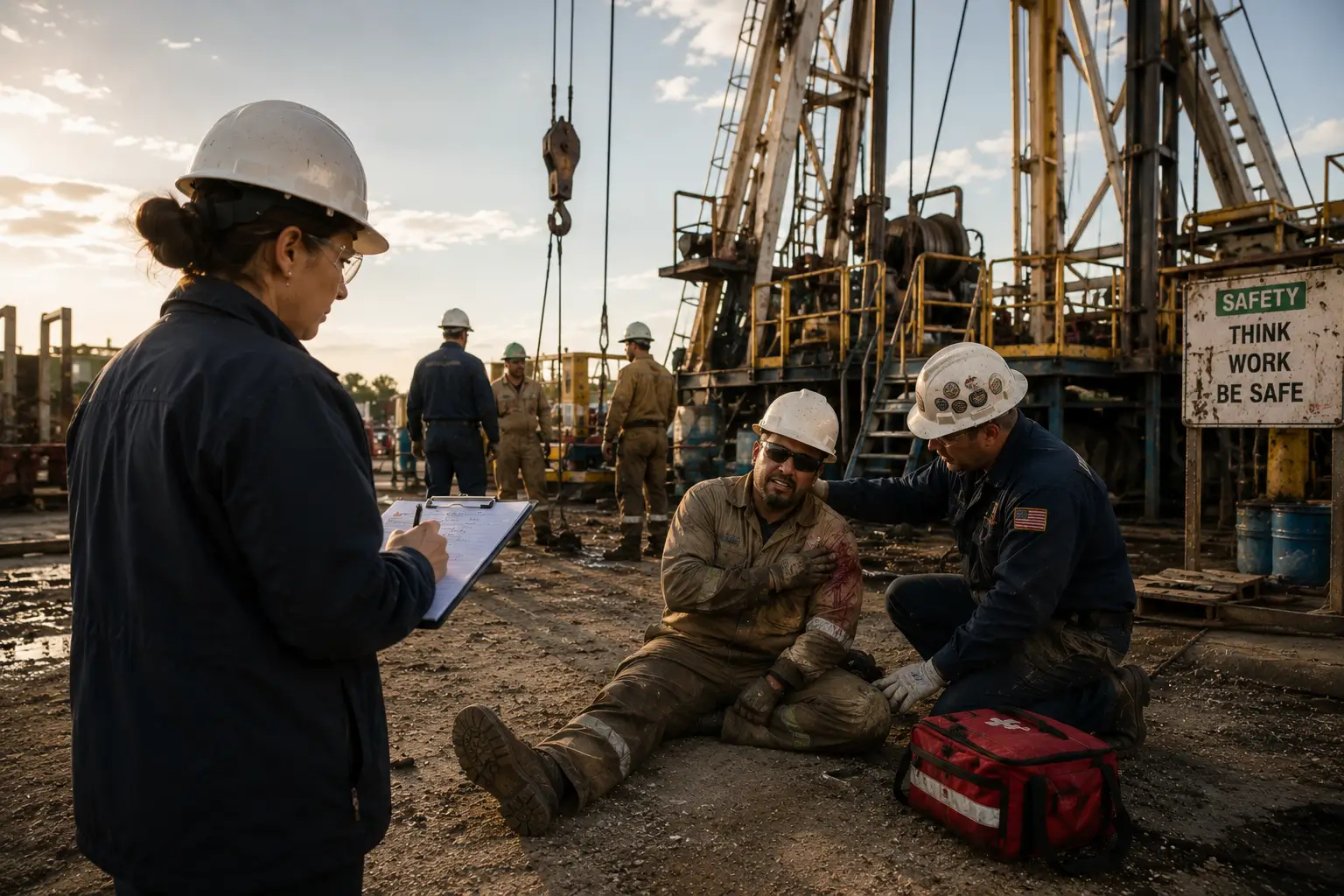
A blowout, a dropped joint of pipe, a high-pressure line failure, a rollover on a lease road at three in the morning an oilfield injury does not ease into a worker’s life. It changes everything before the ambulance arrives.
What most injured oilfield workers are never told is that the company on their paycheck is often not the company that pays for the injury, and the operator who never signed a check to that worker is sometimes the only party who can be sued at all. Texas stacks an elective workers’ compensation scheme on top of contractual insurance arrangements on top of a premises-liability statute built to protect property owners, and each layer changes who answers for the injury.
Texas Labor Code § 406.033: Why Some Oilfield Employers Can Be Sued Directly
Texas is the only state where most private employers are not required to carry workers’ compensation insurance. Under Texas Labor Code § 406.002, participation in the workers’ compensation system is generally elective. Employers that choose not to participate are commonly known as nonsubscribers.
The nonsubscriber distinction: When an oilfield employer declines workers’ compensation coverage, it loses significant legal protections. Texas Labor Code § 406.033 allows injured employees to pursue negligence claims directly against nonsubscribing employers.
The defenses that disappear: The statute removes several defenses employers traditionally relied upon in workplace injury cases. A nonsubscribing employer generally cannot argue that the employee assumed the risk, that a coworker caused the injury, or that the employee’s own negligence completely bars recovery. The injured worker must still prove negligence, but the playing field changes substantially.
The reality in the oilfield industry: Many oilfield service companies, trucking contractors, equipment providers, and specialty contractors operate under different insurance structures. Two workers standing next to each other in the same location may have very different legal rights depending on whether their employers subscribe to workers’ compensation coverage.
Private injury benefit plans: Some nonsubscribing employers offer occupational injury benefit plans instead of workers’ compensation. These programs often provide limited benefits while attempting to restrict an employee’s ability to pursue litigation. Texas Labor Code § 406.033 places limits on an employer’s ability to obtain pre-injury waivers of legal rights. The existence of an injury benefit plan does not automatically eliminate a negligence claim.
The first legal question after an oilfield accident is often whether the employer subscribes to workers’ compensation. The answer can dramatically alter the path of the case.
Texas Labor Code § 406.123: The Contract You Never Signed May Determine Whether You Can Sue
Many injured workers believe their legal rights depend entirely on the company that hired them. In reality, contracts between companies higher up the chain often determine who receives workers’ compensation protections.
The coverage-extension agreement: Texas Labor Code § 406.123 allows a general contractor and subcontractor to enter an agreement extending workers’ compensation coverage to subcontractor employees. Once such an agreement exists, the general contractor may receive the same exclusive-remedy protections normally enjoyed by an employer.
The practical effect: An operator or general contractor may become legally protected from certain lawsuits even though it never directly employed the injured worker. That protection often exists because of contractual arrangements the worker has never seen.
Owner-controlled insurance programs: Large drilling and industrial projects frequently use wrap-up insurance structures commonly called OCIPs. These programs can extend workers’ compensation protection across multiple contractors working on the same project. The Texas Supreme Court recognized this framework in Entergy Gulf States, Inc. v. Summers, 282 S.W.3d 433 (Tex. 2009).
The oilfield exception: Texas Labor Code § 406.123(h) contains language specifically addressing certain independent contractors in oil and gas operations. Consultants, company representatives, and specialty contractors may fall outside coverage-extension agreements depending on the contractual structure. When that occurs, workers’ compensation protections may not extend as far as defendants would like them to.
The existence of a workers’ compensation policy does not end the analysis. The more difficult question is often determining who receives protection from that policy.
The Retained Control Doctrine Under Redinger v. Living, Inc.
Even when workers’ compensation does not shield a defendant, Texas law generally does not hold one company responsible for the acts of an independent contractor.
That principle changes when control enters the picture.
The general rule: Texas courts generally recognize that a company hiring an independent contractor is not automatically responsible for how the contractor performs its work.
The Redinger exception: In Redinger v. Living, Inc., 689 S.W.2d 415 (Tex. 1985), the Texas Supreme Court adopted a rule that remains central to Texas workplace injury litigation. A company that retains control over part of a contractor’s work may owe a duty to exercise that control with reasonable care.
What control actually means: Control is not established simply because a company can inspect the work, receive reports, or stop operations. The retained authority must affect how the work is performed. Safety procedures, mandatory work methods, equipment requirements, hot-work permitting systems, pressure-testing protocols, and operational directives often become important evidence.
Why operators are frequently sued: Oilfield operators commonly retain authority over critical aspects of a project. Decisions involving well design, pressure-management procedures, gas monitoring requirements, contractor coordination, and safety protocols may originate with the operator rather than the contractor performing the physical labor.
A common example: Imagine a service company employee is injured during a high-pressure operation. The worker’s employer may have supplied the crew, but the operator may have established the procedures governing pressure limits, testing requirements, and safety precautions. If those decisions contributed to the accident, the operator may face liability under the retained-control doctrine.
Contractual control versus actual control: Texas courts recognize that liability can arise from contractual authority as well as conduct at the worksite. Contracts, safety manuals, operational procedures, and witness testimony often become critical evidence.
This doctrine explains why serious construction and industrial accident cases, like oilfield injury cases, often focus on documents signed long before the accident occurred. The contract frequently reveals who possessed the authority to prevent the injury in the first place.
Chapter 95 of the Texas Civil Practice and Remedies Code: The Defense Operators Rely Upon Most
Even when an injured worker can establish retained control, another obstacle often appears.
Chapter 95 of the Texas Civil Practice and Remedies Code provides significant protections to property owners facing claims from contractors and subcontractors. These disputes frequently involve premises liability principles applied in an industrial context.
The two-part requirement: Under Texas Civil Practice and Remedies Code § 95.003, an injured worker generally must prove two separate elements. First, the property owner exercised or retained control over the manner in which the work was performed. Second, the property owner possessed actual knowledge of the dangerous condition that caused the injury.
Actual knowledge matters: Texas courts distinguish between actual knowledge and constructive knowledge. Evidence showing a company should have known about a hazard is often insufficient. The injured worker must typically demonstrate that the defendant actually knew the danger existed.
Why operators raise Chapter 95 so often: Oilfield operators frequently own the lease, well, or facility where an injury occurs. Chapter 95 therefore becomes one of the most common defenses in Texas oilfield litigation.
The factual disputes: These cases often turn on highly specific facts. What equipment caused the injury? Who maintained it? Who controlled the work? Who received reports regarding the hazard? The answers determine whether Chapter 95 applies and whether its requirements can be satisfied.
The evidence that matters: Safety audits, inspection reports, incident histories, contractor communications, work permits, and internal emails frequently become critical pieces of evidence. Establishing actual knowledge often requires reconstructing what company personnel knew before the accident occurred.
Because Chapter 95 can dramatically affect liability, early investigation often determines whether a claim succeeds or fails.
How Oilfield Accidents Actually Happen and Who May Be Responsible
Oilfield accidents rarely occur because of a single mistake. Most result from a combination of equipment issues, operational decisions, safety failures, and contractor interactions.
Transportation accidents: Oilfield operations depend heavily on trucks moving water, sand, equipment, chemicals, and production materials. Long hours, remote roads, and demanding schedules contribute to serious collisions. Liability in these truck accidents may extend beyond the driver to trucking companies, contractors, or others responsible for scheduling and supervision.
Rig floor injuries: Dropped objects, pinch-point incidents, equipment failures, and struck-by accidents remain common on drilling and workover rigs. Responsibility may fall on the contractor operating the rig, the company maintaining the equipment, or a manufacturer whose product failed under normal use.
Pressure-control failures: Blowouts, line failures, and uncontrolled releases often involve multiple parties. Operators, service companies, engineering consultants, and equipment manufacturers may all play a role in the chain of events.
Defective equipment: Not every oilfield injury results from negligence at the worksite. Valves, pressure-control systems, lifting equipment, and industrial machinery occasionally fail because of design or manufacturing defects. Product liability claims may exist regardless of the injured worker’s employment relationship.
Hazardous exposure incidents: Hydrogen sulfide releases, chemical exposures, and respiratory hazards remain serious concerns throughout the industry. OSHA regulations, including 29 CFR 1910.134 and related standards, establish safety requirements that may become important evidence when exposure-related injuries occur.
Every accident tells a different story. Identifying every responsible party requires understanding how the operation functioned before the incident occurred.
What Compensation Exists Beyond Workers’ Compensation
Workers’ compensation benefits serve an important purpose, but they often fail to account for the full impact of a catastrophic injury.
Medical treatment: Third-party claims may include recovery for the full cost of past and future medical care.
Lost income: Serious injuries frequently prevent workers from returning to their previous occupations. Texas law permits claims for lost earning capacity in appropriate cases.
Pain and suffering: Workers’ compensation generally does not provide damages for physical pain, emotional distress, or loss of enjoyment of life. Civil litigation may allow recovery for those losses.
Disfigurement and impairment: Burns, amputations, spinal injuries, traumatic brain injuries, and other catastrophic conditions often create lifelong consequences extending beyond wage loss alone.
Wrongful death damages: Texas Civil Practice and Remedies Code Chapter 71 allows surviving family members to pursue wrongful death claims when an oilfield accident proves fatal.
The difference between workers’ compensation benefits and a third-party lawsuit can be substantial. That is why identifying every potentially liable party remains one of the most important aspects of any serious oilfield injury investigation.
Frequently Asked Questions About Oilfield Accidents in Texas
Can I sue the operator if I work for a contractor?
Possibly. The answer often depends on whether the operator retained control over the work under Redinger v. Living, Inc., 689 S.W.2d 415 (Tex. 1985), and whether workers’ compensation protections were extended through Texas Labor Code § 406.123. Many successful oilfield injury claims involve operators that never directly employed the injured worker.
What if my employer has workers’ compensation insurance?
Workers’ compensation may limit claims against the subscribing employer under Texas Labor Code § 408.001. It does not necessarily prevent claims against negligent third parties such as operators, manufacturers, contractors, or equipment suppliers.
Can I sue if defective equipment caused the accident?
Yes. Texas product liability law may allow claims against manufacturers, distributors, and suppliers responsible for defective equipment. These claims often exist regardless of workers’ compensation coverage.
How long do I have to file a lawsuit?
Texas Civil Practice and Remedies Code § 16.003 generally imposes a two-year deadline for personal injury claims. Waiting too long can permanently bar recovery.
Do OSHA violations automatically prove liability?
No. OSHA violations do not automatically establish negligence. They often serve as evidence showing that a company failed to follow recognized safety requirements and may strengthen a civil claim.
Why These Cases Matter in Houston’s Energy Industry
Although many Texas oilfield accidents occur hundreds of miles from Houston, the legal and business decisions behind those projects are frequently made here. Harris County serves as the operational center of much of the American energy industry, with operators, drilling contractors, service companies, and insurers maintaining offices throughout the region.
The effects extend well beyond Harris County. Companies operating in the Permian Basin, Eagle Ford, and Gulf Coast regions often maintain connections to Brazoria, Fort Bend, Galveston, Montgomery, and Waller Counties. Contracts are negotiated in Houston. Safety policies are drafted in Houston. Insurance programs are often managed in Houston.
When a serious injury occurs, the legal questions frequently reach far beyond the wellsite itself. Determining who controlled the work, who created the hazard, and who possesses legal responsibility requires examining the entire operational structure behind the project.
For anyone injured in a Texas oilfield accident, speaking with an attorney who understands both the regulatory framework and the multi-party liability structure is the first step toward understanding the full scope of what recovery may be available.
Jonathan Herrera, J.D. is a Houston-based attorney who represents seriously injured Texans, including construction workers and their families, in personal injury and civil litigation matters across the state. Before practicing law, he spent over a decade as a licensed insurance adjuster managing high-exposure casualty claims, including construction and industrial cases, for carriers and third-party administrators across multiple states. He is the founder of Herrera PLLC and a member of the Texas Trial Lawyers Association and the American Association for Justice.