

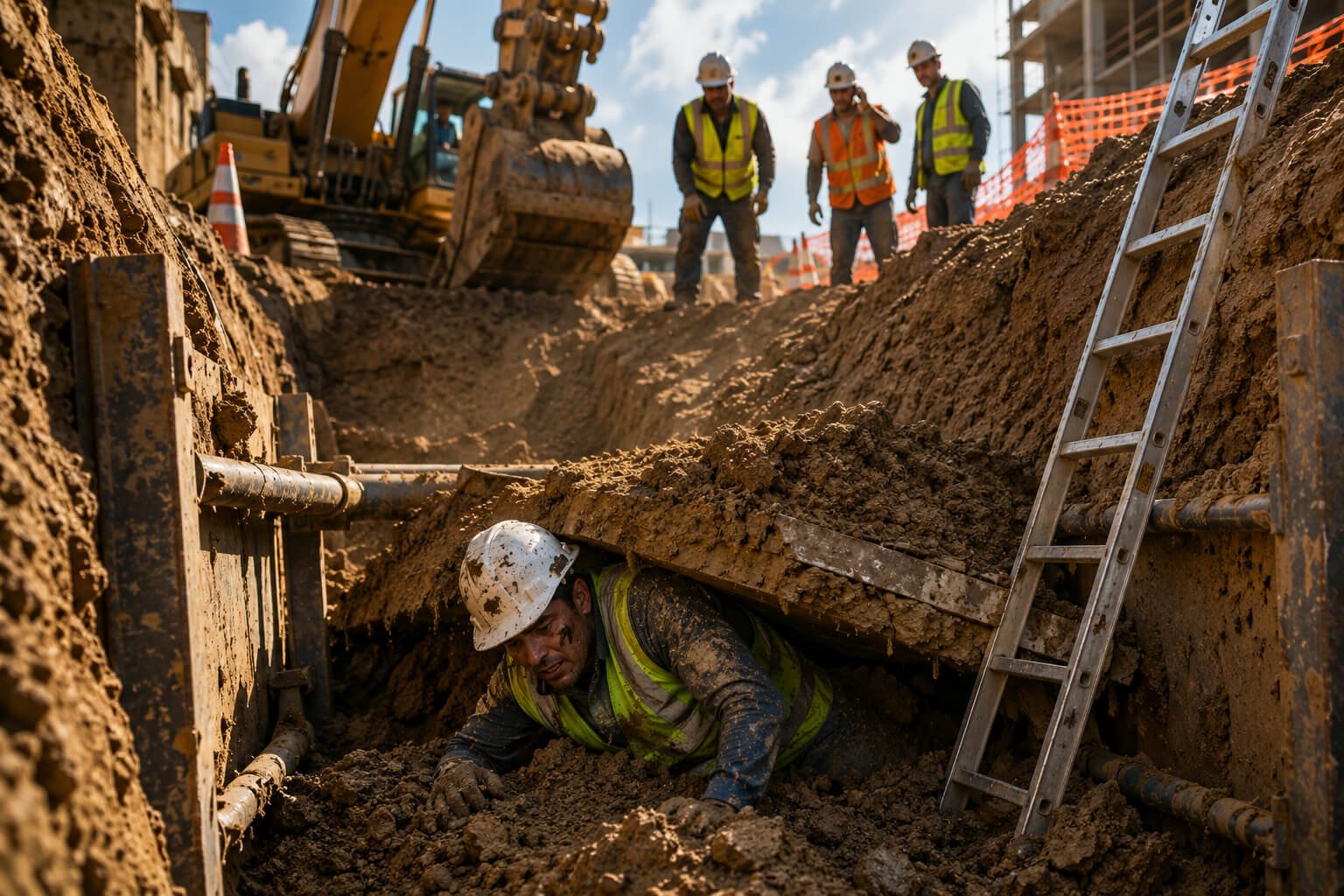
Trench Collapse and Excavation Accidents: A Persistent Danger on Texas Construction Sites

Trench and excavation work is a constant feature of construction in Houston and across Texas, from utility installation to foundation work on major commercial projects. It is also one of the most dangerous categories of construction activity. Unlike many jobsite hazards, a trench collapse happens without warning, and the physics involved make it uniquely unforgiving for the worker inside.
At Herrera PLLC, Jonathan Herrera brings more than a decade of experience evaluating high-exposure casualty and construction claims as a former insurance adjuster to cases involving serious construction and industrial accidents. This article explains why trench collapses are so dangerous, what federal safety standards require of contractors, and how liability is generally evaluated when a preventable safety shortcut leads to a collapse. Learn more about the serious injury cases we handle and how different workplace accidents may affect your legal options.
Why Trench Collapses Are Uniquely Dangerous
Soil is heavy. A single cubic yard of saturated soil can weigh well over a ton, and when a trench wall gives way, that weight comes down with essentially no warning and no time for a worker to escape. Unlike a fall from height or a struck-by incident, a cave-in can bury a worker completely, cutting off breathing almost immediately and making rescue extremely difficult even when help arrives within minutes.
Trenches also present hazards beyond the risk of a wall collapsing. Excavations can accumulate hazardous or oxygen-deficient atmospheres, particularly near landfills or where hazardous substances are stored nearby. OSHA requires atmospheric testing before workers enter trenches deeper than 4 feet when a hazardous atmosphere could reasonably be expected. Standing water and nearby vehicle or equipment traffic add further risk. This combination of factors is why federal regulators treat excavation and trenching work as a distinct, high-priority safety category, separate from general fall or struck-by hazards elsewhere on a construction site.
OSHA’s Protective System Requirements for Excavations
Excavation and trenching work is governed by OSHA’s excavation and trenching standard (29 CFR Part 1926, Subpart P). The standard applies broadly to any man-made cut, cavity, trench, or depression in the earth’s surface, and it sets out specific, depth-based requirements:
- Trenches 5 feet deep or greater generally require a protective system, unless the excavation is made entirely in stable rock. For trenches less than 5 feet deep, a competent person may determine that a protective system is not required based on site conditions.
- Trenches 20 feet deep or greater require that the protective system be designed by a registered professional engineer or based on tabulated data prepared or approved by a registered professional engineer.
- Trenches 4 feet deep or more must have a safe means of access and egress, such as a ladder, ramp, or stairway, positioned so that no worker has to travel more than 25 feet laterally to reach it.
- Spoil piles, excavated materials, and equipment generally must be kept at least 2 feet back from the edge of the excavation to prevent them from falling in.
- A competent person, someone with the training and authority to identify hazards and stop work if needed, is required to inspect the excavation daily before work begins and again whenever conditions change, such as after rainfall or nearby vibration.
Accepted protective systems generally fall into three categories: sloping or benching the trench walls back at a stable angle, shoring the walls with timber, hydraulic, or pneumatic supports, or shielding workers inside a trench box or similar structure. Which method is appropriate depends on the depth of the excavation and the soil conditions involved.
Common Safety Failures That Lead to a Cave-In
Trench collapses are widely described by safety professionals as among the most preventable of serious construction accidents, because the standards governing them are well established and the failures that lead to a collapse tend to repeat across incidents. Common failures include skipping a protective system entirely on the assumption that a trench “looks stable,” failing to have a qualified competent person conduct and document daily inspections, placing spoil piles or heavy equipment too close to the trench edge, failing to reassess conditions after rain or other events that can destabilize soil, and providing inadequate or overly distant means of egress for workers to escape quickly if conditions change.
Soil Classification and Why It Matters to Liability
OSHA’s excavation standard requires that soil be classified, generally as Stable Rock, Type A, Type B, or Type C, using visual and manual testing methods before a protective system is selected. Each classification reflects how likely that soil is to hold together under the stress of an open trench, and the classification directly determines what sloping angle, shoring system, or shielding approach is considered adequate.
This classification step matters not only for safety but also for how a collapse is later evaluated. If a contractor failed to classify the soil at all, misclassified it, or selected a protective system that did not match the actual soil conditions on-site, that failure can be a central fact in determining why the collapse occurred and who was responsible for preventing it. Soil conditions can also change during a project, particularly after significant rainfall, which is part of why ongoing inspection by a competent person is treated as a continuing obligation rather than a one-time check.
Multiple Contractors on a Single Excavation Site
Excavation work frequently involves several companies working in coordination: a general contractor overseeing the project, a utility or excavation subcontractor performing the actual digging, and sometimes additional trades working near the open trench. When a collapse occurs, more than one party’s conduct is often relevant, including which company was responsible for selecting and installing the protective system, which company controlled the equipment and spoil placement near the trench, and which company had the authority and responsibility to stop work if conditions became unsafe.
Because trench collapses are frequently fatal or catastrophic, cases involving a collapse sometimes involve a wrongful death claim on behalf of a worker’s family in addition to, or instead of, an injury claim. Determining which party or parties bear legal responsibility depends on the specific roles and conduct involved at that site, which is something an attorney evaluates on a case-by-case basis.
Building a Claim When Safety Shortcuts Caused the Collapse
Texas is the only state that allows private employers to opt out of the state workers’ compensation system. Whether an injured worker’s employer is a workers’ comp subscriber or a non-subscriber affects what legal options may be available, and a third-party claim against a general contractor, another subcontractor, an engineer, or an equipment supplier may exist separately from, or in addition to, any workers’ comp coverage, depending on who contributed to the hazard.
Information that commonly matters in evaluating a trench collapse claim includes whether a protective system was in place and whether it matched the soil classification and depth involved, whether daily competent-person inspections were performed and documented, any OSHA citation or investigation records connected to the incident, photographs of the excavation and surrounding site conditions, and witness accounts from workers and other contractors present. Insurance carriers evaluating these claims look closely at this same documentation, and understanding how that evaluation happens from the inside is part of what Jonathan Herrera’s background as a former adjuster brings to a construction and industrial accident case.
Texas generally imposes a two-year statute of limitations from the date of injury for personal injury claims, and two years from the date of death for wrongful death claims, so timing matters in evaluating these cases.
Frequently Asked Questions
Why are trench collapses so dangerous?
Soil is extremely heavy, and a trench wall can fail with almost no warning, burying a worker in seconds and cutting off their ability to breathe. Excavations can also present hazardous atmospheres, standing water, and nearby traffic hazards that add to the risk beyond the collapse itself.
What does OSHA require for excavation safety?
Under 29 CFR Part 1926, Subpart P, trenches 5 feet deep or more generally require a protective system such as sloping, shoring, or shielding, unless the excavation is entirely in stable rock. Trenches 4 feet or deeper require safe means of egress within 25 feet of lateral travel, and a competent person must inspect the site daily and after any change in conditions.
What is soil classification?
Soil classification is the process of categorizing excavation soil, generally as Stable Rock, Type A, Type B, or Type C, based on visual and manual testing. The classification determines what protective system is adequate for that trench, and a mismatched or skipped classification can be a key factor in why a collapse occurred.
Who can be held liable for a trench collapse?
Liability depends on the specific facts, including which company was responsible for selecting and installing the protective system, which company controlled site conditions near the trench, and which company had the authority to stop unsafe work. General contractors, excavation subcontractors, and other parties can potentially share responsibility.
What if multiple contractors were on site?
When several companies are working on or near an excavation, more than one may have contributed to the conditions that led to a collapse. An attorney can help identify each responsible party and how a claim against multiple contractors, and their insurers, may be pursued.
What is the deadline to file a trench collapse injury claim in Texas?
In many Texas personal injury cases, the statute of limitations is generally two years from the date of injury. Wrongful death claims are generally subject to a two-year deadline from the date of death. Because deadlines can depend on the facts of each case, it is important to evaluate a potential claim as soon as possible.
This article is provided for general informational purposes and does not constitute legal advice. Every trench collapse and excavation accident case depends on its own specific facts, and reading this article does not create an attorney-client relationship with Herrera PLLC. If you or a family member was affected by a trench collapse or excavation accident on a Texas construction site, Jonathan Herrera offers a free, confidential consultation to help you understand your options, with no fee unless a recovery is made. Call 832-891-3210 or visit the contact page to get started.
Jonathan Herrera, J.D. Jonathan Herrera is the founder of Herrera PLLC, a Houston, Texas law firm representing individuals in serious personal injury, insurance law, and civil litigation matters. Before becoming an attorney, he spent over a decade as a licensed insurance adjuster handling high-exposure casualty and property claims, including construction and industrial losses, before practicing insurance defense and founding Herrera PLLC.