
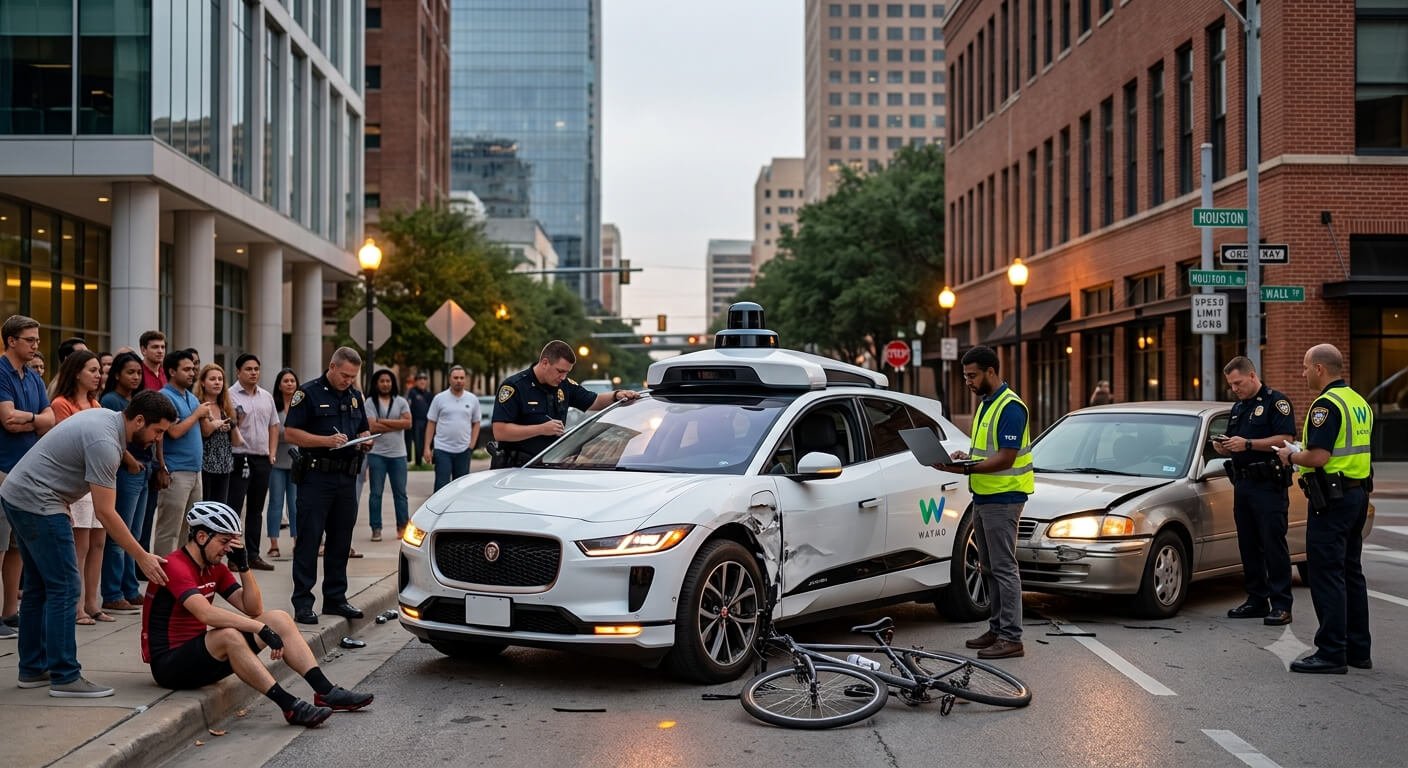

Houston no longer just talks about self-driving cars it drives around them. Since Waymo officially launched public rides in Houston in early 2026, the company has kept expanding its footprint, and the most recent expansion put its vehicles somewhere very specific: the streets right around Herrera PLLC’s own office in East Downtown.
If a Waymo vehicle causes or contributes to a crash, the legal analysis looks different than a typical car accident case. There is no driver to interview, no one to ask “what happened,” and a tangle of companies, software, and insurance policies standing between an injured person and accountability. Understanding how Texas law approaches these cases matters more with each passing month as robotaxis become a normal part of Houston traffic.
Waymo’s Expansion Into EaDo, the Medical Center, and NRG Stadium
Waymo nearly doubled its Houston service area to roughly 50 square miles in 2026, and the expansion specifically added EaDo, the Texas Medical Center, and parts of northeast Houston, with NRG Stadium pulled into the coverage map as well. That means autonomous vehicles are now operating in the same East Downtown streets where Herrera PLLC’s office sits, alongside pedestrians, cyclists, delivery trucks, and the ordinary chaos of an urban Houston neighborhood.
Waymo first opened public rides in Houston, Dallas, and San Antonio in February 2026, and the company says it has served tens of thousands of riders in each city since launch. As the fleet grows and the service area widens, so do the odds that a Houston driver, passenger, cyclist, or pedestrian eventually shares the road with one and, sooner or later, gets into a crash with one.
Why There Is No Driver to Blame in a Level 4 Crash
In a typical Houston car accident, the first legal question is usually simple: who was driving, and what did they do wrong? A Waymo vehicle operating in autonomous mode has no human driver making that judgment call in real time. The vehicle’s software, the “automated driving system” , is making the decisions about braking, steering, lane changes, and right-of-way.
That does not mean no one is responsible. It means the responsibility shifts. Instead of asking whether a driver was negligent, the questions become: Was the automated driving system operating the way it was supposed to? Did the company operating the vehicle maintain and monitor it properly? Was there a defect in the hardware or software that caused the vehicle to behave unsafely? These are fundamentally different questions than the ones asked after a typical two-car collision, and they require different evidence and different legal theories to answer.
Negligence, Product Liability, and Shared Fault Theories Under Texas Law
A crash involving an autonomous vehicle in Texas can potentially involve more than one legal theory, depending on the facts:
Negligence against the operating company. The company operating the robotaxi fleet can still be held to a standard of reasonable care in how it maintains its vehicles, monitors their performance, responds to known safety issues, and trains any remote or on-site staff involved in operations.
Product liability against manufacturers. If a defect in the vehicle’s hardware, sensors, or software contributed to the crash, a product liability claim against the manufacturer of the vehicle or the automated driving system may be available, separate from any claim against the company operating the ride-hailing service.
Shared fault with a human driver. Many autonomous vehicle crashes still involve a second vehicle driven by a person. Under Texas’s modified comparative negligence rule, more than one party can share responsibility, and an injured person can generally recover as long as they are not found more than 50% at fault for the crash.
Because a robotaxi crash can implicate the vehicle operator, the manufacturer, and possibly another driver all at once, sorting out who is actually responsible and in what proportion is rarely straightforward.
Evidence That Disappears If You Do Not Act Fast
Autonomous vehicles generate an enormous amount of data Texas law itself requires every automated motor vehicle authorized to operate commercially to be equipped with a recording device. That data can include sensor logs, camera footage, speed and braking information, and a second-by-second record of what the vehicle “saw” and did leading up to a crash.
That data is also the kind of evidence that can be difficult to obtain later, and companies are not obligated to preserve it indefinitely on their own. The same is true of witness accounts, nearby business surveillance footage, and the physical condition of the roadway all of which can change or disappear within days. Anyone injured in a crash involving a self-driving vehicle benefits from having an attorney move quickly to send preservation requests and begin gathering evidence before it is lost.
Insurance Layers in a Robotaxi Claim
A robotaxi crash claim can involve several layers of insurance coverage rather than a single policy. Texas law requires an automated motor vehicle to be covered by motor vehicle liability coverage, or self-insurance, in an amount at least equal to what state or federal law requires for that type and use of vehicle, which means the company operating the fleet carries commercial coverage tied specifically to its autonomous vehicles.
Depending on the facts of the crash, other coverage may also come into play the injured person’s own auto policy (particularly uninsured/underinsured motorist coverage, if another driver was also involved), coverage carried by a manufacturer, or coverage tied to a rideshare passenger’s trip if they were a passenger in the vehicle at the time. Identifying every applicable policy is a key part of evaluating what compensation may actually be available.
What Changed Under Texas Senate Bill 2807
Beginning May 28, 2026, autonomous vehicles operating commercially in Texas must comply with Senate Bill 2807, which requires every company operating automated vehicles commercially in the state to maintain an active authorization with the Texas Department of Motor Vehicles (TxDMV). The law mandates Level 4 or Level 5 automation for commercial autonomous vehicles and requires companies to operate within a defined Operational Design Domain essentially, the specific conditions and areas where the vehicle is authorized to run itself without a human safety driver.
SB 2807 also requires companies to submit emergency response plans for law enforcement and creates a public portal where residents can verify which operators are authorized and file safety complaints. Under the Texas Transportation Code provisions SB 2807 amended, an automated motor vehicle involved in a crash is still required to comply with the state’s general crash-reporting duties that apply to any vehicle involved in an accident meaning a robotaxi does not get to skip the same post-crash obligations a human driver would face.
For injured Houstonians, this framework matters because it creates a paper trail: authorization records, required insurance filings, and defined operating boundaries that did not clearly exist before. That paper trail can become important evidence in a claim, particularly if a vehicle was found to be operating outside its authorized conditions at the time of a crash.
Frequently Asked Questions About Waymo and Autonomous Vehicle Crashes in Houston
Is Waymo legal in Houston?
Yes. Companies operating automated vehicles commercially in Texas, including Waymo, are required to maintain an active authorization with the Texas Department of Motor Vehicles under Senate Bill 2807, and Waymo has been operating publicly in Houston since early 2026.
Who is at fault if a Waymo hits my car?
It depends on the facts. Fault could rest with the company operating the vehicle if its automated driving system operated unsafely, with the manufacturer if a hardware or software defect contributed to the crash, with another driver involved in the collision, or some combination of these under Texas’s shared-fault rules. An attorney can evaluate the available evidence to determine where responsibility likely falls.
Can I sue Waymo directly after a crash?
Depending on the facts, a claim may be possible against the company operating the vehicle, the manufacturer of the automated driving system, or both. Whether a specific company can be sued directly, and under what legal theory, depends on the details of how the crash happened.
What evidence should I preserve after an autonomous vehicle accident?
Sensor and camera data from the vehicle, photos of the scene and any vehicle damage, contact information for witnesses, nearby surveillance footage, medical records documenting your injuries, and any communication you receive from the company operating the vehicle are all potentially important. Because vehicle data can be difficult to obtain later, involving an attorney quickly can help ensure key evidence is preserved.
Does my own auto insurance cover a robotaxi collision?
Possibly, particularly if you were driving or riding in another vehicle at the time. Uninsured/underinsured motorist coverage on your own policy may apply depending on the circumstances, alongside any commercial coverage carried by the company operating the autonomous vehicle. An attorney can review your policy and the facts of the crash to identify which coverages may apply.
Disclaimer: This article is for general informational purposes only and does not constitute legal advice. Autonomous vehicle regulation in Texas is a developing area of law, and the facts of any specific crash will determine what claims and coverage may apply. If you have been involved in a crash with a self-driving vehicle, an attorney can evaluate the specifics of your situation.
If you or a loved one has been injured in a crash involving a Waymo or other autonomous vehicle in Houston, Herrera PLLC can help you understand your options. Learn more about our serious injury and car accident representation, read more about Jonathan Herrera’s background, or call 832-891-3210 to contact us for a free, confidential consultation.
Jonathan Herrera, J.D. is a Houston-based attorney and the founder of Herrera PLLC, representing Texans injured in serious accidents throughout Greater Houston and across the state. Before practicing law, he spent over a decade as a licensed insurance adjuster managing high-exposure casualty claims for carriers and third-party administrators, giving him firsthand insight into how insurance companies and corporate defendants evaluate complex,