

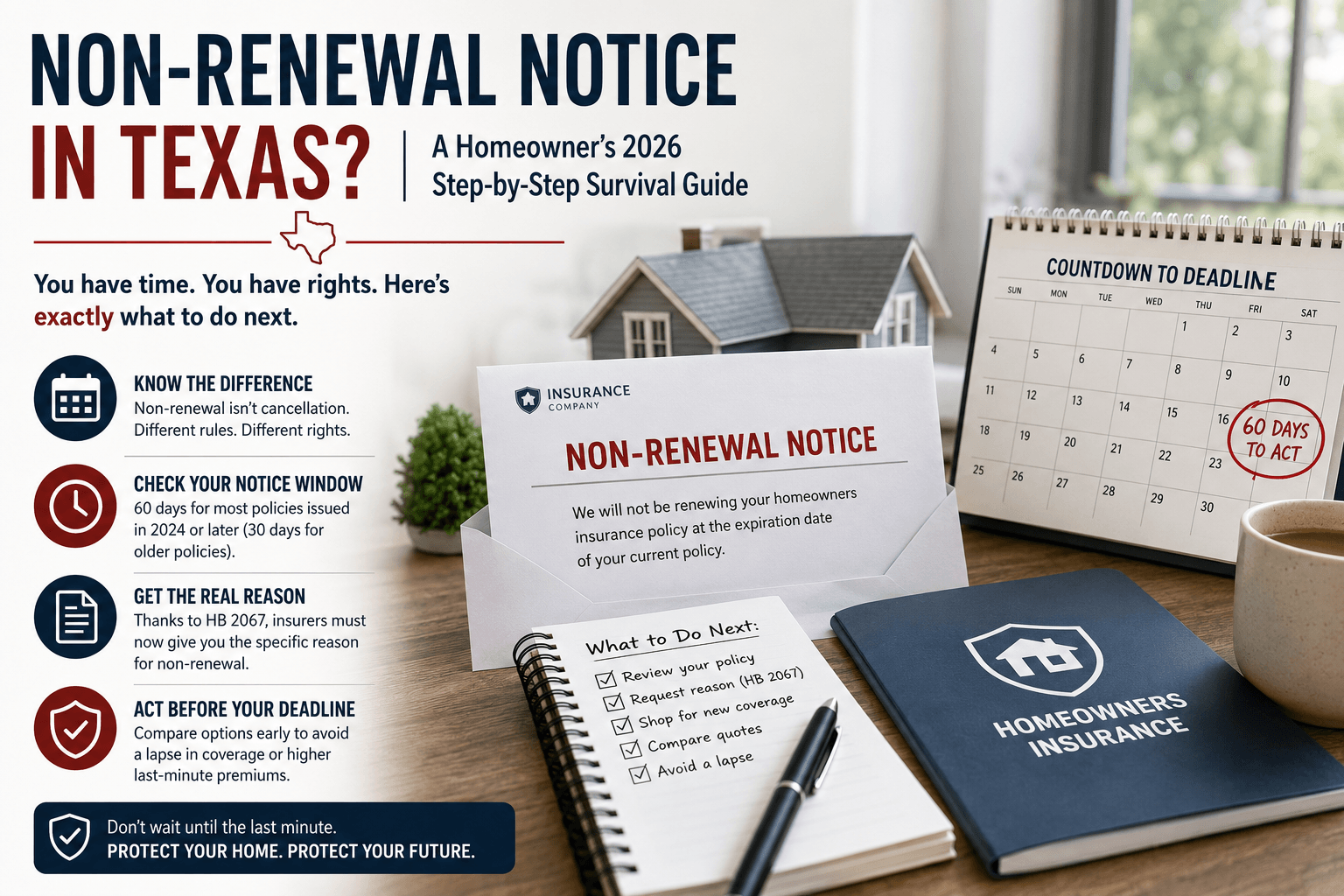

The envelope from your insurance company does not look urgent. It is the same size and shape as every other piece of mail from them. Then you open it and read the word “non-renewal,” and the calm you had about your homeowners coverage disappears. For a growing number of Texas homeowners in 2026, that letter is arriving more often than ever, as carriers redraw their risk maps by ZIP code and pull back from entire neighborhoods that once seemed unremarkable.
A non-renewal notice is not a claim denial, and it is not necessarily a sign that anything is wrong with your home. But it does start a clock, and what you do in the days after you receive it can determine whether you end up with comparable coverage at a fair price, or scrambling for a policy days before your current one lapses. This guide walks through exactly what to do, in order, from the moment that letter lands in your mailbox.
Non-Renewal vs. Cancellation: They Are Not the Same Thing Under Texas Law
The first thing to understand is that Texas law treats non-renewal and cancellation as two entirely different actions, with different rules, different timelines, and different levels of protection for the homeowner. Many people use these words interchangeably, and insurance companies sometimes do little to clarify the distinction in their letters, but the legal difference matters enormously for what happens next.
A cancellation ends your policy in the middle of its term, before the coverage period you already paid for has run its course. Texas law tightly restricts when an insurer can do this. Once a homeowners policy has been in effect for more than sixty days, a carrier generally can only cancel it for a short list of specific reasons: nonpayment of premium, fraud or a material misrepresentation on the application, or an increase in hazard within your control that was not disclosed. Insurers generally must give shorter notice for a cancellation, often as little as ten days, because the reasons that justify a mid-term cancellation are considered serious enough to warrant a faster exit from the relationship.
A non-renewal is different, and in most cases, less alarming. Your policy is allowed to run its full term. You are not being cut off mid-cycle. The insurer is simply declining to offer you a new policy once the current one expires. This gives you something a cancellation does not: a defined runway before your coverage actually ends, along with a legal obligation on your insurer’s part to notify you well in advance rather than springing the decision on you at the last moment. If your letter says “non-renewal” rather than “cancellation,” you are, in a meaningful sense, in a better procedural position, because Texas law gives you real time to respond.
Understanding which situation you are actually in is the first step, because the deadlines, your rights, and your options are not identical between the two, and confusing one for the other can cost you time you do not have.
Your 60-Day (or 30-Day) Notice Window Explained
Once you know you are dealing with a non-renewal rather than a cancellation, the next question is how much notice your insurer was legally required to give you, because the answer determines exactly how much runway you actually have left. Texas Insurance Code Section 551.105 governs this notice requirement, and the rule changed in recent years in a way that many homeowners still do not know applies to them.
For homeowners and personal auto policies that were issued or renewed in 2024 or later, Texas law requires insurers to provide at least sixty days written notice before a non-renewal takes effect. This is a meaningful increase from the older standard, which only required thirty days notice, and it was designed specifically to give homeowners enough time to shop for replacement coverage before a gap opens up. If your policy predates that change and has not been renewed since, you may only be entitled to the older thirty day window, so it is worth checking the effective date on your current policy and the date printed on your non-renewal notice itself.
This notice period is not a courtesy. It is a statutory requirement, and if your insurer fails to provide the legally required notice, that failure can itself become an issue worth raising, potentially requiring the insurer to keep your coverage in place longer than they intended. The safest approach is to calculate your actual deadline the moment you receive the letter, mark it clearly, and treat everything you do afterward as working backward from that date, not forward from the day you happened to open the mail. Many homeowners lose weeks simply because they set the letter aside, assuming they had more time than they actually did, only to realize much later that their coverage was about to end.
Requesting the Specific Reason Under HB 2067
As of January 1, 2026, Texas homeowners have a tool that did not exist in prior years. Under House Bill 2067, insurers are now required to automatically provide a written statement explaining the specific reason behind a non-renewal, cancellation, or declination, rather than waiting for the policyholder to formally request it. Before this law took effect, many homeowners received nothing more than a generic notice referencing vague underwriting criteria, with no real explanation of what actually triggered the decision.
That written explanation is one of the most valuable pieces of paper you will receive during this entire process, because it tells you what you are actually dealing with. A non-renewal driven by an aging roof is a fundamentally different problem than one driven by a prior claims history, a credit based insurance scoring change, or a carrier’s decision to stop writing new business in your ZIP code entirely. Each of these scenarios calls for a different response, and without a specific reason, you are left guessing at exactly the moment you can least afford to guess wrong.
If your notice arrived without a clear, specific explanation attached, or if the language feels generic and boilerplate rather than tied to your actual property and history, that is worth following up on directly with your insurer or your agent. Texas homeowners are entitled to know the real basis for the decision, and a vague or unresponsive answer to that request is itself useful information, both for your own planning and, depending on the circumstances, for evaluating whether the process you received matched what the law actually requires.
Fixing What Can Be Fixed Before Your Policy Lapses
Once you know the specific reason behind your non-renewal, the next step is figuring out whether it is something you can actually address before your policy expires, or before you apply with a new carrier. Not every non-renewal reason is fixable on a short timeline, but a surprising number are, and addressing the underlying issue can sometimes turn a non-renewal into a renewal offer, or at minimum make you a stronger applicant with a new carrier.
If the stated reason involves the physical condition of the home, an aging roof, deferred maintenance, an outdated electrical or plumbing system, getting a licensed contractor to assess and document repairs, and sharing that documentation with your current insurer or a prospective new one, can materially change how your application is viewed. Insurers are generally more willing to work with a homeowner who has taken concrete, documented steps to reduce risk than one who has done nothing since the notice arrived.
If the reason involves your claims history, it is worth reviewing that history carefully for accuracy. Errors on a CLUE report, the industry database insurers use to track prior claims, are more common than most homeowners realize, and a claim that was miscoded, duplicated, or attributed to the wrong property can unfairly follow you from one application to the next. It is also worth remembering that Texas law places limits on how weather related claims can be counted against a homeowner, so a single storm or hail claim generally should not, on its own, be treated the same way as a pattern of unrelated losses.
If the reason is simply that your carrier is pulling back from your area entirely, unrelated to anything about your specific property, there may be nothing to fix on your end, and your energy is better spent moving directly to shopping for replacement coverage rather than trying to change a decision that has nothing to do with you individually.
Shopping the Standard Market, Excess and Surplus Lines, and the Texas FAIR Plan
With your notice period clock running and, ideally, a clear understanding of why you were non-renewed, the practical work of finding replacement coverage begins. Texas homeowners generally have three tiers to work through, and it is worth understanding all three before assuming you have run out of options.
The first tier is the standard admitted market, meaning the roughly 160 licensed companies actively selling homeowners insurance in Texas. Getting quotes from multiple carriers, ideally through an independent agent who can compare several companies at once rather than representing just one, remains the starting point for most homeowners, and it is often faster than people expect, particularly if the reason behind your non-renewal has already been addressed or documented.
The second tier is the excess and surplus lines market, sometimes called the E and S market, which serves homeowners whose properties are considered too high risk for standard admitted carriers to write at standard rates. These policies are placed through specially licensed surplus lines agents and typically come with higher premiums and less standardized policy language than standard market coverage, but they remain a real option for homes that have become difficult to place through ordinary channels, particularly older homes, homes with significant prior claims, or homes in areas carriers have been actively retreating from.
The third tier, and generally the option of last resort, is the Texas FAIR Plan Association. The FAIR Plan exists specifically for homeowners who have been declined by at least two insurance companies actively writing residential property coverage in Texas, and it provides a basic, named perils policy when no other coverage is available. FAIR Plan coverage is intentionally less comprehensive than a standard policy, with lower personal property limits and a narrower list of covered perils, and homeowners along the coast will still need a separate policy through the Texas Windstorm Insurance Association for wind and hail coverage, since the FAIR Plan does not include it. The FAIR Plan should generally be treated as a bridge, coverage to keep your home protected while you continue working to reintegrate into the private market, rather than a permanent long term solution.
When a Non-Renewal Pattern Itself Raises Legal Questions
Most non-renewals are exactly what they appear to be: a business decision by a carrier reassessing risk in a changing market. But there are situations where the pattern behind a non-renewal, or the way it was handled, raises questions that go beyond simply shopping for a new policy.
If your written explanation under HB 2067 does not match the actual facts of your property, if you are non-renewed shortly after filing a legitimate weather related claim that Texas law generally should not penalize on its own, or if neighbors with similar homes and similar histories describe receiving oddly similar non-renewal language despite different circumstances, those patterns can be worth a closer look. A non-renewal is not itself a bad faith claim, and insurers generally have wide latitude to make underwriting decisions about which risks they choose to insure. But when the stated reason does not hold up against the facts, or when a non-renewal appears connected to a claim you had every right to file, it is worth having someone with insurance law experience review what actually happened before you simply accept the explanation at face value and move on.
This is also where having handled claims from the carrier side becomes useful in evaluating a homeowner’s situation, since it means understanding not just what the law requires, but what a carrier’s internal decision making process typically looks like, and what a non-renewal decision that does not add up on paper might actually indicate underneath the surface explanation.
Frequently Asked Questions About Texas Home Insurance Non-Renewal
How much notice must a Texas insurer give before non-renewing my policy?
If your policy was issued or renewed in 2024 or later, Texas law generally requires at least sixty days written notice before a non-renewal takes effect. Older policies that have not been renewed since that change may still fall under the prior thirty day notice requirement.
What is the difference between cancellation and non-renewal in Texas?
A cancellation ends your policy before its term is complete and is limited to a narrow set of reasons such as nonpayment, fraud, or an undisclosed increase in risk. A non-renewal allows your current policy to run its full term, with the insurer simply declining to offer a new policy once it expires, and it comes with a longer required notice period.
Can I get new coverage if a hurricane is already in the Gulf?
Many insurers place a moratorium on new policies or coverage changes once a storm has formed and is being tracked toward Texas, which means the window to secure new coverage can close well before landfall. This is one of the strongest reasons to begin shopping for replacement coverage as soon as you receive a non-renewal notice rather than waiting until closer to your expiration date.
What is the Texas FAIR Plan?
The Texas FAIR Plan Association is a last resort insurer created to provide basic property coverage to homeowners who have been declined by at least two private insurance companies. It offers narrower, named perils coverage compared to a standard policy and is generally intended as temporary coverage while a homeowner continues to seek private market options.
Can I fight a non-renewal?
Insurers generally have broad discretion in underwriting decisions, so a non-renewal is often not something that can simply be reversed through a dispute. However, if the stated reason under HB 2067 does not match the facts, or if the non-renewal appears connected to a weather claim in a way Texas law restricts, those situations can raise legitimate questions worth having an attorney evaluate.
Disclaimer: This article is for general informational purposes only and does not constitute legal advice. Non-renewal notices and insurance timelines can vary based on your specific policy, its renewal date, and the reason stated by your carrier. If you have questions about a specific non-renewal or believe the reason given does not match your situation, an attorney can evaluate the facts of your case.
If you received a non-renewal notice and are not sure whether the reason given holds up, or if you are dealing with a related denied homeowners insurance claim or an underpaid wind, hail, or roof damage claim, Herrera PLLC can help you understand your options. Call 832-891-3210 or contact us for a free, confidential consultation.
Jonathan Herrera, J.D. is a Houston based attorney and the founder of Herrera PLLC, representing Texas homeowners in insurance law and property claim disputes. Before practicing law, he spent over a decade as a licensed insurance adjuster managing high exposure casualty and property claims for carriers and third party administrators, giving him firsthand insight into how underwriting and non-renewal decisions are actually made inside an insurance company. He is a member of the Texas Trial Lawyers Association and the American Association for Justice