

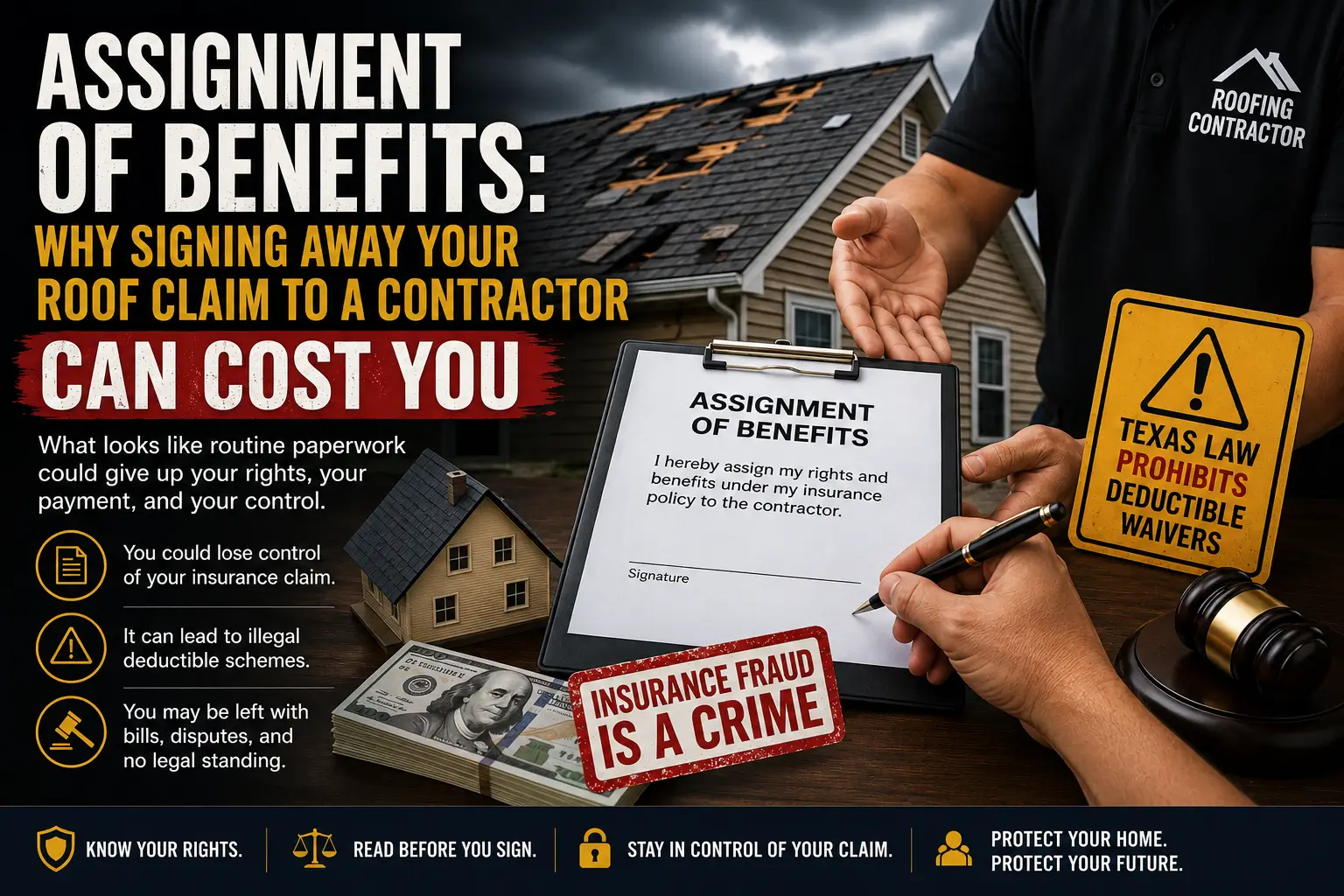
Assignment of Benefits: Why Signing Away Your Roof Claim to a Contractor Can Cost You

A contractor knocks on the door two days after a hailstorm, points out damage you had not noticed, and hands over a clipboard. Somewhere in that stack of paperwork, alongside the estimate and the work authorization, is a document called an assignment of benefits. It looks routine. Many homeowners sign it without reading past the first paragraph, assuming it simply lets the contractor talk to the insurance company on their behalf.
It is rarely that simple. An assignment of benefits, often shortened to AOB, can attempt to transfer meaningful legal rights under your insurance policy directly to the contractor, and once that happens, control over your own claim can shift in ways that feel difficult to undo, even though Texas law is actually more protective of homeowners here than many people realize. In 2026, with active Texas Attorney General enforcement against roofing companies accused of defrauding homeowners and a state law specifically targeting deductible fraud schemes, understanding what an AOB actually does, and what Texas law actually allows it to do, has never mattered more.
What an Assignment of Benefits Actually Attempts to Sign Away
An assignment of benefits is a legal document that attempts to transfer some or all of a homeowner’s rights under an insurance policy to a third party, typically the contractor performing repairs. In its narrowest form, an AOB simply allows the contractor to bill the insurance company directly for repair work rather than requiring the homeowner to pay upfront and seek reimbursement. In its broader and more concerning form, an AOB attempts to transfer the homeowner’s right to negotiate the claim, to receive insurance payments directly, and even to control communication with the insurance company entirely, effectively trying to put the contractor in the driver’s seat of a claim that is legally the homeowner’s to manage.
Here is what many homeowners do not realize, and what many contractors either do not know or do not mention: most Texas property insurance policies contain anti-assignment clauses, and Texas courts have generally enforced them against exactly this kind of broad, post-loss assignment. That means a contractor asking a homeowner to sign over full control of a claim is often asking for something the policy itself does not actually allow, regardless of what the signed paper says. This does not mean an AOB is harmless to sign, it can still create real confusion, delay, and disputes while it is in effect, but it does mean a homeowner is not necessarily as legally stuck as a broad AOB makes it appear.
While that dispute plays out, however, an insurance company may still begin corresponding primarily with the contractor rather than the homeowner, and payments for the claim may be issued directly to the contractor instead of the policyholder. This means the homeowner can lose real time visibility into how the claim is progressing, what the insurance company is actually offering, and whether the contractor is negotiating in the homeowner’s best interest or simply pursuing whatever outcome maximizes the value of the job for the contractor’s own business. If a dispute later arises, the practical disruption can be significant even if the underlying assignment itself is ultimately unenforceable.
Why Reputable Texas Roofers Rarely Ask for One
Not every roofing contractor pushes an assignment of benefits, and that distinction is itself informative. Reputable, established roofing companies generally do not need to control the insurance claim to get paid fairly for their work. They typically operate under a straightforward arrangement: the homeowner remains the policyholder, remains in control of the claim, receives the insurance payment, and pays the contractor directly for completed work, sometimes with a direction of payment agreement, which is a far narrower and more limited arrangement than a full assignment of benefits.
Some contractors, aware that a broad AOB is likely unenforceable in Texas, will instead ask a homeowner to sign a limited power of attorney allowing the contractor to negotiate or settle the claim directly. Homeowners should be just as cautious here. Texas courts have generally viewed this kind of arrangement as an assignment in different clothing, and it carries an additional problem: negotiating or settling an insurance claim on someone else’s behalf is regulated activity in Texas, reserved for the policyholder, a licensed attorney, or a licensed public adjuster. A contractor attempting to negotiate a claim under a power of attorney may be engaged in the unauthorized practice of public adjusting, which is its own separate legal problem, independent of whether the underlying assignment holds up.
Contractors who insist on a broad AOB or a claim-negotiation power of attorney as a condition of doing the work are often signaling something worth taking seriously, an intent to control the claim process itself, sometimes to inflate the scope or cost of repairs, sometimes to avoid the scrutiny that comes with a homeowner reviewing every line item before it is submitted to the insurance company. This does not mean every contractor who mentions an AOB is acting in bad faith, but a homeowner asked to sign away rights under their own policy, particularly within the first conversation after a storm, has every reason to slow down and ask exactly what is being requested and why.
The Illegal Deductible Waiver Scheme and How It Works
One of the most common schemes that assignment of benefits arrangements can enable involves the insurance deductible. Under Texas law, specifically Texas Insurance Code Section 707.002 and Texas Business and Commerce Code Section 27.02, both enacted through House Bill 2102 in 2019, it is illegal for a contractor to pay, waive, rebate, or otherwise help a homeowner avoid paying the deductible required under their property insurance policy. Every insurance policy requires the policyholder to bear this deductible as their own financial share of a covered loss, and the law is explicit that this obligation cannot be quietly absorbed by the contractor as a sales incentive.
The scheme typically works like this: a contractor offers what is marketed as a “free roof,” meaning the homeowner will not have to pay the deductible out of pocket. To make the arrangement work financially, the contractor inflates the invoice submitted to the insurance company, overstating the actual cost of materials and labor by an amount roughly equal to the deductible the homeowner was supposed to pay. The insurance company ends up paying more than the job was actually worth, the contractor recovers the deductible amount through the inflated invoice rather than collecting it from the homeowner directly, and the homeowner gets a roof without writing a check for the deductible. It sounds appealing, but it is insurance fraud, and Texas law makes clear that both the contractor and, in some circumstances, the homeowner who knowingly participates can face serious consequences, including criminal penalties. A broad assignment of benefits can make this scheme easier for a contractor to attempt, because it gives the contractor more direct control over how the claim is billed and paid, with less homeowner visibility into the actual numbers being submitted to the insurance company.
Storm-Chasing Contractors and What Happens When They Disappear
Every major hail or wind event in Texas brings an influx of contractors from outside the immediate area, sometimes from out of state, following the storm system from region to region in search of insurance funded repair work. Some of these companies are legitimate and do quality work. Many are not, and the pattern with the problematic ones tends to look similar: aggressive door to door sales immediately after a storm, pressure to sign paperwork on the spot, and an assignment of benefits presented as a routine part of getting started quickly.
The Texas Attorney General’s office has actively pursued enforcement action against roofing companies engaged in these practices in 2026, including a lawsuit filed in Collin County against a Dallas-Fort Worth area roofing company accused of collecting roughly half a million dollars in insurance funded payments from dozens of homeowners, including elderly Texans, and then delaying or never completing the promised work. That case describes a pattern that recurs across many similar situations: contracts secured through high pressure sales tactics, payments collected including insurance proceeds, and then months of excuses or complete abandonment of the project. When a storm-chasing contractor holding a broad assignment of benefits disappears, either after collecting an insurance payment or after doing substandard work, the homeowner can be left in a genuinely difficult position, needing to reassert control over a claim that the contractor was never entitled to fully control in the first place.
Getting Your Claim Back Under Your Own Control
If you have already signed an assignment of benefits and have concerns about the contractor, there is good news worth knowing upfront: Texas is one of the states that generally does not enforce broad, post-loss assignments of benefits, because most property insurance policies contain anti-assignment clauses that Texas courts have consistently upheld. That means many homeowners have a stronger legal position to reclaim control of a claim than the signed document alone would suggest.
That said, acting quickly still matters. The first step is reviewing the actual document you signed to understand exactly what was requested and how broadly it was written, since some AOBs are narrow and limited to a specific payment, while others attempt the kind of broad transfer discussed above. Contacting your insurance company directly, informing them of your concerns about the contractor, and requesting that future communication and payments be directed to you rather than the contractor is an important early step, and insurers are generally required to work with the policyholder of record regardless of what a contractor’s paperwork claims. Documenting everything, including the original contract, any correspondence with the contractor, and the current status of both the repair work and the insurance claim, gives you and anyone helping you a clear picture of where things actually stand. The longer a contractor has been operating as though it controls the claim, communications rerouted, payments already issued, work already underway, the more entangled things can become in practice, even when the underlying assignment is not legally binding, which is exactly why prompt action is worth taking rather than assuming the paperwork has settled the matter.
Red Flags Before You Sign Anything After a Storm
The best time to avoid the problems an assignment of benefits can create is before you sign anything at all. Several warning signs are worth watching for in the hours and days after a storm, when contractors are actively canvassing damaged neighborhoods. Extreme urgency, including pressure to sign a contract or an AOB during the very first visit before you have had time to review it or get a second opinion, is one of the most consistent red flags across problematic contractor situations.
A contractor who cannot or will not clearly explain what a document does before asking you to sign it, or who brushes off questions about what an assignment of benefits actually means for your rights, deserves additional scrutiny rather than trust. Any suggestion, subtle or direct, that you will not have to pay your deductible is a direct signal of the illegal scheme described above, regardless of how it is phrased. A lack of a permanent local address, an unfamiliar company name with no verifiable history in your area, and an unwillingness to provide references or point to completed local jobs are all worth checking before any contract is signed. Taking the time to verify a contractor’s licensing, checking for complaints with the Texas Department of Insurance or the Better Business Bureau, and simply slowing down enough to actually read every document before signing it protects both your roof and your legal rights under your own insurance policy.
Frequently Asked Questions About Assignment of Benefits in Texas
What is an assignment of benefits in a roofing claim?
An assignment of benefits is a legal document that transfers some or all of a homeowner’s rights under their insurance policy to a third party, typically the roofing contractor. Depending on how broadly it is written, it can shift control over claim negotiation, communication with the insurer, and even direct payment away from the homeowner and to the contractor.
Is it illegal for a contractor to waive my deductible in Texas?
Yes. Under Texas Insurance Code Section 707.002 and Texas Business and Commerce Code Section 27.02, it is illegal for a contractor to pay, waive, rebate, or otherwise help a homeowner avoid paying their insurance deductible. This law was enacted specifically to stop the practice of contractors offering a “free roof” by absorbing the deductible into an inflated insurance invoice.
How do I spot a storm-chasing roofing contractor?
Warning signs include high pressure sales tactics immediately after a storm, unfamiliarity with or lack of presence in your local area, reluctance to explain contract terms clearly, any offer to waive or cover your deductible, and pressure to sign paperwork, including an assignment of benefits, before you have had time to review it fully.
Can I cancel an assignment of benefits after signing it?
Depending on the specific language of the document and how much work has already been performed, it may be possible to revoke or limit an assignment of benefits. Reviewing the actual agreement, contacting your insurance company directly about your concerns, and acting promptly are important steps if you are trying to regain control of a claim.
What should I do if a contractor already filed my claim?
Contact your insurance company directly to understand the current status of the claim and to request that future communication and payments come to you. Gather and review all documentation, including the original contract and any assignment of benefits you signed, and consider having an attorney review the situation if the contractor is unresponsive, appears to be engaged in questionable practices, or if the claim outcome does not seem to reflect the actual damage to your home.
Disclaimer: This article is for general informational purposes only and does not constitute legal advice. Assignment of benefits agreements vary significantly in their terms, and how a specific document affects your rights depends on its exact language and the facts of your situation. If you have signed an assignment of benefits and have concerns about your claim, an attorney can evaluate the specifics of your case.
If you signed an assignment of benefits and feel you have lost control of your roof claim, or if your homeowners claim was denied or underpaid, Herrera PLLC can help you understand your options. Learn more about our approach to denied homeowners insurance claims and underpaid wind, hail, and roof damage claims, or call (832-891-3210) to contact us for a free, confidential consultation.
Jonathan Herrera, J.D. is a Houston based attorney and the founder of Herrera PLLC, representing Texas homeowners in insurance law and property claim disputes. Before practicing law, he spent over a decade as a licensed insurance adjuster managing high exposure casualty and property claims for carriers and third party administrators, giving him firsthand insight into how claims are documented, valued, and sometimes manipulated by parties on either side of the transaction. He is a member of the Texas Trial Lawyers Association and the American Association for Justice.