

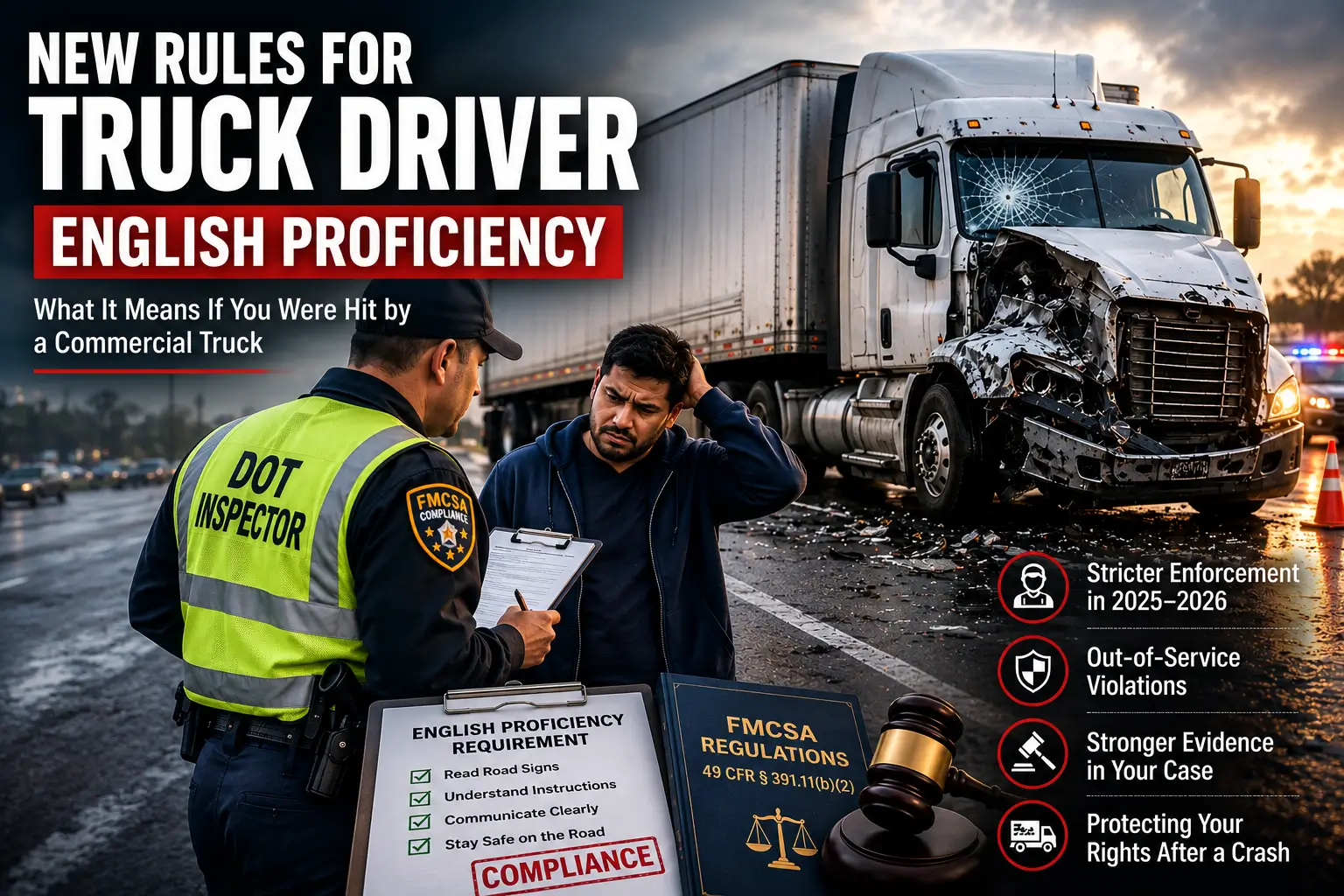
New Rules for Truck Driver English Proficiency: What It Means If You Were Hit by a Commercial Truck

A commercial truck cannot legally operate on American highways with a driver who cannot read a road sign, understand an officer’s instructions during a roadside stop, or communicate with emergency responders after a crash. That has been federal law for decades. What changed in 2025 and 2026 is enforcement, and enforcement is exactly where the story becomes relevant to anyone injured by a commercial truck in Texas.
Federal regulators spent nearly a decade quietly declining to enforce this requirement at the roadside. That changed with an executive order, new inspection guidance, and eventually an act of Congress. Thousands of drivers have now been placed out of service. For a truck crash victim, a documented violation of this rule, or a related driver qualification failure, is not just a regulatory footnote. It can be direct evidence of exactly the kind of hiring and oversight failure that makes a trucking company legally responsible for what happened.
What Federal Law Actually Requires of Commercial Drivers
Federal motor carrier regulations have long required, under 49 CFR Section 391.11(b)(2), that a person is not qualified to drive a commercial motor vehicle unless they can read and speak English sufficiently to converse with the general public, understand highway traffic signs and signals, respond to official inquiries, and make legible entries on reports and records. This is not a new rule invented in 2025. It has existed in some form since the earliest federal motor carrier safety regulations were written, on the straightforward premise that a driver operating an eighty thousand pound vehicle needs to be able to read warning signs, follow instructions from law enforcement and emergency responders, and understand the paperwork tied to the load they are carrying.
For years, however, the practical consequence of failing this requirement was limited. A 2016 FMCSA guidance memo instructed roadside inspectors not to place a driver out of service solely for an English language proficiency violation, effectively turning a driver qualification standard into something closer to a paperwork citation. That guidance shaped roadside enforcement for nearly a decade, meaning a driver who could not meaningfully communicate in English could still often be cited and sent back on the road with the same load, the same truck, and the same trip ahead of them.
That changed sharply starting in 2025, and the shift matters because it reflects a broader point relevant to any trucking accident case. The requirement that a driver be able to communicate in English is fundamentally a highway safety standard, tied directly to a driver’s ability to read warning signage, understand detour and hazard instructions, and respond appropriately in an emergency. Whether or not it was being actively enforced at a given moment, motor carriers remained legally responsible for confirming, before ever putting a driver behind the wheel, that the driver met this basic qualification standard.
The 2026 Executive Order and Stricter Enforcement
On April 28, 2025, President Trump signed an executive order titled Enforcing Commonsense Rules of the Road for America’s Truck Drivers, directing the Department of Transportation and FMCSA to rescind the 2016 guidance and issue new inspection procedures ensuring actual compliance with the English language proficiency requirement. The order specifically directed that the out of service criteria be revised so that a violation results in the driver being pulled from the road immediately, rather than simply cited and released.
The Commercial Vehicle Safety Alliance, the organization of law enforcement officials that conducts roadside inspections nationwide, acted quickly. Effective June 25, 2025, the Alliance added noncompliance with Section 391.11(b)(2) to its North American Standard Out of Service Criteria, meaning any driver who fails an English proficiency assessment during a roadside inspection can now be placed out of service on the spot. Congress went further in early 2026, passing the Consolidated Appropriations Act of 2026 with a provision requiring FMCSA to formally codify this out of service consequence in its regulations, turning what began as an executive branch enforcement priority into statutory law less likely to shift with a future administration.
The results have been significant. A multi-state enforcement effort called Operation SafeDRIVE conducted roadside inspections across twenty six states, including Texas, over three days in January 2026, placing over seven hundred drivers and more than twelve hundred vehicles out of service, with approximately five hundred of those driver violations tied specifically to English language proficiency failures. FMCSA described the operation as a first wave, signaling that this level of enforcement intensity is expected to continue rather than fade.
How an Out-of-Service Violation Becomes Evidence in Your Case
For someone injured by a commercial truck, an out of service violation, whether for English proficiency or another driver qualification issue, is not simply a piece of regulatory trivia. It becomes relevant evidence in two overlapping ways.
First, if the driver involved in your crash had a documented history of qualification violations, including prior English proficiency failures, hours of service violations, or other out of service orders, that history speaks directly to whether the motor carrier that employed or dispatched the driver exercised reasonable care in its hiring and ongoing supervision. A carrier that continued to put a driver on the road despite a known or discoverable qualification failure has potentially failed in a duty that exists specifically to prevent the kind of harm that resulted.
Second, and more immediately, if the driver who caused your crash was not actually qualified to be driving under federal law at the time of the collision, whether due to an English proficiency failure, an invalid or ineligible CDL, or another driver qualification defect, that fact becomes powerful, documented evidence of negligence that does not require expert reconstruction or speculation. It is a federal violation that existed at the moment of the crash, tied to the exact regulation designed to prevent exactly this kind of harm. Federal inspection records, out of service orders, and roadside citation history are public safety data that an attorney can pull and examine as part of investigating what actually happened before your crash occurred.
Non-Domiciled CDL Rule Changes and Why They Matter
A related but separate development adds another layer to this picture. On February 13, 2026, FMCSA issued a final rule titled Restoring Integrity to the Issuance of Non-Domiciled Commercial Driver’s Licenses, effective March 16, 2026, which sharply narrows who is eligible to hold a non-domiciled CDL or commercial learner’s permit. Under the new rule, eligibility is limited to holders of three specific employment based nonimmigrant visa categories, and employment authorization documents alone are no longer sufficient proof of eligibility on their own. FMCSA has estimated that a substantial majority of existing non-domiciled CDL holders do not hold one of the newly qualifying visa categories, meaning a significant share of the non-domiciled driver population faces losing eligibility to hold a CDL at all unless they establish state domicile or qualify under one of the specified categories.
FMCSA’s stated rationale for the rule centered on a documented safety gap: domestic CDL applicants undergo driving history verification through national databases, while non-domiciled applicants historically had no equivalent way to verify prior driving history from outside the United States, creating a gap in the vetting process that the new rule is intended to close. For a trucking accident case, this means a driver’s CDL status itself, whether it was validly issued, whether the visa category and lawful presence documentation actually supported the license at the time it was issued, and whether the carrier verified any of this before putting the driver on the road, has become a more significant and more scrutinized part of any driver qualification investigation than it was before 2026.
Requesting a Driver’s Qualification File After a Crash
Every motor carrier is required to maintain a driver qualification file for each driver it employs, and that file is one of the single most important pieces of evidence in a serious trucking accident case. Federal regulations require the file to include, among other things, the driver’s employment application, a copy of the driver’s CDL, road test certification, medical examiner’s certificate, and records related to the driver’s qualification to operate the vehicle, which can include documentation of an English proficiency assessment and any prior out of service history the carrier was aware of or should have discovered.
After a serious crash, requesting and preserving the driver qualification file, along with the carrier’s own hiring and safety records, is a critical early step, because this evidence can be lost, altered, or become harder to obtain the longer a claim is delayed. If a carrier failed to properly assess or document a driver’s English proficiency, failed to verify that a non-domiciled CDL was validly issued and supported by current lawful presence documentation, or simply never checked at all, that failure becomes part of the record showing whether the carrier exercised reasonable care in putting that specific driver behind the wheel of that specific truck.
Building a Negligent Hiring Claim Against the Carrier
When a driver qualification failure, whether an English proficiency violation, an invalid CDL, or another documented deficiency, contributed to a serious crash, it can support a negligent hiring or negligent entrustment claim against the motor carrier, separate from and in addition to a standard negligence claim against the driver. These claims focus not on how the driver was operating the truck at the moment of the crash, but on whether the carrier should have put that driver on the road in the first place.
Building this kind of claim generally requires pulling federal inspection and violation history, obtaining and carefully reviewing the driver qualification file, comparing what the carrier’s records show against what federal regulations actually require, and identifying gaps between the two. In an environment where federal enforcement of these qualification standards is intensifying rather than easing, a documented violation is often easier to establish and harder for a carrier to explain away than it might have been just a few years ago, when weak enforcement gave carriers more room to argue that a qualification gap was minor or immaterial to the crash.
Frequently Asked Questions About Truck Driver Qualification Violations and Injury Claims
What is the English Language Proficiency rule for truck drivers?
Federal regulation 49 CFR Section 391.11(b)(2) requires that a commercial driver be able to read and speak English sufficiently to converse with the public, understand highway signs and signals, respond to official inquiries, and complete required reports and records. Since 2025, enforcement of this requirement has increased significantly, with violations now resulting in the driver being placed out of service at roadside inspections.
What happens when a driver is placed out of service?
An out of service order means the driver is prohibited from operating the commercial vehicle further until the violation is corrected, immediately stopping that specific trip. For the driver’s employer, an out of service violation becomes part of the carrier’s federal safety record and can be evidence of a broader qualification or hiring failure if it reflects a pattern rather than an isolated incident.
How does a CDL violation help my injury claim?
Depending on the facts, a documented driver qualification violation, such as an English proficiency failure or an invalid non-domiciled CDL, can support a claim that the motor carrier failed to exercise reasonable care in hiring or continuing to employ the driver, in addition to any claim based on how the driver operated the vehicle at the time of the crash.
What is a driver qualification file?
A driver qualification file is a set of records federal law requires every motor carrier to maintain for each driver, including the driver’s application, license information, road test results, medical certification, and other documentation related to whether the driver meets federal qualification standards. This file is often central evidence in a serious trucking accident investigation.
Can I request a trucking company’s safety records?
Depending on the stage of a claim, an attorney can typically request a carrier’s driver qualification files, safety records, and related documentation as part of investigating a serious crash. Federal inspection and violation history is also generally available through public FMCSA safety data, which can be reviewed early in an investigation.
Disclaimer: This article is for general informational purposes only and does not constitute legal advice. Federal trucking regulations and enforcement priorities continue to evolve, and how a specific driver qualification issue applies to a particular crash depends on the facts involved. If you were injured by a commercial truck, an attorney can evaluate the specifics of your situation.
If you or a loved one was injured in a crash involving a commercial truck, Herrera PLLC can investigate whether driver qualification failures played a role. Learn more about our serious injury representation, our work on truck accident cases, or our broader civil litigation practice, or call 832-891-3210 to contact us for a free, confidential consultation.
Jonathan Herrera, J.D. is a Houston based attorney and the founder of Herrera PLLC, representing Texans injured in serious commercial trucking accidents throughout Greater Houston and across the state. Before practicing law, he spent over a decade as a licensed insurance adjuster managing high exposure casualty claims, including commercial trucking incidents, for carriers and third party administrators, giving him firsthand insight into how carriers document, or fail to document, driver qualification and hiring decisions. He is a member of the Texas Trial Lawyers Association and the American Association for Justice.