
How Insurance Companies Use AI to Decide Your Claim and What It Means for Policyholders

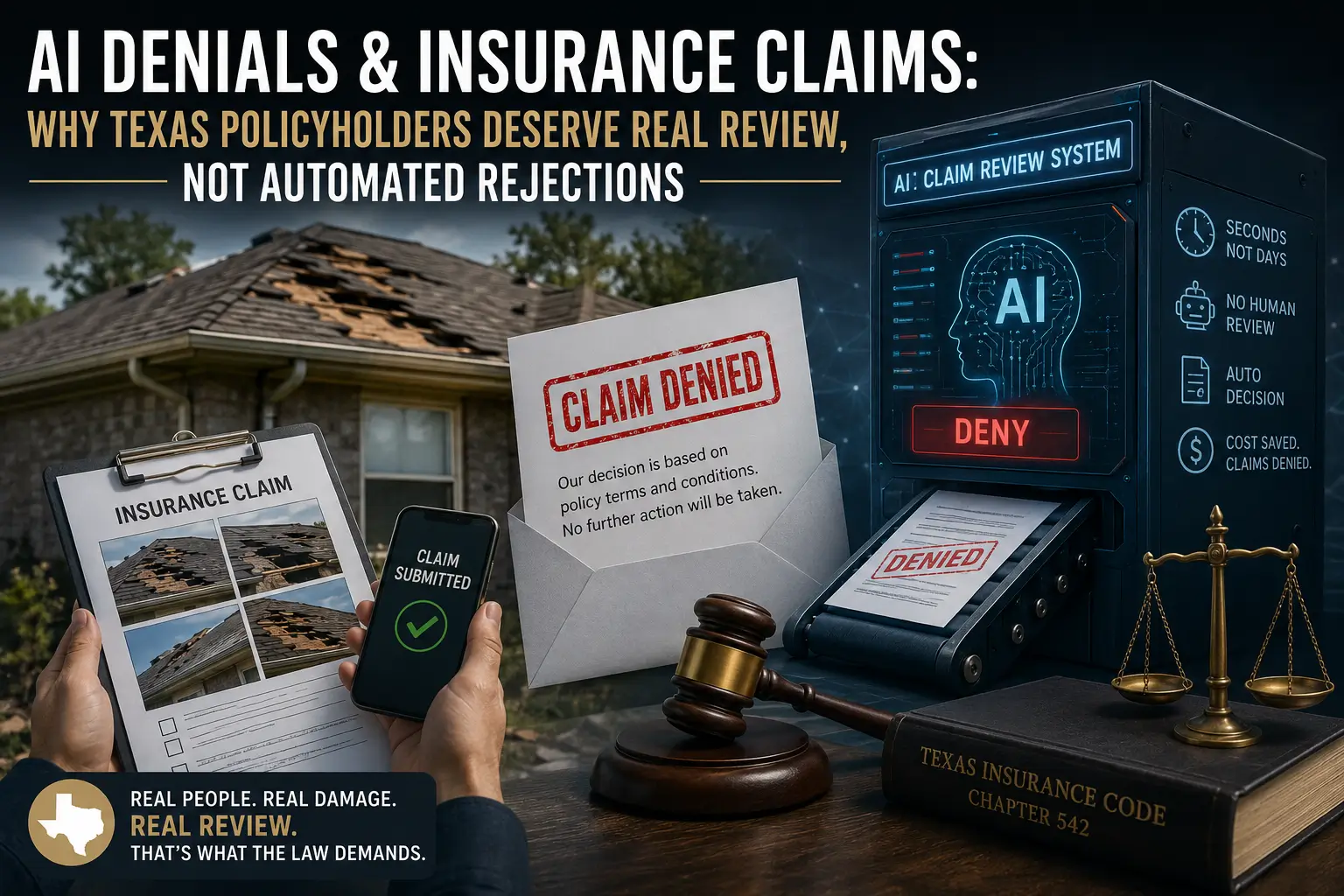
A homeowner submits photos of storm damage. A denial letter arrives within days. No adjuster ever walks the roof. No phone call ever happens. The explanation reads like it came from a template, because in a growing number of cases, it did.
Insurance companies have used software to speed up claims processing for years. What has changed in 2026 is how much of the actual decision, not just the paperwork around it, is now being made by artificial intelligence with minimal or no human review. Courts are beginning to notice, and so are the lawyers representing policyholders whose claims were denied in seconds.
Nine in Ten Insurers Now Use AI Somewhere in Claims
Industry surveys published in 2026 show that nearly nine in ten insurers are now using artificial intelligence somewhere in their claims, underwriting, or customer service operations, with more than half reporting AI already implemented in live claims workflows rather than still in pilot testing. That shift has moved fast. As recently as a few years ago, AI in claims handling mostly meant fraud detection flags or faster paperwork routing. Today, in a meaningful share of cases, AI systems are making or heavily influencing the actual coverage decision.
For a homeowner or business owner, this means the entity reviewing a claim may not be a person who looked at the file, weighed the facts, and made a judgment call. It may be a model trained to process claims at scale, optimized for speed, and never required to explain its reasoning the way a human adjuster would.
What ‘Individualized Review’ Is Supposed to Mean Under Texas Law
Insurance policies promise individualized review. That promise is not just marketing language. Texas law imposes specific obligations on carriers under Chapter 542 of the Texas Insurance Code, the Prompt Payment of Claims Act. Under Chapter 542, an insurer generally must acknowledge receipt of a claim within 15 days, begin investigation promptly, and accept or reject the claim within 15 business days after receiving all information reasonably necessary to make that decision. A carrier that misses these deadlines can face statutory penalties, including 18% annual interest on the unpaid claim amount plus the policyholder’s attorney’s fees.
These deadlines were written with the expectation that a real investigation happens somewhere inside that window, someone actually looks at the property, reviews the documentation, and applies the specific facts of the claim to the specific language of the policy. When a denial is generated by an automated system with little or no human involvement, the fundamental question becomes whether that promised individualized review ever actually took place, or whether the claim was simply run through a formula.
Signs Your Claim Was Auto-Denied Rather Than Actually Reviewed
Not every fast denial is an AI denial, and not every AI-assisted decision is improper. But certain patterns are worth paying attention to:
The denial arrived within hours or a day or two of submission, far faster than a genuine inspection and file review would typically take.
The explanation is generic and formulaic, using the same boilerplate language regardless of the specific facts of your claim, rather than referencing details specific to your property or loss.
No adjuster ever visited the property or spoke with you directly before the denial was issued.
The denial letter cites a policy exclusion or a coverage limitation without connecting it to the actual facts of what happened.
Similar claims from other policyholders in your area describe nearly identical denial language, suggesting a batch process rather than individualized handling.
None of these signs alone proves a claim was mishandled. Together, they can raise a legitimate question worth investigating: was your claim actually reviewed, or was it processed.
Why Courts Are Now Allowing Discovery Into Insurer AI Tools
Litigation over AI-driven claims decisions has accelerated through 2026. In a widely watched federal case, The Estate of Gene B. Lokken v. UnitedHealth Group, Inc., the court granted a motion to compel discovery into whether the insurer used an AI program to deny claims without meaningful human review, allowing plaintiffs to examine how the tool actually functioned. While that case involves health coverage, the underlying legal principle applies broadly across insurance lines. If a policyholder can show that a carrier’s coverage decision was generated by an algorithm with no or minimal human verification, that can become relevant evidence in a bad faith claim.
Similar scrutiny has reached property and casualty insurers as well, with lawsuits alleging that automated claims tools processed and denied large volumes of claims without individualized consideration of each policyholder’s situation. Courts evaluating these cases have focused on a consistent question: did the insurer’s process allow for genuine, individualized review of the claim, or did it simply run the claim through a system optimized to produce fast outcomes at scale.
Requesting the Claim File to See What Actually Decided Your Case
One of the most important tools available to a policyholder after a denial is the ability to request the insurer’s complete claim file. That file typically includes the documentation the insurer relied on, the notes generated during the review, and, increasingly, records showing whether an automated system played a role in the decision and how much human oversight, if any, was applied.
Insurance companies do not always volunteer this information. Requesting the claim file, and following up when the response is incomplete, is often the only way a policyholder can determine whether their claim received the kind of individualized review the policy promises, or whether it was decided by a system with no one meaningfully checking the output before the denial letter went out.
When an AI Denial Becomes Evidence of Bad Faith
Texas law does not prohibit insurers from using software to help manage claims. The problem arises when a carrier lets an automated system make or drive a coverage decision without adequate human oversight, particularly when that decision turns out to be wrong or fails to account for facts specific to the claim.
If an insurer denies a valid claim based on flawed AI output, and no human caught or corrected the error before the denial was issued, that combination can support an argument that the insurer failed to conduct the kind of reasonable investigation Texas law requires. When paired with a stated reason that does not match the actual facts of the loss, or a documented pattern of similar denials across other policyholders, an AI-driven denial can become an important piece of evidence in a broader bad faith claim, not simply a technology complaint on its own.
Frequently Asked Questions About AI and Insurance Claim Denials
Can an insurance company deny my claim using only AI?
Insurers are increasingly using AI as part of the claims process, and in some cases it plays a significant role in the decision. Whether a denial that relied heavily on AI, with little or no human review, meets Texas law’s requirement of individualized claim handling depends on the specific facts, and it is an issue courts are actively examining in current litigation.
Is it legal for an insurer to use AI without telling me?
Texas law does not currently require an insurer to disclose upfront whether AI was used to evaluate your claim. However, once a claim is denied, you generally have the right to request the claim file, which can reveal what tools and processes were actually used to reach the decision.
How do I find out if AI was used to deny my claim?
Requesting the complete claim file is typically the starting point. Depending on the facts of the denial, an attorney can also help identify whether the pattern of the decision, its speed, its language, and its level of detail suggest automated processing rather than genuine individualized review.
What is bad faith insurance in Texas?
Bad faith generally occurs when an insurer unreasonably denies a valid claim, fails to properly investigate, misrepresents policy provisions, or uses unfair claims handling practices. Depending on the facts, an AI-driven denial issued without adequate human review and verification may be relevant evidence in a bad faith claim.
Can I request my insurer’s claim file?
Yes. Policyholders generally have the right to request the claim file related to their own claim. Reviewing that file can help reveal what documentation the insurer relied on and whether the decision reflects genuine individualized review of your specific situation.
Disclaimer: This article is for general informational purposes only and does not constitute legal advice. The use of AI in insurance claims handling is a rapidly developing area of law, and how it applies to a specific denial depends on the facts of that claim. If your claim was denied quickly or without clear explanation, an attorney can evaluate the specifics of your situation.
If your homeowners or business insurance claim was denied and you suspect little or no genuine review took place, Herrera PLLC can help you find out what actually happened. Learn more about our insurance law practice or our approach to denied homeowners claims, or call 832-891-3210 to contact us for a free, confidential consultation.
Jonathan Herrera, J.D. is a Houston based attorney and the founder of Herrera PLLC, representing Texas homeowners and businesses in insurance law and bad faith litigation. Before practicing law, he spent over a decade as a licensed insurance adjuster managing high exposure casualty and property claims for carriers and third party administrators, giving him firsthand insight into how claims decisions are actually made, and how that process is changing as insurers turn to automated systems. He is a member of the Texas Trial Lawyers Association and the American Association for Justice.